

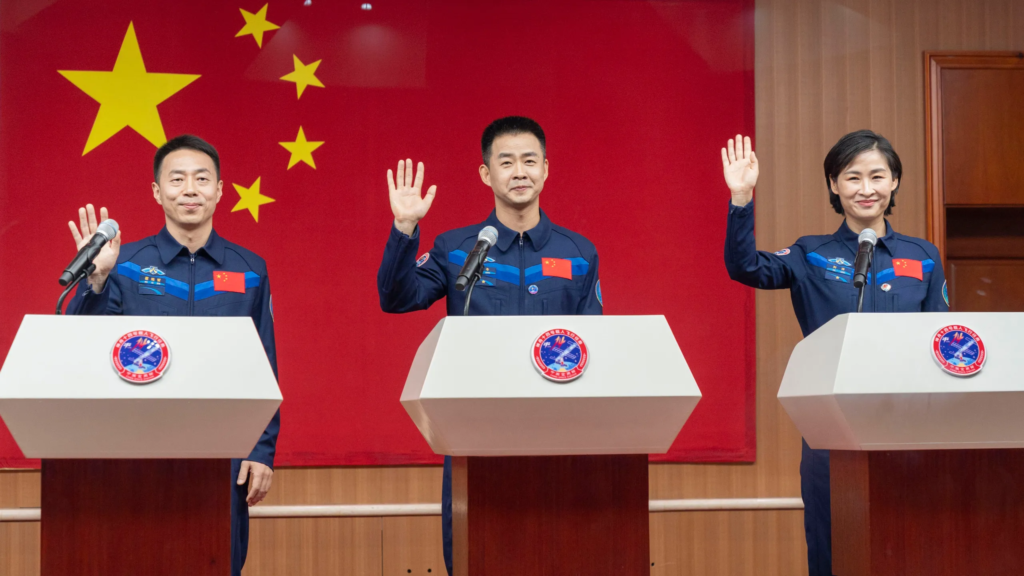
Space exploration journey has reached a new milestone as China’s youngest astronaut crew has successfully docked with the Tiangong space station. With a carefully selected team, including China’s first female space engineer, this mission underscores China’s commitment to establishing a formidable presence in space, with an eye toward a lunar mission by 2030.
As the Shenzhou 19 crew begins its six-month stay at Tiangong, they are set to conduct experiments, undertake spacewalks, and advance China’s long-term goals in space technology and exploration.
A Historic Launch and National Pride
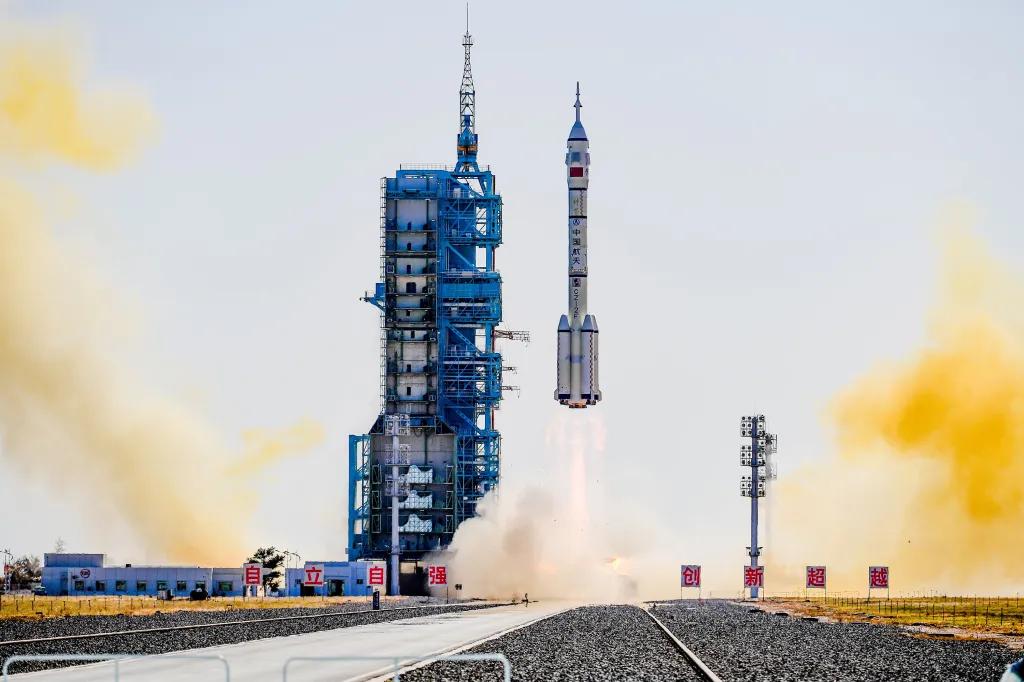
The successful launch of Shenzhou 19 was celebrated as a “complete success” by the Chinese authorities. This achievement adds to an ambitious year of space exploration in which China has set a record with over 100 launches planned, marking a pivotal year for its space agency.
The launch site, Jiuquan Satellite Launch Center in the Gobi Desert, was illuminated with the fiery ascent of the spacecraft, filling the desert with both light and sound. Hundreds of spectators gathered to cheer for the “taikonauts,” China’s astronauts, showcasing a moment of collective pride that reflected China’s growing space ambitions.
Read : Founder of TikTok Parent Company ByteDance, Zhang Yiming, Becomes the Richest Person in China
From children waving flags to a brass band performing patriotic songs, the atmosphere at Dongfeng Space City highlighted the enthusiasm and support for China’s space program.
This historic event is further amplified by the youth of the Shenzhou 19 crew, featuring a new generation of astronauts trained under rigorous programs. These young crew members, born in the 1990s, represent China’s future in space and serve as an inspiration for the next generation of scientists and engineers.
Read : The Cradle of Chinese Civilization: Exploring the Majesty of the Yellow River
China’s space program, officially launched under President Xi Jinping’s declaration that China aspires to become a “space power,” has made rapid progress in a relatively short span. From landing a rover on Mars to bringing samples from the Moon’s far side, China’s space achievements are turning global attention toward its program.
This momentum comes amid a rekindled space race with the United States, where both nations aim to explore and potentially utilize the Moon’s resources.
The Ambitions of the Shenzhou 19 Mission
The Shenzhou 19 crew will spend six months at the Tiangong space station, conducting advanced scientific experiments and tests designed to deepen our understanding of the effects of microgravity on the human body.

Among the research topics are studies on bone density loss, muscle atrophy, and nerve health—issues of critical importance for long-duration space travel. This research not only aids in preparing for future lunar missions but could also offer insights beneficial to medical fields on Earth, particularly in areas like osteoporosis treatment.
Wang Haoze, China’s first female space engineer, plays a crucial role in this mission. Her inclusion in the team is a testament to China’s commitment to developing a diverse and capable astronaut corps.
The crew is also composed of veteran astronaut Cai Xuzhe and rising star Song Lingdong, who represents the next generation of Chinese space travelers. Together, they aim to set the groundwork for China’s more complex space missions planned in the next decade, including a lunar landing and potential explorations of Mars.
China’s space station, Tiangong, has already demonstrated its capacity to serve as a hub for human spaceflight and scientific research. Tiangong, which means “Heavenly Palace,” is set to support a rotating crew, ensuring a continuous human presence in orbit.
The Shenzhou 19 mission marks the first time that two crews will overlap at the station, with Shenzhou 18’s team scheduled to return to Earth on November 4, following the Shenzhou 19 docking.
A New Space Race and the Moon’s Resources
As China accelerates its space efforts, tensions between the United States and China regarding space dominance are growing. NASA’s administrator, Bill Nelson, has openly acknowledged a “race” between the two nations, voicing concerns over the potential for China to establish territorial claims on the Moon.
The lunar surface holds minerals such as iron, titanium, and helium-3, a potential fuel source for nuclear fusion that has garnered interest due to its scarcity on Earth and abundance on the Moon. While the potential value of these resources varies widely, it’s clear that both nations see the Moon as a future site of economic and strategic importance.
China, for its part, has emphasized the peaceful intentions of its space program, with Chinese space officials advocating for international collaboration and knowledge sharing.
They have reiterated China’s position as a nation committed to the peaceful use of space, while also acknowledging the unique technological and logistical challenges that lay ahead for lunar missions. This new space race is not solely about exploration but involves strategic considerations for the control of resources, with implications that stretch far beyond national borders.
In recent years, China has launched an array of satellite constellations for purposes ranging from weather monitoring to high-speed internet. The latest constellation of 14,000 satellites aims to compete with SpaceX’s Starlink network, providing broadband coverage across the globe.
This network has raised concerns in the U.S. over potential military uses, particularly as China has rapidly expanded its satellite capabilities in recent years, building what has been described as a “kill web” of satellites for intelligence and tracking in the Pacific region. However, China maintains that its space efforts are primarily civilian in nature and focused on peaceful scientific advancement.
Inspiring the Future of China’s Space Program
China’s recent strides in space exploration are creating a culture of excitement and pride across the country, with the Shenzhou 19 mission inspiring the next generation of engineers and scientists.
The enthusiasm in Dongfeng Space City, from children waving flags to adults donning patriotic attire, exemplifies the national pride associated with these accomplishments. For China, space exploration is not just about scientific advancement but is deeply intertwined with national identity and the aspiration to stand among the world’s leading nations in space.
As China pushes toward its lunar goals, President Xi has underscored the importance of self-sufficiency in developing the necessary technology. Despite the achievements, China’s space officials acknowledge the challenges ahead, particularly in preparing for lunar landings and other ambitious projects planned in the coming decades.
The Tiangong space station serves as both a laboratory and a training ground for these future endeavors, ensuring that China’s astronauts are prepared for the rigors of long-duration space travel.
With a determined young crew now in space and a new generation of astronauts in training, China’s space program is on an upward trajectory. The Shenzhou 19 mission is just one part of a broader strategy that includes building a research station on the Moon, conducting missions to Mars, and launching more than 30 space missions by the middle of the century.
China’s leaders have made it clear that space exploration is a priority, even as the nation navigates economic challenges and a rapidly changing geopolitical landscape.
China’s space exploration is positioned as a “collective mission for humanity,” with leaders stating that their research and advancements will be shared with the global community.
The Shenzhou 19 mission embodies this spirit of exploration and collaboration, representing a new era in Chinese space exploration that seeks to benefit humanity while solidifying China’s standing as a space power. With its youngest crew in orbit and ambitions set for the Moon, China’s journey to the stars has only just begun.