
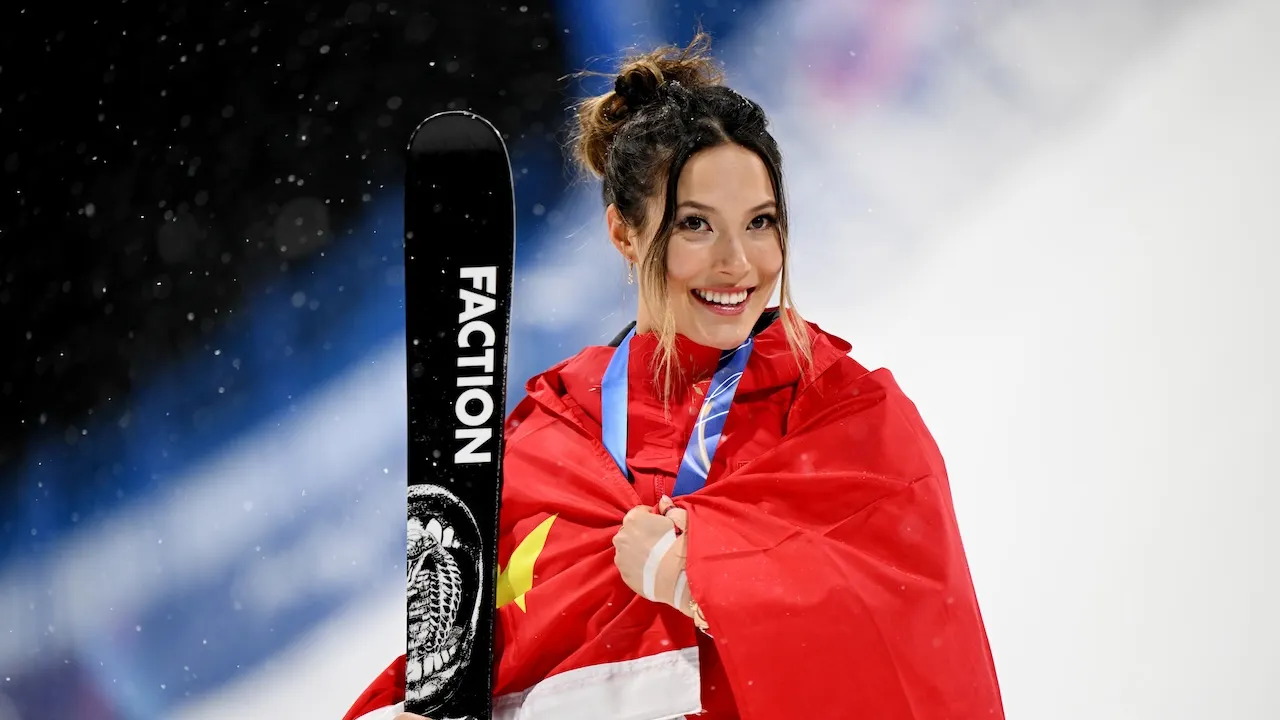
Eileen Gu is one of the most visible and multifaceted young athletes in the world today, known not only for her achievements in freestyle skiing but also for her influence across fashion, business, and global culture. At just 22 years old, she has accumulated Olympic medals, lucrative endorsement deals, and international celebrity status that extends far beyond winter sports. Her public identity combines elite athletic performance with academic ambition, commercial success, and a bicultural background that has placed her at the center of one of the most debated nationality decisions in modern sports.
Born in the United States and raised primarily in California, Gu grew up navigating two cultures through her Chinese mother and American father. From an early age, she demonstrated exceptional athletic talent, quickly rising through the competitive freestyle skiing ranks. At the same time, she developed a strong connection to her Chinese heritage, spending time in China and maintaining fluency in Mandarin. This dual identity would later define both her global appeal and the intense scrutiny surrounding her career.
Her decision to compete internationally for China rather than the United States transformed her from a promising athlete into a symbolic figure in a broader cultural and political conversation. The move sparked widespread debate about identity, loyalty, opportunity, and the meaning of national representation in an increasingly globalized world. As her career progressed and her fame expanded, that debate only intensified, turning her into both a celebrated sports icon and a target of persistent criticism.
Early Life and Dual Identity
Eileen Gu’s upbringing played a central role in shaping both her worldview and her public image. Growing up in the San Francisco Bay Area, she benefited from access to world-class training facilities, coaches, and educational opportunities. Her early skiing career developed within the American sports system, where she quickly distinguished herself as an extraordinary talent. At the same time, her family life ensured that her Chinese heritage remained a meaningful part of her identity rather than a distant cultural connection.
Her mother, who immigrated from China, encouraged Gu to maintain strong ties to Chinese language and traditions. This upbringing meant that Gu did not experience her identity as singular or fixed. Instead, she grew up feeling deeply connected to both countries, a perspective that later informed her decision to represent China in international competition. For Gu, nationality was not simply a legal designation but an expression of personal history and cultural belonging.
When she announced that she would compete for China, she described the decision as deeply personal and emotionally complex. She emphasized pride in both her American upbringing and her Chinese heritage, framing the move not as a rejection of one country but as an embrace of another part of herself. Yet public reactions often interpreted the decision in far more rigid terms. Critics questioned her loyalty, while supporters viewed her choice as a natural reflection of her bicultural identity.
Her dual background became central to her public narrative, especially during her Olympic debut. She presented herself as a bridge between cultures, someone who could inspire young athletes in China while also representing the possibilities of global identity. However, that positioning also placed her under constant scrutiny, with observers from both countries projecting expectations onto her. For some, she symbolized international cooperation and shared heritage. For others, she represented geopolitical rivalry and national competition.
Did not expect a question that starts out 'Do you think before you speak?' to go so well. A+ question from Charlotte Harpur A++ response from Eileen Gu. pic.twitter.com/cvNJ6rSwl3
— sim (@simscircuit) February 23, 2026
As she matured, Gu became increasingly vocal about the pressures associated with this dual identity. She has spoken about feeling as though she carries the weight of two countries’ expectations, navigating constant evaluation from audiences who interpret her decisions through political or cultural lenses. This tension between personal identity and public symbolism has been a defining feature of her career.
Olympic Success, Fame and Commercial Power
Eileen Gu’s athletic achievements alone would have secured her global recognition. She has become one of the most successful freestyle skiers of her generation, earning Olympic medals and dominating major international competitions. Her technical skill, competitive consistency, and ability to perform under pressure have placed her among the sport’s elite performers. She has accumulated victories across multiple freestyle disciplines, building a record that distinguishes her from many of her peers.
Her Olympic performances elevated her visibility dramatically. Winning medals on one of the world’s most watched sporting stages transformed her into a household name in multiple countries. Her success also coincided with the rapid growth of freestyle skiing’s global popularity, allowing her achievements to reach wider audiences than ever before. She quickly became one of the most recognizable faces in winter sports.
Beyond competition, Gu has built an extraordinary commercial profile. She ranks among the highest-earning female athletes in the world, with endorsements accounting for the majority of her income. Major international brands have partnered with her, recognizing her unique combination of athletic credibility, cultural reach, and market appeal. Her fluency in Mandarin and familiarity with both Western and Chinese audiences have made her especially valuable to global companies seeking cross-cultural influence.
Her modeling career has further expanded her public presence. Signed to a major international agency, she has appeared in high-profile campaigns and fashion events, presenting herself as both an athlete and a style icon. This crossover success reflects a broader shift in modern sports culture, where top athletes increasingly function as global lifestyle figures rather than solely competitors.

At the same time, Gu has pursued rigorous academic goals. Enrolling at a prestigious American university to study quantum physics, she has maintained a demanding academic schedule alongside elite athletic competition and commercial commitments. This combination of intellectual ambition and athletic excellence has contributed to her reputation as an unusually multidimensional public figure.
Her success has also generated enormous popularity in China, where she is widely celebrated. Her image appears across advertising campaigns, television broadcasts, and social media platforms. She is admired not only for her victories but also for her perceived role in promoting winter sports participation among young people. In that environment, she is often viewed primarily as a national sporting hero rather than a controversial figure.
The contrast between her reception in different parts of the world has become one of the most striking aspects of her public life. While she enjoys enthusiastic admiration in China, reactions in the United States have been far more divided. This divergence reflects broader political and cultural tensions that extend well beyond sports.
Political Backlash, Public Debate and Personal Resilience
The criticism directed at Eileen Gu intensified as geopolitical tensions between the United States and China grew more pronounced. Her nationality decision became intertwined with wider political narratives, particularly in discussions about national loyalty and global competition. Commentators and public figures began to treat her athletic representation as a symbolic statement about international alignment rather than a personal or professional choice.
Some critics argue that athletes who benefit from American training systems and educational opportunities should represent the United States in international competition. Others link her decision to broader concerns about human rights, political governance, or strategic rivalry between nations. These arguments often position her as a figure within debates that extend far beyond the realm of sports.
Read : 13-Year-Old Sleeping Teen Injured as Drunk Driver Alec Dillon Plows Car Into Bedroom
Social media has amplified these tensions, providing a platform for both criticism and support. Online commentary frequently compares her to other American-born athletes with immigrant backgrounds who represent the United States. Such comparisons often reflect competing ideas about national identity and cultural belonging, with Gu’s decision serving as a focal point for these broader disagreements.

Supporters, however, defend her right to represent the country that reflects her personal identity and heritage. Many argue that dual-nationality athletes have long competed for different countries based on opportunity, family ties, or individual preference. From this perspective, her choice is consistent with established patterns in international sports rather than an exceptional or controversial act.
Amid this debate, Gu has spoken openly about the personal impact of public scrutiny. She has described receiving threats, experiencing harassment, and enduring both online and offline hostility. She has also reported incidents that raised concerns about her safety, illustrating the real-world consequences of intense public attention.
Her response to these challenges has been to emphasize resilience and personal growth. She frequently speaks about adapting to pressure, learning from adversity, and becoming stronger through difficult experiences. As she has matured, she has become more willing to address criticism directly rather than remaining neutral or silent.
Her increasing confidence may reflect both personal development and professional security. Having achieved extraordinary success at a young age, she now operates from a position of established credibility. She has little left to prove in terms of competitive legitimacy, allowing her to express her perspective more freely.
At the same time, her experience highlights the evolving role of athletes in global culture. Modern sports figures often function as symbols within political, cultural, and economic debates that extend far beyond their performance. Gu’s career illustrates how athletic success can intersect with questions of identity, nationality, and public expectation in complex and sometimes volatile ways.
Despite ongoing controversy, she continues to compete at the highest level while pursuing academic goals and expanding her global influence. Her career reflects both the opportunities and pressures of modern international sports, where personal decisions can carry far-reaching symbolic meaning.