

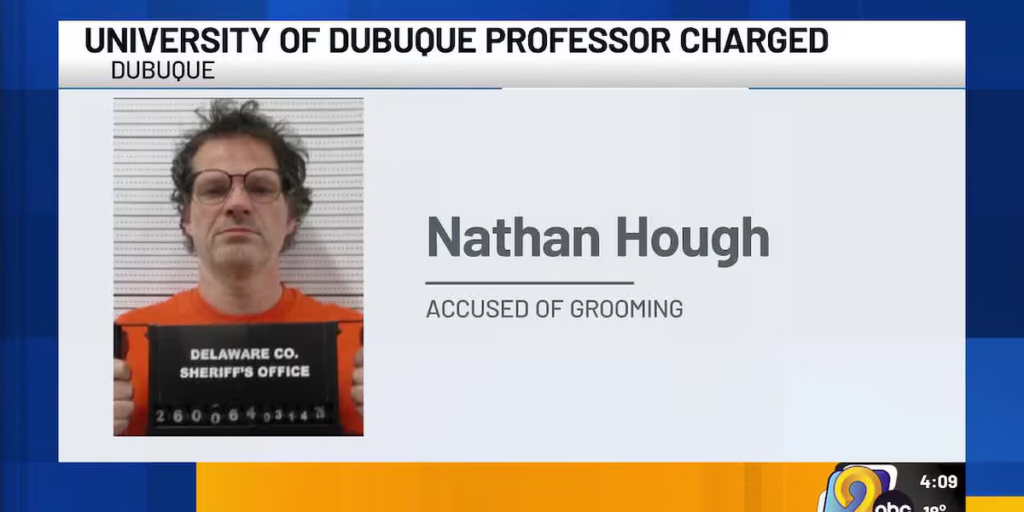
The arrest of a university professor in connection with an undercover police operation has drawn significant public attention and raised serious concerns about online safety, professional accountability, and the growing use of digital platforms in criminal investigations. Nathan Allen Hough, a now-former associate professor of psychology at the University of Dubuque, was taken into custody after authorities alleged that he attempted to engage in illegal activities with someone he believed to be a minor.
The case, which unfolded over the course of several days, highlights both the risks posed by online interactions and the proactive steps law enforcement agencies are taking to identify and prevent potential crimes before they occur. According to law enforcement officials, the investigation began when an undercover officer created a profile on a dating application while posing as a teenage boy.
The profile reportedly listed an age of 18 but was designed in a way that suggested a younger appearance, allowing officers to monitor interactions and identify individuals who might attempt to exploit minors. It was during this operation that Nathan Hough allegedly initiated contact and engaged in conversations that quickly became explicit in nature. Authorities claim that the communication included inappropriate messages and the sharing of explicit images, as well as discussions of intended sexual acts.
The situation escalated when Hough allegedly arranged to meet the individual in person, believing he was communicating with a 16-year-old. Law enforcement officers monitored the communication and planned the arrest accordingly. When Nathan Hough arrived at the agreed-upon location in Manchester, he was taken into custody without incident. Items reportedly found in his vehicle further supported the allegations outlined in the criminal complaint, intensifying the seriousness of the charges against him.
The Investigation and Arrest
The details of the investigation reveal a carefully coordinated effort by local law enforcement to identify individuals attempting to exploit minors through online platforms. The operation began on March 7, when an officer created the undercover profile as part of a broader initiative aimed at detecting grooming behavior. This approach reflects a growing trend in policing, where digital environments are actively monitored to prevent crimes that originate online but have the potential to escalate into real-world harm.
Over the course of several days, authorities allege that Nathan Allen Hough engaged in increasingly explicit communication with the undercover officer. The criminal complaint describes conversations that included detailed discussions of sexual acts, as well as the transmission of explicit images. These interactions formed the basis of the charges against him, including grooming, classified as a felony, and dissemination of obscene material to a minor, categorized as a serious misdemeanor.
The arrest took place on the morning of March 14, when Nathan Hough arrived at a park in Manchester, believing he was meeting the teenager he had been communicating with. Officers were already present at the location and apprehended him shortly after his arrival. The timing and execution of the arrest suggest that authorities had gathered sufficient evidence during the online interactions to proceed with charges and ensure a controlled and safe conclusion to the operation.
Read : Top 5 Places in india Where You Can Spot Majestic White Tigers
The use of undercover profiles in such investigations has become increasingly common, as it allows law enforcement to identify suspects before any direct harm can occur. While the methods may raise questions about entrapment in some discussions, authorities maintain that these operations are designed to catch individuals who demonstrate clear intent and take active steps toward committing a crime. In this case, the allegations indicate that the suspect not only engaged in explicit communication but also took concrete action by traveling to meet the supposed minor.
Institutional Response and Professional Consequences
The arrest of a university faculty member has broader implications beyond the immediate legal case, particularly in terms of institutional reputation and trust. The University of Dubuque responded promptly after becoming aware of the situation, confirming that Nathan Allen Hough was no longer employed at the institution as of the same day the arrest became public. The university’s statement was brief, emphasizing that it had just learned of the incident and that no further information was available at that time.
Such swift action reflects the seriousness with which educational institutions treat allegations involving misconduct, especially those that involve potential harm to minors. Universities are expected to uphold high ethical standards, particularly among faculty members who often hold positions of authority and influence. When those standards are called into question, institutions must act quickly to protect their students, staff, and overall integrity.
The professional consequences for individuals involved in such cases are often immediate and far-reaching. In addition to the loss of employment, there can be long-term impacts on career prospects, reputation, and personal life. For a professor, whose role typically includes teaching, mentoring, and conducting research, allegations of this nature can permanently undermine credibility and trust.
The case also raises questions about the responsibilities of institutions in monitoring or addressing potential risks associated with their employees’ conduct outside the workplace. While universities generally do not have oversight over personal activities, incidents like this often prompt discussions about policies, background checks, and preventive measures aimed at ensuring a safe environment for students and the broader community.
Broader Implications for Online Safety and Law Enforcement
Beyond the immediate details of the case, the arrest highlights the evolving landscape of online safety and the challenges associated with digital communication. Dating applications and social platforms have become common spaces for interaction, but they also present opportunities for misuse. The anonymity and accessibility of these platforms can make it easier for individuals to engage in inappropriate or illegal behavior, particularly when targeting vulnerable users.
Read : Former Harvard President Larry Summers to Resign Professorship Amid Epstein Ties Fallout
Law enforcement agencies have increasingly adapted their strategies to address these risks, using technology to identify and prevent potential crimes. Undercover operations, like the one described in this case, are part of a broader effort to intervene before situations escalate into direct harm. By posing as minors, officers can detect patterns of behavior that indicate grooming, allowing them to take action based on evidence gathered through communication and intent.
At the same time, these operations serve as a reminder of the importance of vigilance among users of digital platforms. Parents, educators, and communities are often encouraged to promote awareness about online interactions, particularly among young people who may be more susceptible to manipulation. The presence of law enforcement in these spaces underscores the seriousness of the issue and the need for ongoing education and prevention efforts.
The legal process following such arrests is also an important aspect to consider. Charges such as grooming and dissemination of obscene material carry significant penalties, reflecting the severity with which the justice system treats offenses involving minors. As the case moves forward, it will be subject to legal scrutiny, including the examination of evidence and the determination of guilt or innocence in court.
Ultimately, incidents like this one highlight the intersection of technology, law enforcement, and societal responsibility. They demonstrate how digital tools can be used both to commit and to prevent crimes, and they emphasize the need for continued efforts to ensure that online spaces remain as safe as possible. The outcome of the case will be closely watched, not only for its legal implications but also for the broader conversations it may prompt about safety, accountability, and the role of institutions in addressing such issues.