

A Thanksgiving stroll for a Texas family turned into a near-disaster when a 12-year-old girl Trapped in Sand Hole along the Spring Creek trail in The Woodlands. What began as a simple holiday outing in the late afternoon quickly shifted into a frantic rescue effort involving multiple emergency agencies and a father fighting to keep his daughter alive.
The incident, which occurred around 5 p.m., has sparked renewed concern over the hidden dangers of sand collapses — a hazard that has claimed several lives in recent years. Though the young girl was ultimately rescued unharmed, the terrifying circumstances surrounding her entrapment highlighted just how quickly sand structures can fail and how vital swift response can be in preventing tragedy.
A Frightening Collapse on a Family Outing
According to the Woodlands Fire Department, the 12-year-old had been digging a large hole in the sand when the ground suddenly gave way, collapsing around her and engulfing her entire body. In a matter of seconds, the fun she was having became life-threatening as the weight of the sand pinned her beneath the surface. Witnesses described the scene as chaotic and alarming, as her family rushed to find her beneath the layers of loose sediment.
Her father, acting with instinctive speed and determination, managed to clear enough sand from her face and head to allow her to breathe while help was on the way, preventing the situation from deteriorating even further. When first responders arrived, they found the girl in a deeply vulnerable position — completely buried except for her face, which was barely visible above the sand.
Rescue crews were immediately confronted with the need to secure the unstable mound around her before making any attempt to dig her out. Sand collapses are unpredictable, and any sudden movement can cause the remaining volume to shift, creating additional pressure on the trapped victim. The teams had to work deliberately yet quickly, ensuring that the area would not cave in further as they proceeded. This delicate balance between urgent action and structural stability is one of the greatest challenges in sand rescue operations.
Read : NASA Reveals Giant Lava Lake on Jupiter’s Volcanic Moon
Although the girl remained conscious, the danger she faced was significant. Sand is considerably heavier than many people assume, and when packed around the body, it restricts movement and can hinder breathing. The pressure can also impede circulation or lead to suffocation if the head becomes covered. These risks meant that every passing moment was crucial. The coordination between crews was tight and disciplined as they navigated the precarious conditions. The responders’ training and experience in such scenarios proved essential in preventing further collapse while creating a safe access point to remove the trapped child.
A Seamless Rescue Effort by Multiple Agencies
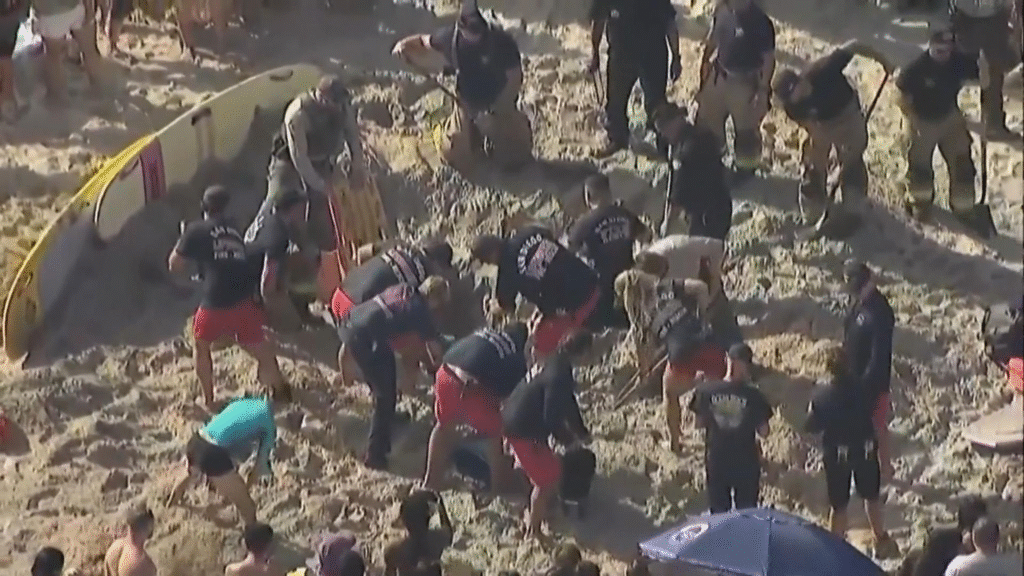
The Woodlands Fire Department reported that first responders from four separate agencies joined forces in the operation. Upon arrival, rescue crews worked to shore up the walls of the collapsed hole before methodically removing sand from around the girl’s body. The process required specialized equipment and careful hand-digging to prevent the already unstable sand from shifting. The cooperation displayed among the agencies allowed them to establish an efficient rescue line and maintain communication throughout the operation, ensuring each step was taken with precision.
Once the area was stabilized, responders focused on clearing sand from around her torso and limbs. This stage is often the most difficult because a trapped individual cannot assist in their own extraction; the pressure of the sand immobilizes them completely. Every handful of sand removed must be balanced against the potential for another collapse. The rescue teams continued working layer by layer, keeping constant watch for signs of movement in the surrounding sand and adjusting their approach as needed.

After successfully extracting the girl from the sand, medics evaluated her condition on-site. According to the fire department, she was released to her parents, and the family declined transport to a hospital. Officials did not specify whether she sustained any injuries, but her ability to walk away from the scene was a relief to both her family and the responders who had put extraordinary effort into saving her. The department later praised the seamless collaboration of all agencies involved, describing the outcome as a Thanksgiving “story that will be told for decades.”
Such high-risk rescues demand not only technical skill but also rapid adaptation to challenging and unstable environments. The responders’ ability to stabilize the area, maintain clear communication, and use appropriate extraction techniques played a decisive role in preventing what could have been a far more tragic incident. Their coordinated effort demonstrated the importance of prepared and well-trained emergency units, especially in unpredictable natural terrains like sandy trails, beaches, and creek beds where collapses can occur without warning.
Growing Awareness of Sand Hole Dangers
Though the girl in The Woodlands survived unharmed, the incident is a stark reminder of how dangerous collapsed sand holes can be. Many people assume sand is safe to play in, particularly in casual settings like beaches or trails, but the truth is that sand structures can be highly unstable and collapse with little to no warning.
When a hole is dug deep enough, the walls become prone to collapsing under their own weight. Even minor vibrations or shifts from movement nearby can trigger a sudden cave-in, burying anyone inside. Sand is far denser than it appears, and when it traps a person, the sheer weight can make it nearly impossible for them to escape without assistance.
Similar incidents in recent years have resulted in devastating outcomes. Last year, a seven-year-old Indiana girl died at a Florida beach after the sand hole she was digging collapsed and buried her completely. Her nine-year-old brother was trapped up to his chest, while rescuers and bystanders desperately tried to free the children. Despite rapid response and efforts from those nearby, the young girl did not survive. Cases like this underscore just how rapidly these situations develop and how difficult they are to manage without immediate help and proper stabilization techniques.
Three years ago, another tragedy occurred in Ocean County, New Jersey, when an 18-year-old man and his 17-year-old sister were both trapped during a sand collapse. The sister was rescued, but the young man lost his life in the incident. These heartbreaking stories highlight the severe risks associated with digging deep sand holes, yet the danger remains widely underestimated by the public. Many families, especially those visiting beaches or sandy recreational areas, see digging as harmless fun, unaware of how quickly conditions can become life-threatening.
The incident in Texas serves as a timely warning for parents, guardians, and anyone engaged in recreational activities in sandy environments. Experts consistently advise that holes dug in sand should never exceed the depth of the smallest child involved and should be filled in immediately after play. It is also recommended to avoid tunnels, expansive pits, or any structure that could collapse under its own weight. Even seemingly stable sand can shift unexpectedly due to moisture levels, underlying layers, or nearby foot traffic.
For emergency responders, sand collapses represent some of the most challenging rescue scenarios due to the unpredictability of the terrain. The need for quick action is paramount, but so is the need for caution. A poorly executed rescue attempt can worsen the collapse, putting both victims and rescuers at greater risk. This is why coordinated, multi-team responses such as the one seen in The Woodlands are so important — they bring together diverse expertise and resources to tackle an inherently unstable and dangerous situation.
The near-tragedy faced by the Texas family is likely to ignite further conversation about safety measures on public trails and sandy recreational spots. While natural environments offer valuable opportunities for exploration and play, they also come with hazards that must be taken seriously. Awareness campaigns, posted safety notices, and educational outreach may help reduce future incidents. Parents might also become more vigilant when children play in sand-heavy areas, recognizing the hidden risks beneath the surface.
As the story continues to spread, it may serve as a critical reminder that even a holiday outing can present unexpected dangers. The swift and skilled actions of the girl’s father, combined with the coordinated response from multiple agencies, prevented what could have been a heartbreaking Thanksgiving tragedy. The event underscores not only the importance of emergency preparedness but also the need for greater public understanding of the risks associated with sand collapses.
Hey guys, has anyone had experience with plusph11? Thinking of checking it out, looks kind of interesting. Any recommendations? More details: plusph11
**mitolyn**
Mitolyn is a carefully developed, plant-based formula created to help support metabolic efficiency and encourage healthy, lasting weight management.
The juridical landscape encompassing hemp-derived CBD https://www.cornbreadhemp.com/collections/thc-drinks changed dramatically with the 2018 Farm Bill in the United States. Products containing less than 0.3 percent THC became constitutionally legal, unlocking doors for consumers and businesses in equal measure. Yet, state regulations nonetheless vary, so reviewing local laws remains important. This developing framework continues to influence how people reach and enjoy cannabidiol-based wellness products across the country.