
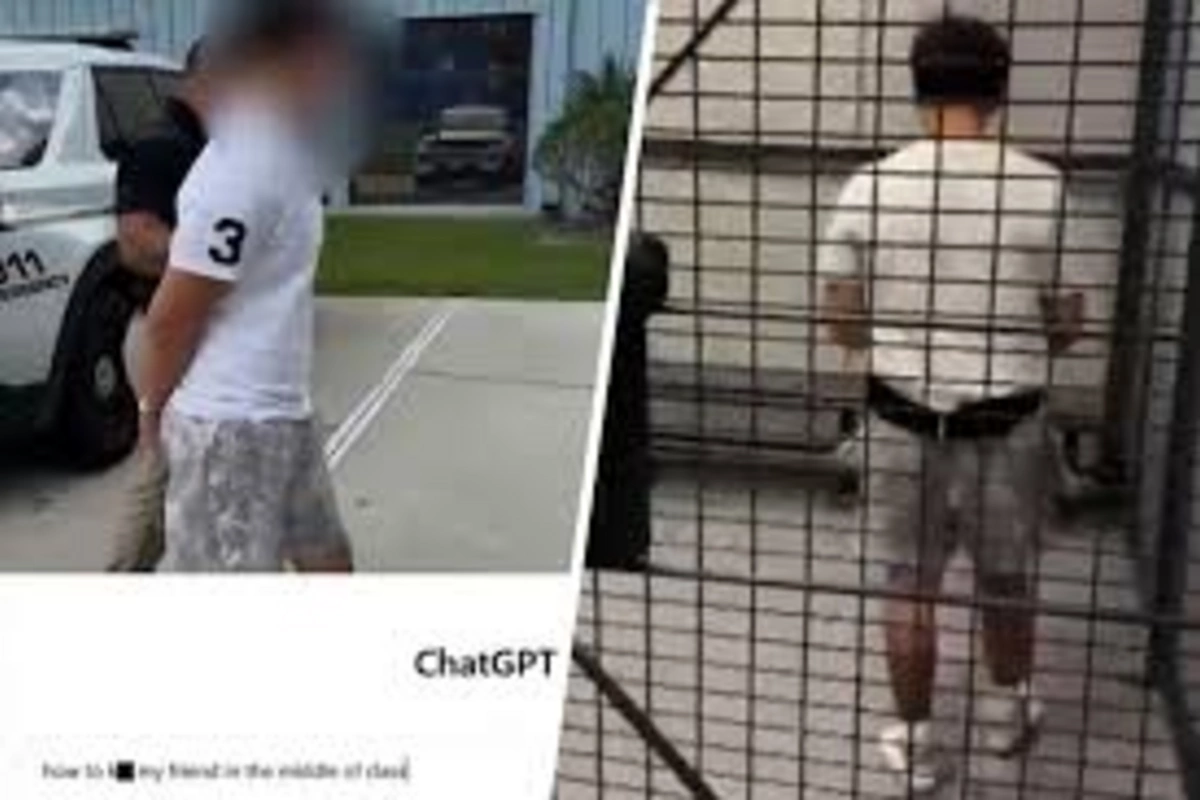
In a shocking incident that has sent ripples through Florida’s educational community, 13-year-old Ian Franco, a student at Southwestern Middle School in DeLand, Volusia County, was arrested on September 27, 2025, following a disturbing query he made to OpenAI’s ChatGPT during class time. The query, which read, “How to kill my friend in the middle of class,” was immediately flagged by the school’s digital monitoring system, prompting a swift response from authorities. This event underscores the growing intersection of artificial intelligence, student behavior, and school safety protocols in an era of heightened vigilance against potential threats.
The Volusia County Sheriff’s Office confirmed the arrest, emphasizing that what Franco described as a “joke” escalated into a full emergency response. School officials, working in tandem with law enforcement, evacuated parts of the campus and initiated lockdown procedures as a precaution. Ian Franco was taken into custody without incident and booked at the Volusia County Branch Jail. While specific charges have not been publicly detailed, deputies have classified the matter as a serious threat that warranted immediate action. This case highlights the zero-tolerance stance on violent rhetoric in schools, particularly in Florida, where memories of past tragedies like the 2018 Parkland shooting remain fresh.
Eyewitness accounts from school staff and students, as reported by local outlets, describe a tense atmosphere on the day of the incident. The alert interrupted normal classes, with teachers ushering students to safe areas while awaiting clearance from the responding school resource officer. No weapons were found on Franco, and there was no indication of an imminent plan to act on the query, but the potential for harm was deemed too great to ignore.
The sheriff’s office released a statement urging parents to engage in open dialogues with their children about the consequences of online statements, noting, “This was another ‘joke’ that created an emergency situation.” As details emerge, the focus remains on ensuring the safety of all students and staff at Southwestern Middle School, a public institution serving grades 6 through 8 with an enrollment of approximately 800 students.
The Incident Unfolds: From Query to Custody
The sequence of events began around midday on September 27, when Ian Franco, using a school-issued device during instructional time, accessed ChatGPT and submitted the alarming prompt. According to the Volusia Sheriff’s Office, the query was not isolated but part of a broader pattern of impulsive online activity that the monitoring software detected as high-risk. Within seconds, Gaggle—a widely used AI-driven safety platform employed by thousands of U.S. schools—analyzed the content and sent an automated alert to the school’s resource deputy stationed on campus.
Gaggle’s system scans student communications, including searches, emails, and chat interactions, for keywords and patterns indicative of self-harm, violence, or other dangers. In this case, the explicit nature of the query triggered an immediate notification, complete with screenshots and timestamps. The deputy, trained in threat assessment, approached Franco in the classroom, separated him from peers, and conducted an initial interview. Ian Franco reportedly admitted to the query but insisted it was meant as “trolling” directed at a classmate who had been annoying him.
Read : Parents Sue Character AI After 13-Year-Old Daughter Juliana Peralta Dies by Suicide
Despite this explanation, protocol demanded escalation: the school principal was notified, parents were contacted, and Volusia County deputies arrived within minutes to take over the investigation. Video footage obtained from body cameras and school security shows Franco being escorted from the building in restraints, his face obscured for privacy but his school uniform clearly visible.
Teenager arrested after asking ChatGPT 'how to kill my friend in the middle of class'
— GDN Online (@GDNonline) September 30, 2025
Ian Franco, a 13-year-old student from Southwestern Middle School, Florida, was arrested after a Gaggle alert identified a message in ChatGPT that read, “How to kill my friend in the middle of… pic.twitter.com/oAVwktpETN
The arrest was processed at the juvenile facility, where Franco was held pending evaluation by mental health professionals and juvenile justice officials. School administrators later confirmed that the targeted “friend” was interviewed and reported no prior knowledge of the query, alleviating immediate fears of targeted harassment but not the broader concerns about student mental health. The incident lasted less than an hour from alert to apprehension, a testament to the efficiency of modern school safety measures, yet it left the community grappling with questions about intent versus impact.
This rapid response prevented any potential escalation, but it also exposed the raw vulnerability of middle schoolers navigating complex social dynamics through digital lenses. Southwestern Middle School, located in a suburban area about an hour north of Orlando, has a reputation for strong academic programs but now faces scrutiny over how such an event could occur under supervised conditions. Preliminary reviews indicate Franco had no prior disciplinary record, making the incident all the more puzzling to educators familiar with him.
School Safety Protocols: The Role of AI Monitoring in Modern Education
At the heart of this arrest lies Gaggle, the digital sentinel that has become a cornerstone of school safety in the digital age. Deployed across more than 2,000 districts nationwide, Gaggle employs machine learning algorithms to monitor online activity on school networks, flagging content that matches predefined risk indicators. Terms like “kill,” “harm,” or “weapon” in conjunction with personal targets trigger alerts 24/7, allowing administrators to intervene before situations deteriorate. In Franco’s case, the system’s accuracy was unquestionable, but it reignited debates about its broader implications.
Critics of Gaggle argue that it contributes to a surveillance-heavy environment, potentially stifling free expression among students and leading to overreach. Reports from organizations like the Electronic Frontier Foundation highlight instances of false positives—innocent searches for school projects or literary discussions mistakenly flagged as threats—resulting in unnecessary trauma for young users. In Volusia County alone, Gaggle has processed millions of scans since its implementation in 2020, with a reported 85% accuracy rate for high-priority alerts.
However, the Franco incident serves as a stark reminder of its value: in a nation where school shootings claim lives annually, erring on the side of caution can be lifesaving. Florida’s educational policies, governed by the Marjory Stoneman Douglas High School Public Safety Act of 2018, mandate such technologies in public schools, requiring threat assessment teams and digital monitoring as standard practice.

Southwestern Middle School complies fully, integrating Gaggle with other tools like anonymous tip lines and behavioral intervention plans. Post-incident, the school conducted a full debrief, reinforcing training for staff on de-escalation and cultural sensitivity in handling alerts. Experts from the National Association of School Psychologists note that while tools like Gaggle are essential, they must pair with human-centered approaches, such as counseling services, to address root causes like bullying or adolescent impulsivity.
The integration of AI in education extends beyond monitoring; it includes adaptive learning platforms and administrative efficiencies. Yet, this event illustrates the double-edged sword: ChatGPT, designed for helpful responses, was queried in a way that bypassed its built-in safeguards, which typically deflect violent prompts with warnings or refusals. OpenAI has since reiterated commitments to enhancing content filters, but the onus falls heavily on schools to bridge the gap between technology and teenage judgment.
Broader Implications: AI Ethics, Parental Oversight, and Lessons for Families
The arrest of Ian Franco transcends a single classroom mishap, spotlighting urgent issues at the nexus of AI accessibility, youth psychology, and legal accountability. At 13, Franco embodies the first generation immersed in generative AI from an early age, where tools like ChatGPT are as commonplace as textbooks. His query, framed as a prank, reveals a troubling naivety about digital permanence: once typed, words can summon real-world consequences, from arrests to eroded trust among peers.
Legal ramifications for minors in such cases vary by jurisdiction, but Florida’s statutes treat written threats seriously, even if hyperbolic. Franco faces potential juvenile charges that could include misdemeanor disorderly conduct or felony written threats, depending on prosecutorial discretion. Juvenile court proceedings prioritize rehabilitation over punishment, often incorporating community service, therapy, or probation. As of October 6, 2025, no court date has been set, but advocates for youth justice emphasize the need for restorative measures to prevent recidivism.

On the parental front, the sheriff’s office issued a clarion call: “Please talk to your kids.” With AI chatbots now embedded in daily life, families must navigate uncharted territory. OpenAI’s recent rollout of parental controls for ChatGPT—allowing account linking, content restrictions, and usage tracking—offers a starting point, but adoption lags. Surveys from Common Sense Media indicate that only 40% of parents actively monitor teen AI interactions, citing time constraints and privacy concerns.
This incident amplifies the push for digital literacy curricula in schools, teaching students about ethical AI use, the spectrum of “jokes” online, and the blurred line between virtual and physical harm. Nationally, similar episodes have proliferated: a Texas teen suspended for AI-generated threats in 2024, a California student flagged for self-harm queries earlier this year. These cases fuel discussions on balancing innovation with safeguards, with policymakers eyeing federal guidelines for AI in minors.
For Volusia County, the event prompts a community-wide reflection—town halls are scheduled at Southwestern Middle School to foster dialogue between parents, educators, and mental health experts. As one deputy put it, “In today’s world, what starts as a whisper in a chat can roar into a crisis.” Franco’s story, while resolved without tragedy, serves as a pivotal lesson: vigilance in the digital realm is not optional but imperative for safeguarding the next generation.