
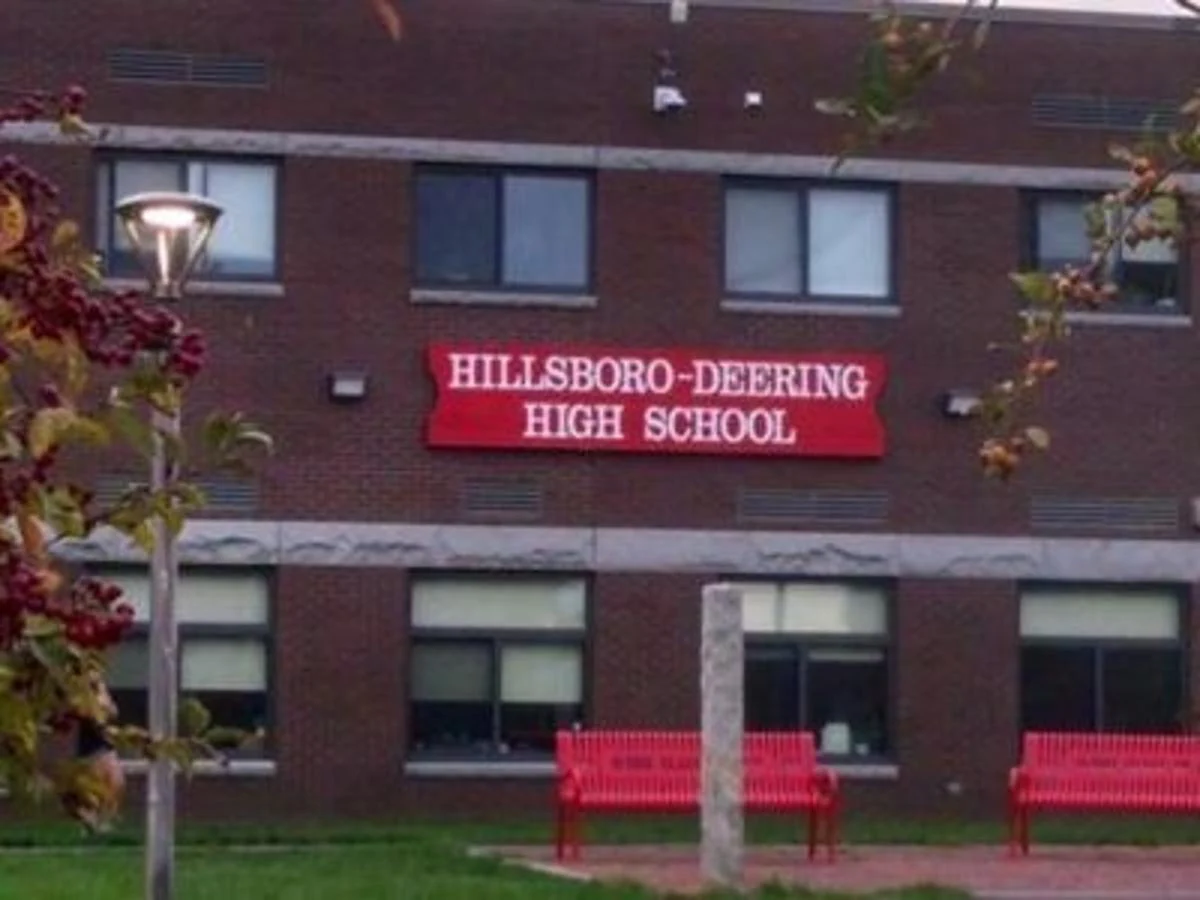
An 18-year-old New Hampshire student, Jack Harrington, has filed a federal lawsuit against his former high school’s administrators, alleging that they violated his constitutional rights by conducting an unlawful search of his vehicle solely because he was known to be a lawful gun owner. The case, now attracting national attention, underscores a growing legal and ethical debate surrounding students’ rights, gun ownership, and the limits of school authority in the post-Columbine era of heightened campus safety concerns.
According to the complaint filed in the U.S. District Court, Harrington’s ordeal began earlier this year, months before his graduation from Hillsboro-Deering High School. The suit names as defendants the school’s superintendent, principal, vice principal, and the school resource officer—each accused of participating in or authorizing a search that allegedly lacked any legal basis. Backed by the Second Amendment Foundation (SAF), Harrington’s case argues that administrators unlawfully targeted him after learning that he legally possessed a firearm, even though there was no indication he had ever brought it onto school property or intended to do so.
At the heart of the dispute lies a fundamental constitutional question: can mere knowledge of lawful gun ownership justify intrusive action by public school officials against a student? For Jack Harrington and his attorneys, the answer is a resounding no. They claim the search amounted to harassment and discrimination against someone for merely exercising a legal right, setting a potentially dangerous precedent for the balance between safety policies and personal freedoms.
A Conversation That Sparked Controversy
The events leading up to the search trace back to an off-campus traffic stop that occurred roughly two months before the alleged incident. Jack Harrington reportedly told a classmate that, during the stop, he had informed police officers of a lawfully stored handgun in his truck’s glove box. In New Hampshire—a state that recognizes both open and concealed carry without a permit for adults—such an admission would not normally invite suspicion. But within the walls of a high school, where weapons policies are among the most strictly enforced, that revelation sparked alarm.
When administrators learned of Harrington’s conversation, they allegedly called him into the office on April 24 to question him about the matter. According to the lawsuit, they confirmed that he was indeed a gun owner and proceeded to “badger” him about allowing them to search his vehicle, which was parked in the school lot. Jack Harrington told them he had never brought his firearm to school and had no intention of doing so. But the school resource officer, the complaint alleges, dismissed his assurances, stating, “You can say whatever you want, we’re going to search it anyway.”
The subsequent search of Jack Harrington’s truck turned up nothing illegal—no firearm, no ammunition, and no evidence of wrongdoing. Despite this, the lawsuit contends that the incident left the student humiliated and stigmatized. It also raises serious questions about how far school officials can go in the name of security when confronted with a student who is merely exercising a constitutional right outside of school grounds.
Read : 31-Year-Old Thomas Brown Jailed for Killing of Two Student of Arcadia High School
New Hampshire state law, like federal law, clearly prohibits students from bringing firearms onto school property. However, it does not criminalize lawful gun ownership off-campus or discussing it in conversation. Harrington’s attorneys argue that this distinction was entirely disregarded by the administrators, who acted solely on the basis of his admission to owning a gun—a legal activity in the state.
The Legal Foundation: Privacy, the Fourth Amendment, and Reasonable Suspicion
The U.S. Constitution’s Fourth Amendment protects citizens from unreasonable searches and seizures by the government, including school officials acting as state agents. However, Supreme Court rulings have carved out nuanced exceptions for the educational setting. In the 1985 case New Jersey v. T.L.O., the Court held that school administrators may search a student’s property without a warrant if they have “reasonable suspicion” that a law or school rule has been violated. This standard is lower than the “probable cause” required for law enforcement, reflecting the unique responsibilities schools bear in maintaining safety and discipline.
Yet, the “reasonable suspicion” requirement is not an open-ended license for arbitrary searches. Courts have repeatedly emphasized that such suspicion must be grounded in specific, articulable facts suggesting wrongdoing—not mere hunches, assumptions, or stereotypes. The Harrington lawsuit argues that the administrators’ actions failed to meet even this lowered threshold. Simply knowing that Harrington legally owned a gun, his attorneys say, does not constitute reasonable suspicion of a crime or policy violation.
Read : 20-Year-Old Gunman Who Fired at Trump Was Rejected from School Rifle Team
“Being public about exercising your private rights cannot be grounds for being harassed and searched on campus,” said Bill Sack, the Second Amendment Foundation’s director of legal operations. “The apparent position of the school district here is ‘choose to exercise one right, give away another.’ That’s just not how it works.”

Legal analysts following the case note that while schools enjoy broad discretion in ensuring student safety, their authority is not absolute. “The challenge here,” one education law expert commented, “is determining when preventive measures cross into constitutional violations. A student’s lawful conduct off-campus cannot be retroactively criminalized or used as justification for a search unless there’s a legitimate reason to suspect a school safety threat.”
If the court agrees with Jack Harrington’s argument, the decision could reaffirm the limits of school surveillance and search powers, particularly when they encroach upon constitutionally protected activities like lawful firearm possession. It may also clarify how administrators should interpret “reasonable suspicion” in cases involving students’ personal rights unrelated to school grounds.
Balancing School Safety and Constitutional Rights
The tension between school safety and individual rights has long been a source of legal and moral debate in American education. Since the 1990s, tragic incidents like Columbine, Sandy Hook, and Parkland have profoundly shaped public attitudes and policy responses. Many school districts have adopted zero-tolerance approaches to weapons, implementing strict search policies, security checkpoints, and resource officer programs aimed at preventing potential violence.
However, civil liberties advocates argue that these measures, while well-intentioned, sometimes lead to overreach and discriminatory enforcement. Students have reported being searched for carrying innocuous objects mistaken for weapons or being punished for expressing pro–Second Amendment views. Jack Harrington’s case, they contend, fits within this troubling pattern of fear-driven policies infringing upon lawful behavior.
In New Hampshire—a state that prides itself on its libertarian ethos and robust protection of gun rights—the case has generated strong reactions. Gun rights supporters have rallied behind Jack Harrington, portraying him as a symbol of resistance against what they view as a creeping erosion of constitutional liberties within educational institutions. “This is about more than just one student’s truck,” said one local advocate. “It’s about the right to live openly and lawfully without being treated like a criminal for owning a gun.”
At the same time, educators and administrators nationwide face mounting pressure to prioritize safety above all else. Any perceived lapse in vigilance can lead to devastating consequences, both in human and legal terms. For many schools, the line between caution and overreach is increasingly difficult to navigate. Critics of Jack Harrington’s lawsuit caution that administrators must often make rapid decisions in ambiguous circumstances and that the courts should be wary of second-guessing their intentions when student safety is involved.

Nonetheless, the question remains: does the fear of potential harm justify disregarding an individual’s fundamental rights? Courts have long recognized that constitutional protections do not disappear at the schoolhouse gate. In fact, several landmark cases—from Tinker v. Des Moines to Goss v. Lopez—have reinforced that students retain their constitutional liberties, albeit in a modified form. Jack Harrington’s case may test how far that principle extends when those rights involve firearms, one of the most polarizing issues in American law and culture.
If successful, Jack Harrington’s lawsuit could set a precedent restricting schools from conducting searches based solely on a student’s lawful gun ownership or off-campus activities. It could also encourage clearer policies on how administrators handle reports of student firearm possession outside of school jurisdiction. Conversely, if the court sides with the district, it may reinforce schools’ authority to act preemptively when they perceive even a remote risk to campus safety.
The lawsuit also seeks unspecified damages, alleging emotional distress, reputational harm, and violation of Jack Harrington’s Fourth and Fourteenth Amendment rights. The Second Amendment Foundation has indicated that it views the case as a potential landmark in its broader campaign to defend gun rights in educational and public spaces. While Harrington himself has declined to speak publicly, the foundation’s representatives have framed the litigation as a defense not only of the right to bear arms but also of the right to privacy and due process.
A Case with National Implications
As the case proceeds, its implications are likely to resonate beyond New Hampshire. Across the country, schools continue to grapple with how to balance vigilance and restraint in addressing possible threats. The Harrington lawsuit exposes a deep philosophical divide: should administrators act on every perceived sign of potential danger, or must they respect the boundaries of lawful conduct and personal freedom even in a climate of heightened security awareness?
For constitutional scholars, the outcome may hinge on whether the court views the school’s actions as a legitimate response to potential safety concerns or as an overstep into punitive surveillance of lawful behavior. The nuances of “reasonable suspicion” will be central to this determination. The court will likely consider whether the administrators had any objective reason to believe Harrington violated the law or school policy—beyond his admission of owning a gun—and whether their actions were proportionate to the information they had.
Meanwhile, the case continues to fuel broader conversations about how American institutions treat lawful gun owners, particularly young adults. Advocates for gun rights see Harrington’s treatment as emblematic of a broader cultural stigma surrounding firearms, where ownership alone is conflated with dangerousness. Civil rights advocates, on the other hand, frame the issue more broadly as one of privacy and autonomy, warning that if unchecked, such intrusions could extend to other constitutionally protected behaviors.
Regardless of the outcome, Harrington v. Hillsboro-Deering School District will likely serve as a benchmark case in the evolving intersection of education law, constitutional rights, and gun policy. It challenges the assumption that safety and liberty must exist in tension, suggesting instead that responsible governance can—and must—uphold both.
For now, the court will decide whether the administrators acted out of justified concern or unwarranted bias, and whether a young man’s constitutional rights were compromised in the name of safety. The ruling could shape not only how schools handle similar situations in the future but also how far Americans are willing to let fear dictate the limits of freedom.
There is a lot in this article about when administrators should be allowed to search, and probable cause etc. There was no gun the boy’s truck. At no time was there a threat, at no time did the boy do anything wrong. There was no reason for anyone to be suspicious of hm. He did not threaten, he was not seen with a gun on school grounds. What is really being asked regarding school administrators is should they be allowed to to search anyone or anything they want based on rumors? Because if that is the case, then surely rumors will be made up to search anyone they want.