

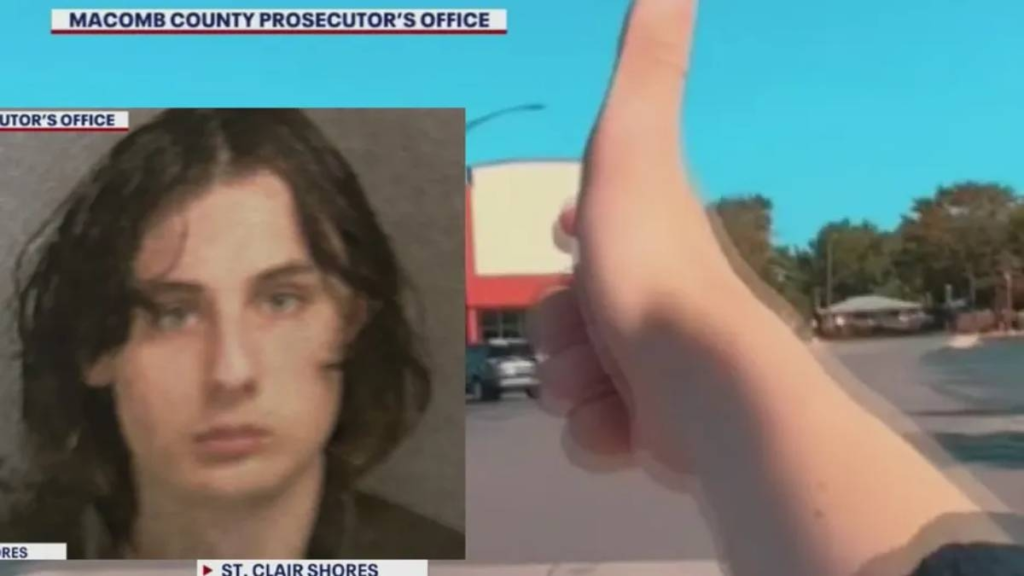
The case of Joel Edwards, a 20-year-old resident of St Clair Shores, Michigan, has sparked widespread alarm and intense public scrutiny after authorities alleged that he recorded a TikTok video making finger guns outside a local elementary school. What began, according to his mother, as an attempt to mimic fictional characters escalated swiftly into a criminal investigation involving the FBI, local police, and the Macomb County Prosecutor’s Office. Edwards, who was already on probation for an unrelated offense, now faces a series of serious charges that could result in a prison sentence of up to ten years.
The incident has rattled the suburban community, stirring fears of school violence and reigniting debates about online behavior, threat assessment, and mental health intervention. The situation unfolded on September 13, when the FBI alerted state police to disturbing social media activity allegedly tied to Joel Edwards’ accounts. Authorities claim the content included expressions of interest in committing a mass shooting, prompting officers to conduct a welfare check at his home.
Weapons were reportedly discovered during the visit, intensifying concerns about the potential for real-world violence. Despite his mother’s insistence that the recordings were merely performative imitations of characters such as Patrick Bateman and Walter White, prosecutors have emphasized that the matter cannot be dismissed as harmless behavior. With his bond set at $5 million and significant public anxiety surrounding the case, Joel Edwards awaits an upcoming probable cause conference on December 16 followed by a preliminary exam on December 19.
Community Concerns and the Escalation of the Investigation
The escalation of the case began with social media monitoring conducted by federal agents. According to the Macomb County Prosecutor, Peter Lucido, the FBI reported that online content linked to Joel Edwards included statements interpreted as expressing a desire to carry out a mass shooting. While the exact nature of the posts has not been publicly detailed, they were concerning enough to trigger a rapid law-enforcement response. St. Clair Shores Police officers conducted a welfare check at Edwards’ home shortly after the alert.
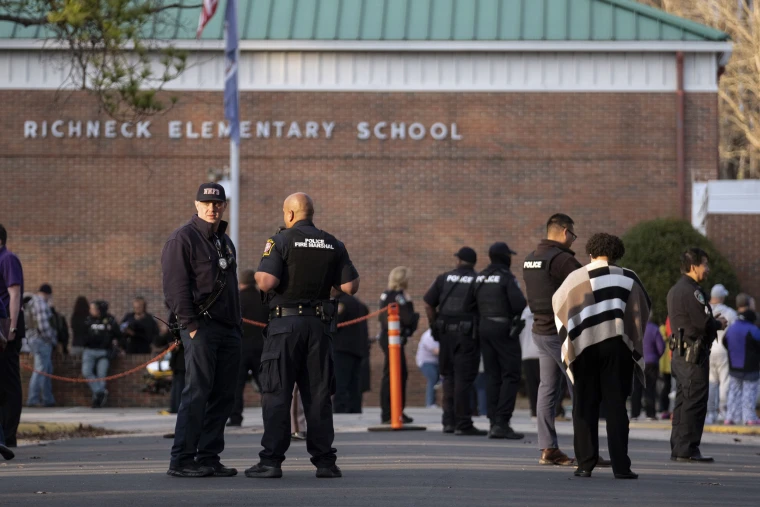
During the visit, they allegedly found weapons, a discovery that prosecutors have highlighted as a major factor in the seriousness of the charges now facing the 20-year-old. The video that drew the most attention was reportedly recorded outside Masonic Heights Elementary School, located in a Detroit suburb. In the footage, Joel Edwards can be seen making finger-gun gestures, a detail that, when combined with the alleged online statements and the weapons recovered at his residence, led authorities to conclude that the situation warranted aggressive legal action.
Local residents, informed through news coverage and community communication channels, reacted with alarm. Many described their fear not only of what might have happened but also of what could happen if Joel Edwards is eventually granted release. One parent, Jessica Frye, voiced the sentiment shared by many in the neighborhood. She described experiencing a level of fear she had never felt in her community before, referring specifically to the proximity of Edwards’ residence to the school grounds.
Her concerns reflect the heightened national sensitivity surrounding school safety, an atmosphere shaped by years of tragic incidents across the United States. For residents, the allegations against Joel Edwards struck at the core of a long-standing fear: the threat of violence against children in what should be one of the safest environments. The discovery of weapons at Edwards’ home added another layer of concern. While prosecutors have not clarified whether the weapons were legally owned, their presence was immediately factored into the charges.
Read : Controversial! Branham High School Students Form Human Swastika on Football Field
Macomb County officials have stated that, based on the evidence collected so far, they believe Joel Edwards demonstrated both the “specific intent” and the “overt act” required under Michigan law to justify charges related to threatening violence against a school. This point is critical, as prosecutors are obligated to distinguish between constitutionally protected speech and genuine threats that cross the line into criminal activity.
Read : 20-Year-Old Gunman Who Fired at Trump Was Rejected from School Rifle Team
Nevertheless, the community impact has been undeniable. Parents have reported difficulty explaining the situation to their children while also struggling themselves to comprehend how an incident like this could arise so close to home. Schools in the region have also had to contend with the ripple effects, including increased communication with families, heightened security concerns, and the ongoing psychological toll that repeated exposure to such incidents imposes on educators and students.
Family Perspective and the Question of Intent
While authorities and community members have expressed alarm, Joel Edwards’ mother, Rebekah, has maintained that the situation has been blown out of proportion and fundamentally misunderstood. In interviews with local media outlets such as WXYZ, she described her son as someone who becomes absorbed in fictional characters to the point of imitation, suggesting that the content he created reflected attempts at acting rather than any form of genuine threat. She specifically cited his fascination with Patrick Bateman, the protagonist of American Psycho, and Walter White from Breaking Bad, both well-known for their violent and morally ambiguous narratives.
Rebekah Edwards’ account raises questions about the intersection of mental health, media influence, and personal accountability. She stated that her son experiences periods during which he attempts to assume the persona of various characters, often ones that she admits are poor role models. From her perspective, the finger-gun gesture and accompanying behavior should be interpreted within this psychological and emotional framework rather than as indicators of violent intent.
She also emphasized that her son is not receiving the help she believes he urgently needs. In her words, “he needs help and he’s not getting the help he needs from the place he’s at,” a statement that implies both concern for his mental well-being and frustration with existing support systems. Her comments point toward a broader societal debate over how the legal system handles individuals whose concerning actions may stem from underlying mental health challenges rather than malicious intent.
However, prosecutors have presented a starkly different interpretation. From their standpoint, the combination of online content, behavior outside an elementary school, and the weapons recovered during the welfare check constitutes a serious threat. Peter Lucido described the case as “deeply disturbing,” asserting that the public must be protected from potential acts of violence regardless of the motivations behind the behavior. This tension is at the heart of the case: determining where the line lies between performance and threat, and how authorities should react when that line is unclear.
Complicating matters is Joel Edwards’ existing criminal history. He was already on probation for a separate, unrelated offense at the time of his arrest. This fact, while not directly connected to the current charges, contributes to the prosecutorial argument that he poses a risk requiring stringent legal measures. For Edwards’ defense, the challenge will be to separate his online behavior and performative actions from any genuine intention to cause harm, while also addressing the allegations regarding the weapons found in his home.
Legal Proceedings and the Potential Consequences Ahead
The legal consequences facing Joel Edwards are severe. He has been charged with using a computer to commit a crime, making an intentional threat to commit an act of violence against a school with specific intent to carry it out or by committing an overt act, and felony firearm charges. Under Michigan law, these offenses combined carry a potential sentence of up to ten years in prison. The bond set at $5 million reflects both the seriousness of the charges and the court’s assessment of the potential threat posed by the defendant.
If Joel Edwards is able to post bail, several strict conditions will be enforced. He will be required to wear a GPS tether, remain under home confinement, and avoid any contact with students or school officials. These measures are designed both to protect the public and to ensure that he remains in compliance with the law while awaiting trial. Such restrictions highlight how seriously the judicial system is treating the case, underscoring broader concerns about school safety and threat prevention.
Read : Viral! 88-Year-Old Army Veteran Ed Bambas Still Working Full-Time at Michigan Grocery Store
The prosecutorial emphasis on an “overt act” is particularly important. In cases involving alleged threats of violence, it is not enough for authorities to identify disturbing speech alone. Instead, they must demonstrate that the defendant took some concrete step toward committing the threatened act. Prosecutors argue that filming the finger-gun video outside the elementary school satisfies this requirement, thereby justifying the charges.
It is likely that the defense will challenge this interpretation, possibly arguing that the gesture was symbolic rather than actionable, or that it was taken out of context. As the December 16 probable cause conference approaches, both sides are preparing to present initial arguments. At that stage, a judge will determine whether sufficient evidence exists for the case to proceed to a preliminary examination, scheduled for December 19. During the preliminary examination, prosecutors must show that a crime was likely committed and that the defendant was likely responsible.
These early hearings will set the tone for the remainder of the legal process, providing insight into how the court views the evidence, the defendant’s intent, and the credibility of the competing narratives presented by the prosecution and the defense.
A notable aspect of this case is the broader national context. Incidents involving threats to schools—even those that later prove to be misunderstandings or hoaxes—are now handled with extreme caution. Law enforcement agencies across the country have adopted a policy of zero tolerance for actions that may suggest violence, driven by the tragic history of school shootings in the United States. This backdrop shapes public perception and legal expectations, often resulting in swift and harsh responses to incidents that might previously have been dismissed as ill-conceived pranks.
For Joel Edwards , the road ahead is uncertain. The charges he faces carry significant weight, and the public reaction has been overwhelmingly shaped by fear rather than sympathy. At the same time, his mother’s claims regarding his mental health and his fascination with fictional characters raise questions that are likely to become important in court. The legal system must balance public safety with fair treatment, determining whether Edwards intended real harm or whether his actions were misguided but ultimately non-threatening.
As the hearings approach, the case continues to draw attention from both local residents and observers across the country. It touches on complex issues at the intersection of digital behavior, school safety, mental health, and criminal law. The outcome will likely influence ongoing discussions about how communities and legal institutions respond to perceived threats in an era where online content can blur the lines between fantasy and reality.
Joel Edwards’ next key court dates, the probable cause conference on December 16 and the preliminary examination on December 19, will be pivotal moments in determining whether the case proceeds to trial and how the charges against him will ultimately be resolved.
Fancy a bonus from Fun88, do ya? Keep an eye on their ‘khuyến mãi’—that’s promo in Vietnamese. They’re always chucking out deals. Worth checking before you play! Find the deals here: fun88 khuyến mãi