
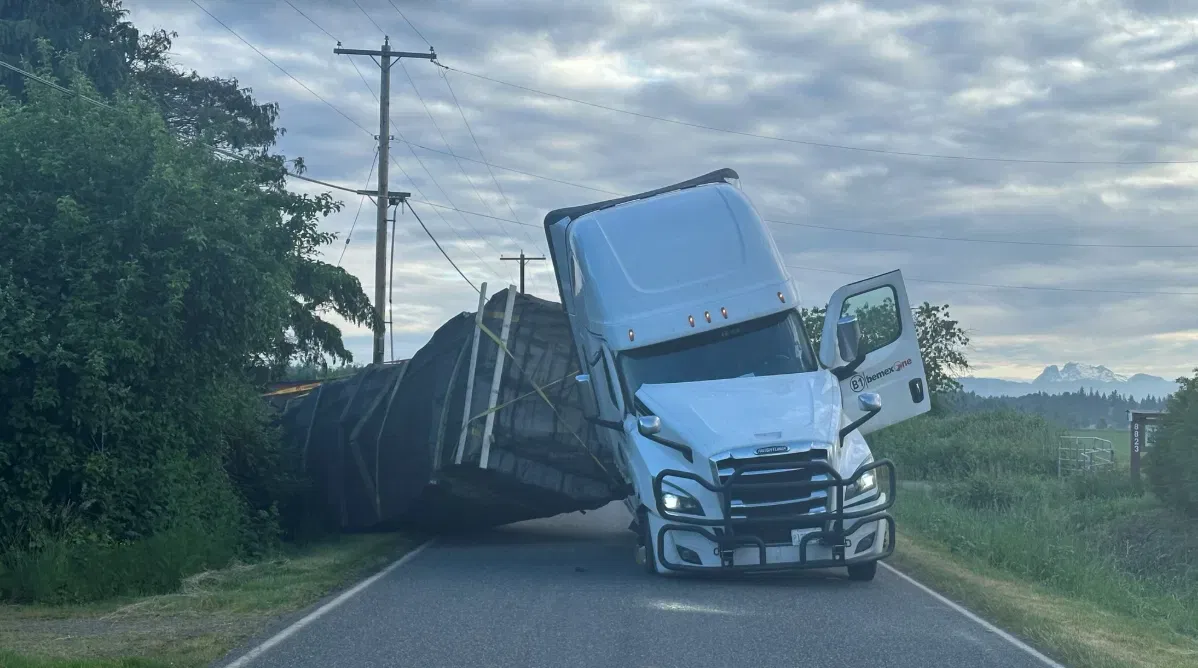
In a startling incident that stunned both locals and emergency responders, approximately 250 Million Bees Escape After Semi-Truck Overturns in Whatcom County, Washington, following the overturning of a commercial semi-truck hauling thousands of beehives.
The massive bee spill, which took place around 4 a.m. on a rural highway near the Canadian border, prompted an immediate and urgent response from emergency management officials, local authorities, and an army of beekeepers. The event caused momentary chaos and concern, not only due to the sheer number of bees but also because of the potential hazards involved in managing such a swarm.
The semi-truck had been transporting roughly 70,000 pounds of honey bee hives after completing pollination work at a local blueberry field, with its destination reportedly being South Dakota. However, the journey took an unexpected and dramatic turn when the truck rolled over, leaving millions of bees in disarray and the road shut down for public safety.
A Stinging Emergency Unfolds
Authorities were swift to recognize the scale of the incident, immediately urging residents to stay away from the area. The Washington Emergency Management Division humorously but seriously warned people on social media: “No one could have predicted 250 MILLION BEES would be loose on a road… Just… Don’t go anywhere near them.” Emergency alerts were echoed by the Whatcom County Sheriff’s Office, which also took to social media to provide updates and instructions to the public.
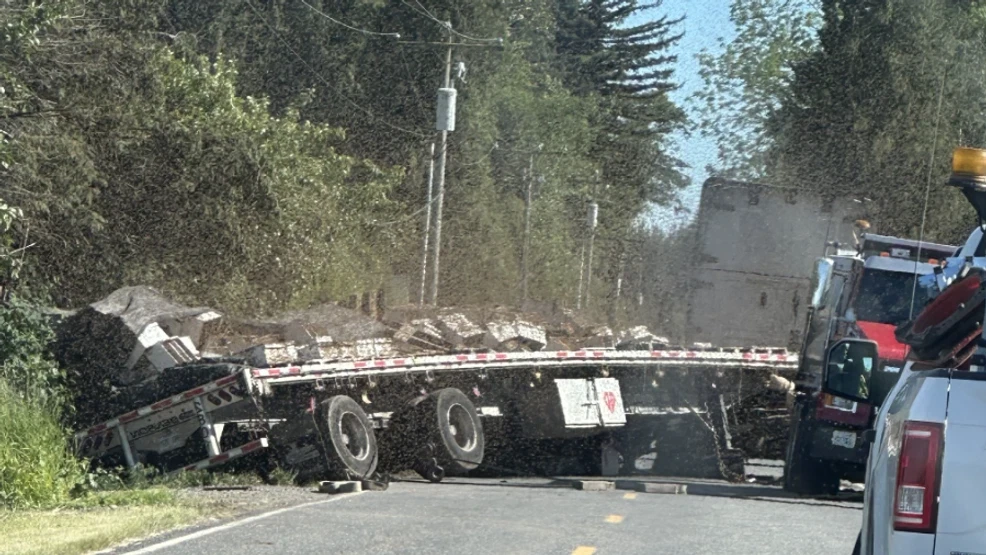
The bees didn’t escape all at once. The truck’s hives reportedly “came off” around 9 a.m., hours after the initial rollover. As the sun rose and the temperature increased, bees began to exit their damaged hives and swarm the area in search of new locations, confused by the sudden upheaval. Those near the scene, including journalists and emergency workers, faced the unexpected challenge of maneuvering through dense clouds of bees.
Deputy Director of Emergency Management Matt Klein, who was helping manage the response, reported being stung a dozen times and still had bee stingers in his ears by nightfall. Despite the multiple stings, he downplayed the medical threat, explaining that honeybee stings, while painful, are not as dangerous as those from more aggressive species. Nonetheless, the discomfort and risks posed by such a dense swarm were enough to warrant extreme caution.
NEW: 250 million bees escape after semi-truck overturns in Washington State
— Unlimited L's (@unlimited_ls) May 31, 2025
A truck carrying 70,000 pounds of honeybee hives overturned in rural Whatcom County near Seattle around 4 a.m. Friday
The hives broke open around 9 a.m., releasing the bees
Authorities urged residents… pic.twitter.com/xWtUcpEgyp
Meanwhile, KOMO reporter Denise Whitaker was stung while reporting from a distance of 300 yards, highlighting how widespread the swarming had become. “These bees were aggressive,” she noted, describing the difficulty in avoiding them despite maintaining what should have been a safe distance.
Beekeepers to the Rescue
Recognizing that this was a specialized emergency, more than two dozen beekeepers from the surrounding region were called in to help contain and recover the displaced bee colonies. Donning protective suits and armed with their tools and expertise, the beekeepers worked tirelessly under stressful conditions to save as many bees and hives as possible.
Local beekeeper Derek Condit described the painstaking process of picking up damaged hive boxes, carefully collecting frames filled with honey, bees, and brood (developing bees), and restacking them in hopes of salvaging some of the colonies. “We’re literally grabbing a bee box and then grabbing the frames… to hopefully have some survival rate to work with here,” he explained.
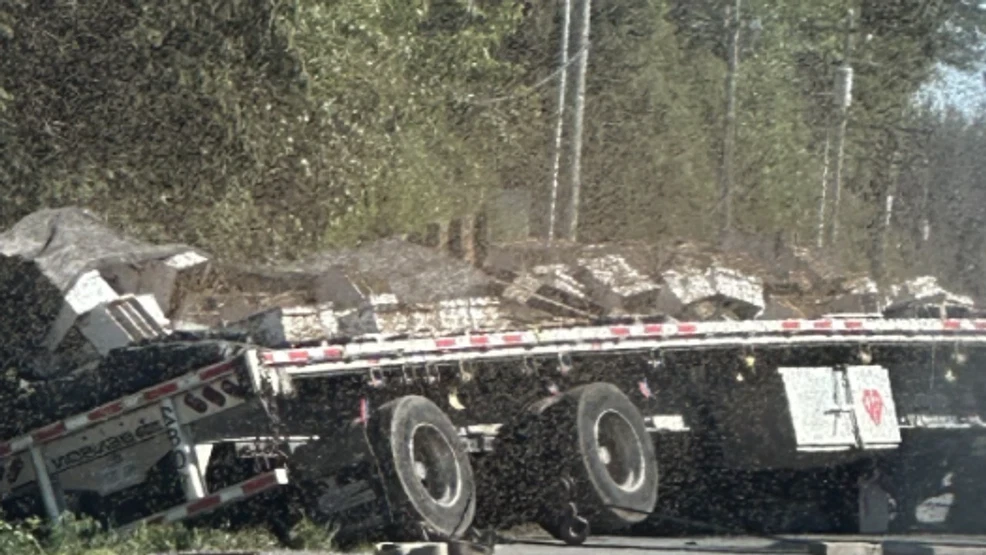
The situation was not only challenging but emotionally taxing as well. Beekeepers, who often form strong connections with their hives, had to witness massive losses firsthand. Condit noted that while some bees would likely swarm to nearby locations and establish new hives—contributing to local pollination—there would also be “great losses” due to the trauma of the accident.
The hives were eventually recovered, restored, and restacked on new pallets, and by Friday evening, the on-scene work had been completed. According to the sheriff’s office, it was expected that most of the bees would return to their hives by the following morning. The truck’s owners, and those responsible for delivering the bees, would take over from there.
Bees, Berries, and the Bigger Picture
This bee-related emergency may have seemed bizarre and even comedic to some, but it shines a spotlight on the crucial role bees play in the local economy and agriculture. Whatcom County is not just another rural area; it’s home to Bee City USA, based in Bellingham—a hub that promotes pollinator conservation and education. The region’s fertile lands and mild climate make it ideal for berry farming, and honeybees are central to pollinating crops like blueberries, which are a major industry in the area.
The truck was leaving Whatcom County after completing a pollination contract with a local blueberry farm, showing how mobile beekeeping operations support agriculture across states. Such services are common in the United States, with bees routinely shipped long distances to pollinate almonds, berries, melons, and other crops at specific times of the year.
However, the incident also reminded locals of another headline-making moment in their beekeeping history. In 2020, Whatcom County became the first location in the United States to report the presence of a nest of Asian giant hornets, often sensationalized in the media as “murder hornets.” These invasive hornets posed a major threat to bee populations and sparked widespread concern about the fragility of pollinator ecosystems.
In this context, the semi-truck accident adds another layer to the region’s complex relationship with bees. While the escaped bees are not inherently dangerous, their mass release is a stark reminder of how reliant both the environment and food systems are on healthy, managed pollinator populations.
As of Friday night, authorities confirmed that there was no general health risk to the public. The bees, while active and defensive, were not behaving aggressively beyond expected levels. Residents were still advised to remain cautious, especially if allergic to bee stings.
The release of 250 million honeybees in Whatcom County following a semi-truck accident is a vivid example of how unexpected events can have broad and unusual implications for both public safety and agriculture. Thanks to the quick actions of emergency responders and local beekeepers, the potential crisis was brought under control within a day, although long-term losses to the bee colonies may still emerge.
This incident highlights the vital role bees play in our ecosystem, the importance of pollination to local economies, and the unpredictable nature of transporting live animals—especially in such large quantities. It also underscores the resilience and dedication of the beekeeping community, who stepped in swiftly and bravely to manage what could have become a far more serious disaster.
In the end, while the bees may have caused a temporary buzz of chaos on a rural highway in Washington state, they also served as a powerful reminder of the fragile balance between nature and industry.