
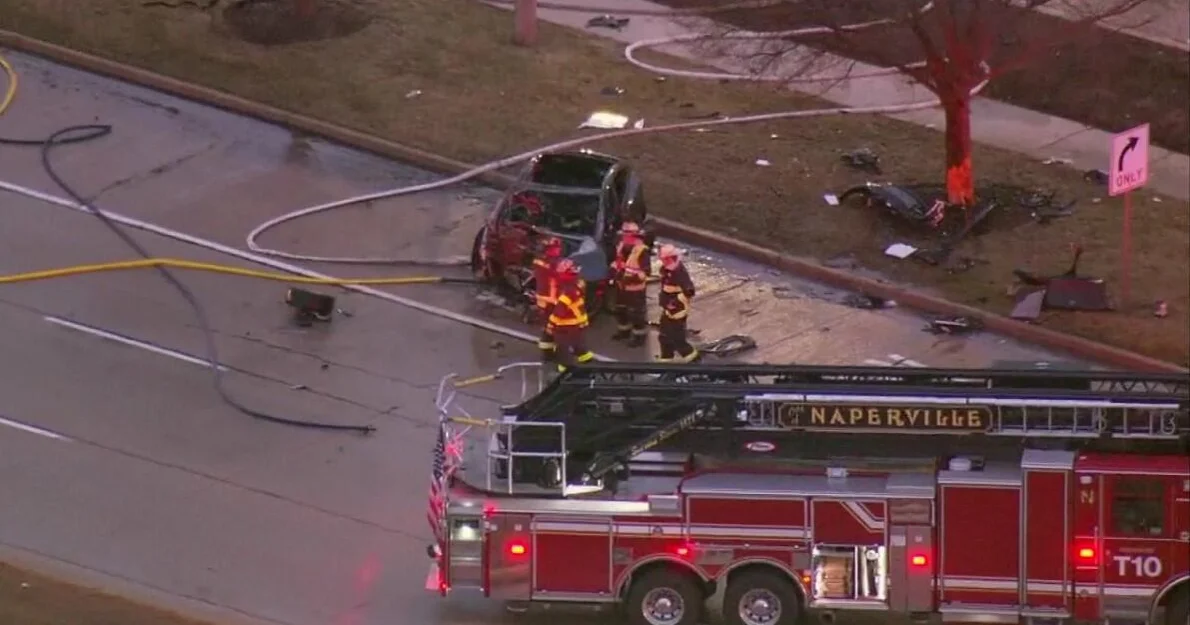
A serious road incident in the Chicago suburb of Naperville on Friday afternoon drew attention to the risks posed by sudden medical emergencies while driving and the unique challenges associated with electric vehicle fires. A 37-year-old man was injured after suffering a medical emergency behind the wheel of a 2025 Tesla Model Y, leading to a multi-stage crash that ended with the vehicle catching fire. The incident unfolded during the early evening hours on Route 59 near Cantore Road, a busy thoroughfare that was temporarily shut down as emergency crews worked to control the situation.
While the driver survived with relatively minor injuries, the dramatic nature of the crash and the extensive fire damage to the vehicle prompted a significant emergency response and raised broader questions about electric vehicle safety and emergency preparedness. According to police and fire officials, the crash occurred at around 5 pm when the driver suddenly became ill while traveling along Route 59.
The medical episode caused him to lose control of the Tesla, which first sideswiped another vehicle before veering off the roadway. The car then struck a tree and almost immediately caught fire, sending thick black smoke into the air and scattering debris across the road and shoulder. The severity of the fire, combined with the location of the crash, forced authorities to close Route 59 to traffic for an extended period as firefighters worked to extinguish the flames and secure the scene.
Medical Emergency Triggers Chain-Reaction Crash on Route 59
Preliminary information released by Naperville police indicates that the driver’s sudden medical emergency was the primary factor behind the crash. While specific details about the nature of the illness have not been made public, investigators confirmed that the man experienced a health issue severe enough to impair his ability to control the vehicle. As a result, the Tesla struck another car traveling nearby before leaving the roadway entirely.
The initial sideswipe caused damage to the other vehicle, though no serious injuries to its occupants were immediately reported. After that impact, the Tesla continued off the road, colliding with a tree with significant force. The collision caused extensive structural damage to the vehicle and led to a fire that rapidly engulfed much of the car. Witnesses described seeing flames and thick smoke rising from the crash site within moments of impact, creating a dangerous and chaotic scene.
An off-duty Naperville police officer happened to be nearby at the time of the crash and witnessed the incident unfold. Recognizing the urgency of the situation, the officer rushed to the burning vehicle and managed to pull the driver out before the fire intensified further. This quick intervention likely prevented more serious injuries or worse, as electric vehicle fires can escalate rapidly due to the involvement of high-voltage battery systems.
Why are all these Tesla alway catching on fire🙄
— JoNation (@idrick) January 5, 2026
pic.twitter.com/cgXIMF9nB4
Emergency medical services arrived shortly afterward and transported the driver to a local hospital. Authorities said he suffered minor burns, likely sustained during the fire or rescue, and was treated for those injuries. His overall condition was not described as life-threatening, and no fatalities were reported in connection with the crash. Police continued to investigate the circumstances surrounding the medical emergency, including whether any underlying conditions or contributing factors may have played a role.
Firefighting Challenges and Specialized Response to EV Battery Blaze
The fire that followed the crash posed significant challenges for first responders, largely due to the nature of electric vehicle battery systems. Lithium-ion batteries, commonly used in electric cars like the Tesla Model Y, can burn at extremely high temperatures and may reignite even after initial flames are extinguished. As a result, firefighters must take extra precautions and use specialized equipment to ensure the fire is fully controlled and the battery is adequately cooled.
Video footage from the scene showed the Tesla heavily damaged and engulfed in flames, with black smoke billowing upward as firefighters worked to contain the blaze. Debris from the crash was scattered across the roadway and nearby shoulder, and helicopters were observed flying overhead as part of the broader emergency response. Fire crews used a large volume of water not only to extinguish the visible flames but also to cool the vehicle’s battery pack, a critical step in preventing reignition.
Officials confirmed that the Naperville Fire Department deployed a specialized tool known as a Poseidon Nozzle during the operation. The Poseidon Nozzle is designed specifically for electric vehicle battery fires and allows firefighters to deliver water directly into the battery pack, improving cooling efficiency and reducing the risk of flare-ups. Notably, the device was invented by a Naperville firefighter, reflecting the department’s proactive approach to adapting to the growing presence of electric vehicles on local roads.

Photos taken after the fire was brought under control showed the Tesla almost completely burned out, with firefighters continuing to spray water on the remains as a precaution. Emergency responders were also seen carefully inspecting the vehicle to ensure there were no lingering hazards. The use of specialized equipment and extended cooling measures underscored the evolving nature of firefighting in an era where electric vehicles are becoming increasingly common.
Route 59 remained closed to traffic for some time as crews completed their work and investigators documented the scene. The closure caused temporary disruptions in the area, but authorities emphasized that it was necessary to ensure public safety and allow firefighters to fully address the risks associated with the burned electric vehicle.
Growing Attention on Tesla Fires and Electric Vehicle Safety
The Naperville crash is the latest in a series of incidents that have drawn public attention to electric vehicle fires, particularly those involving Tesla models. While experts and manufacturers often note that electric vehicles are statistically no more likely to catch fire than gasoline-powered cars, the intensity and duration of EV fires can make them appear more dramatic and difficult to control. This has led to heightened scrutiny whenever such incidents occur.
Read : 30-Year-Old Driver Arrested After Jake Neaves and Jenson Seal Killed in Tesla Tree Crash
In the aftermath of the Naperville crash, videos and photos circulated widely on social media, showing the burning Tesla and the extensive damage left behind. One bystander-recorded video captured the vehicle engulfed in flames, with thick smoke pouring into the sky as emergency crews worked from a distance. The visual impact of these images has fueled ongoing discussions about the safety of electric vehicles and the preparedness of emergency services to handle battery-related fires.
Separate from the Naperville incident, another video circulating online shows a different Tesla catching fire under unrelated circumstances. In that clip, a man driving a red Tesla with an open top is seen pulling over as flames suddenly appear at the rear of the vehicle. The driver quickly exits and moves away as the fire spreads. While authorities have not confirmed any connection between the two incidents, the timing of the videos has contributed to renewed public interest in Tesla fire cases.
Officials in Naperville emphasized that the cause of Friday’s crash was the driver’s medical emergency, not a mechanical failure or defect in the vehicle itself. However, once the collision occurred, the fire became a central concern due to the presence of the electric battery system. Fire departments across the country have been adapting their training and equipment in response to the growing number of electric vehicles, and the use of tools like the Poseidon Nozzle reflects those efforts.
As investigations continue, authorities are expected to release additional information regarding the crash, including any findings related to the driver’s medical condition and the sequence of events leading up to the fire. For now, the incident serves as a reminder of the unpredictable nature of medical emergencies on the road and the complex challenges faced by first responders when electric vehicles are involved in serious accidents.