
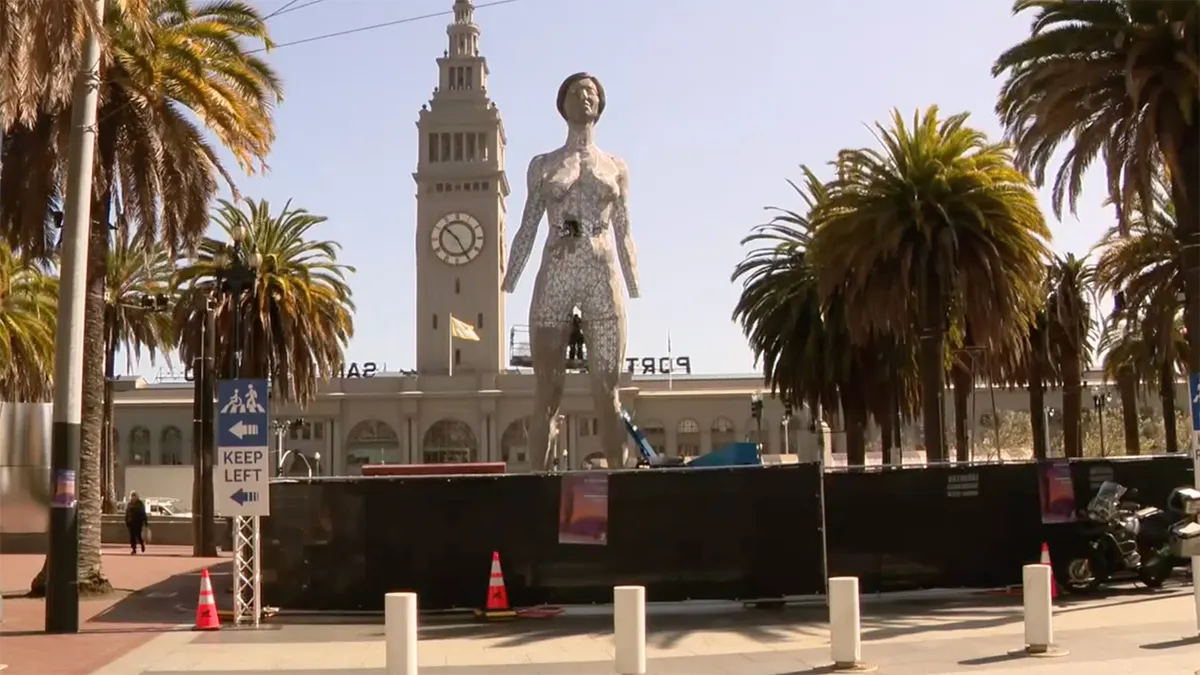
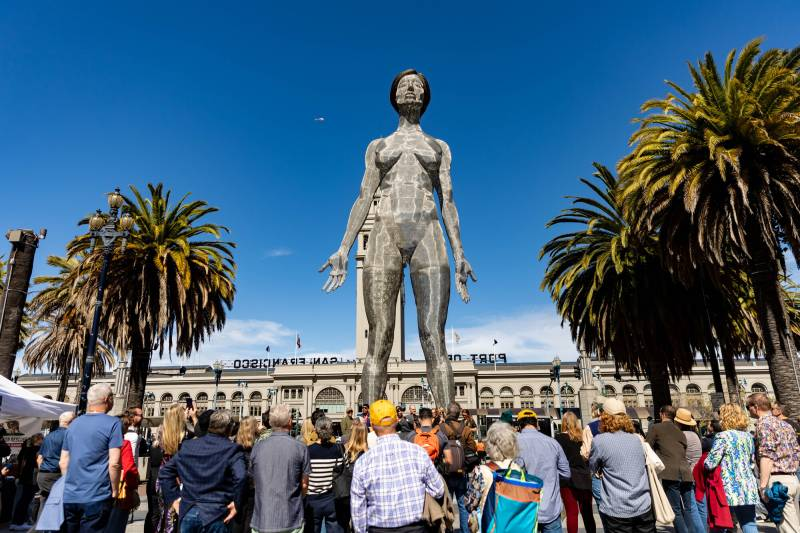
San Francisco, a city known for its artistic flair and progressive ideals, is once again at the center of a cultural storm following the unveiling of a massive 45-foot-tall statue of nude woman in Justin Herman Plaza (also known as Embarcadero Plaza).
Titled R-Evolution, the towering sculpture by artist Marco Cochrane has drawn admiration, mockery, and outrage alike. Originally created for the Burning Man festival in 2015, the piece has now been installed with fanfare in one of the city’s busiest public spaces — just steps from the iconic Ferry Building.
The artwork was introduced to the public with an elaborate event involving lights, music, and performance art, courtesy of Illuminate, a nonprofit organization known for its public art installations. According to its creators, R-Evolution was designed to represent female strength, compassion, and freedom.
It glows at night and is equipped with internal motors that make it appear to “breathe,” symbolizing life and energy. But in a city struggling with homelessness, addiction, and economic hardship, not everyone is celebrating this new addition to the skyline.
While some hail the statue of nude woman as empowering and bold, many residents and commentators argue that it reflects the city’s misplaced priorities and growing detachment from the everyday concerns of its citizens.
Anatomy of Controversy: Art or Tone-Deaf Spectacle?
The backlash to the statue of nude woman began almost immediately, and much of it was captured and amplified by social media. A video shared by influencer Collin Rugg showed a cherry picker being awkwardly hoisted between the statue’s legs during its installation, prompting a flood of jokes, memes, and commentary.
“Nothing says ‘reviving downtown’ like a 45-foot naked lady getting rear-end surgery,” one user quipped, while another commented, “This picture kind of embodies the spirit of San Francisco — head up a–.”
What was intended to symbolize female empowerment quickly became an internet spectacle. Many San Franciscans felt blindsided by the installation, questioning not only its appropriateness but its timing and location.
Read : French Lawmaker Raphaël Glucksmann Demands US to Return the Statue of Liberty
The sculpture, installed in an area surrounded by boarded-up storefronts, visible homelessness, and open-air drug use, struck many as a tone-deaf gesture in a city that is struggling to keep its downtown vibrant and safe.
San Francisco unveiled their 45-foot statue of a nude woman Thursday at Embarcadero Plaza to attract tourism. The piece is titled “R-Evolution.”
— Paul A. Szypula 🇺🇸 (@Bubblebathgirl) April 13, 2025
SF continues to be plagued by crime, homeless, and illegals. The city would have many more tourists if these issues were addressed. pic.twitter.com/zc0EUunniF
Bruce Lou, a Republican challenger to Nancy Pelosi in a recent congressional election, didn’t hold back in his criticism. “I don’t know where to begin about the misplaced priorities for the city of San Francisco,” he stated. “They seem like they are focused on absolutely everything except the things that matter.”
Indeed, with more than 8,300 homeless individuals currently living in San Francisco — according to the most recent point-in-time count — and hundreds of millions of dollars being allocated to housing and homelessness services, critics ask why energy and resources are being channeled into controversial public art installations.
Political and Cultural Reactions Across the Spectrum
What’s particularly striking about the reaction to R-Evolution is that criticism has come from all corners of the political and cultural spectrum. While right-wing voices have condemned the statue of nude woman as part of what they describe as a feminist, anti-male agenda, more liberal and progressive critics have also voiced discontent.
In a KQED article bluntly titled “Nobody Asked for This,” arts editor Sarah Hotchkiss expressed her embarrassment and frustration over the statue. “As I gazed up at this monumental steel and mesh sculpture on Thursday, I felt embarrassed for the city of San Francisco,” she wrote.
Hotchkiss’s commentary underscores a broader feeling among residents — that the installation was pushed through without meaningful public consultation.

Many people feel that R-Evolution was dropped into the public space without understanding the context or concerns of the community. “We are all the audience for this thing, and no one asked us if we wanted it,” she added.
Former San Francisco GOP Chair John Dennis went further, suggesting the sculpture is symbolic of deeper cultural shifts in the city. “The city named after St. Francis is now dominated by the feminist, anti-male agenda. The results speak for themselves,” he said. “A giant, naked woman blocking the proud, iconic Ferry Building is a perfect metaphor for San Francisco these days.”
Although some might argue that such statements exaggerate the sculpture’s significance, the reactions show that public art — especially in public spaces — does not exist in a vacuum. It must contend with the environment around it, and the political, economic, and cultural issues that define that environment.
Art, Identity, and the Struggles of a City in Transition
R-Evolution is slated to remain at Justin Herman Plaza for at least six months and possibly up to a year. While it may serve as a focal point for tourists and Instagrammers, its presence raises important questions about San Francisco’s identity and direction.
Can a city in crisis afford to invest in monumental art installations that polarize rather than unite? Is bold public art a sign of cultural vitality, or a distraction from urgent social issues? San Francisco has long prided itself on being a haven for creativity, counterculture, and free expression.
The city has hosted everything from the Summer of Love to the LGBTQ+ rights movement. Burning Man, where R-Evolution first debuted, is itself a descendant of San Francisco’s unique cultural DNA. So in some sense, the arrival of a 45-foot naked woman in a public square is entirely in character. But the city of 2025 is not the city of 1967 or even 2015.
While some residents celebrate the statue as a reminder of San Francisco’s artistic spirit, others view it as a painful emblem of a city out of touch with its own people. Public safety remains a top concern. Though violent crime dropped 14% last year and car break-ins hit a 22-year low, gun violence ticked up 5%.
Drug-related arrests are up nearly 40% in early 2025 compared to the previous year — yet public drug use remains highly visible. Critics argue that without sufficient addiction treatment and housing, enforcement alone does little to solve the root issues.
Add to that the vacant storefronts and declining foot traffic in downtown areas, and the optics of installing a massive nude sculpture begin to seem more like escapism than progress.
While Illuminate and its supporters argue that public art can play a role in revitalizing neighborhoods and sparking conversation, many residents believe the conversations that matter most are about housing, safety, and community care.
The city’s $690 million budget for homelessness services has yet to show significant results in reducing visible suffering on the streets. For many, the juxtaposition of a glowing 45-foot steel woman next to human beings sleeping on sidewalks is not just ironic — it’s infuriating.
The debate around R-Evolution reflects a larger national conversation about urban priorities, the role of public art, and who gets to shape the character of a city. Is the statue of nude woman a symbol of resilience and freedom, as its creators intended, or a monument to disconnection from reality?
Only time will tell how San Franciscans come to view R-Evolution. Will it be remembered as an empowering statement of artistic vision or as a tone-deaf monument to a city’s misplaced ambitions? Either way, its towering presence ensures that the conversation — and the controversy — will not fade away anytime soon.