

A former school nurse is facing serious criminal charges following allegations that she engaged in inappropriate and increasingly concerning communication with a 13-year-old boy. The case has drawn attention due to the nature of the relationship described by investigators, as well as the position of trust held by the accused within a school environment. Authorities say the interactions extended beyond casual communication and evolved into a pattern that raised significant legal and ethical concerns. The allegations, supported by digital evidence and statements from the minor, have led to felony charges and ongoing legal proceedings.
The investigation began after the teenage boy was interviewed on October 17, 2025, at a child advocacy center. During that interview, the boy described how he had met 40-year-old Abby Render through his school in Evansville, where she worked as a nurse. According to the boy’s account, what started as simple communication gradually developed into frequent contact that included texting, video calls, and in-person meetings. The details outlined by investigators suggest a relationship that went far beyond what would be considered appropriate between a school staff member and a minor.
Development of the Relationship and Alleged Grooming Behavior
According to police records, the interaction between Abby Render and the teenage boy began with casual messages such as greetings. Over time, however, the communication reportedly became more frequent and personal. The boy told investigators that Render would pick him up and take him to her home, indicating a level of access and involvement that raised immediate concern among authorities. He also described frequent FaceTime calls and recalled an instance in which she kissed him on the cheek after dropping him off, an action that investigators viewed as inappropriate given the circumstances.
Law enforcement officials examined the boy’s phone and discovered a substantial number of messages exchanged between the two. In one particular exchange, the boy sent a photo of himself with another young female. Investigators noted that Render responded with jealousy, and the tone of her messages was described as resembling that of an adult involved in a romantic relationship. This shift in tone was considered a key indicator that the communication had crossed professional and appropriate boundaries.
Further examination revealed that there were more than 1,100 messages exchanged between Render and the minor. Authorities stated that some of these messages contained vulgar or perverse content, which contributed to the charges filed against her. In addition to text messages, investigators found that the two had shared videos through social media platforms, further expanding the scope of their interaction.
Read : 26-Year-Old Kristian Parry Jailed for Making Indecent Images of Children While Working at Nursery
Police also alleged that Render encouraged the boy to delete certain messages from his phone. When questioned, she later admitted to deleting messages from her own device as well. This behavior was interpreted by investigators as an attempt to conceal the nature of their communication. The act of instructing a minor to delete messages, particularly in the context of an inappropriate relationship, played a significant role in shaping the case against her.
Authorities believe that these actions align with patterns commonly associated with grooming, where an adult gradually builds trust and emotional dependence with a minor for the purpose of future exploitation. Investigators pointed to conversations in which Render allegedly shared personal details about her own life, including sensitive topics, as further evidence supporting this conclusion.
Police Investigation and Statements from the Accused
On October 16, detectives visited Render’s residence to question her about the allegations. During the interview, she described her relationship with the boy as similar to that of an adopted son, stating that she had known him for five to six months. She denied any inappropriate or sexual nature in their communication and characterized their exchanges as harmless, consisting mainly of shared videos and humorous messages.
When confronted with the allegations of inappropriate messaging, Render maintained that the content had been misunderstood. She acknowledged that she had asked the boy to delete certain messages but claimed that these were jokes or content she considered inappropriate in a non-serious context. She also admitted that they had told each other they loved one another, a detail that investigators viewed as highly concerning given the age difference and her role as a school employee.

Investigators noted that Render was also in regular contact with the boy’s mother during the same period. This communication added another layer of complexity to the case, as it indicated that she maintained a level of trust with the family while simultaneously engaging in a separate, undisclosed relationship with the minor. According to authorities, the boy even shared messages showing that he and Render had arguments related to her communication with his mother.
The mother, police said, was unaware of the nature of the relationship between her son and Render. This lack of awareness further reinforced investigators’ concerns that the interactions were being deliberately concealed. Authorities concluded that the combination of frequent private communication, emotional exchanges, and attempts to delete evidence pointed toward a deliberate effort to maintain secrecy.
Based on the totality of evidence, detectives stated that they believed Render’s actions were consistent with grooming behavior. This conclusion was supported by the progression of communication, the personal nature of the conversations, and the efforts to hide or erase digital records.
Charges Filed and Institutional Response
Following the investigation, Abby Render was formally charged with Child Solicitation, classified as a Level 5 felony, and Dissemination of Matter Harmful to Minors, a Level 6 felony. A judge reviewed the evidence presented and determined that there was probable cause to proceed with the charges. As part of the legal process, Render’s bond was set at $2,500 cash or $25,000 surety.
Read : Anonymous $1 Million Donation Helps Nurses at Bryn Mawr Hospital Pay Down Student Loan Debt
In addition to the financial conditions, the court imposed restrictions on Render’s contact with the alleged victim. She has been ordered to have no communication with the teenage boy as the case moves forward. These measures are intended to ensure the safety of the minor and to prevent any further interaction while the investigation and legal proceedings continue.
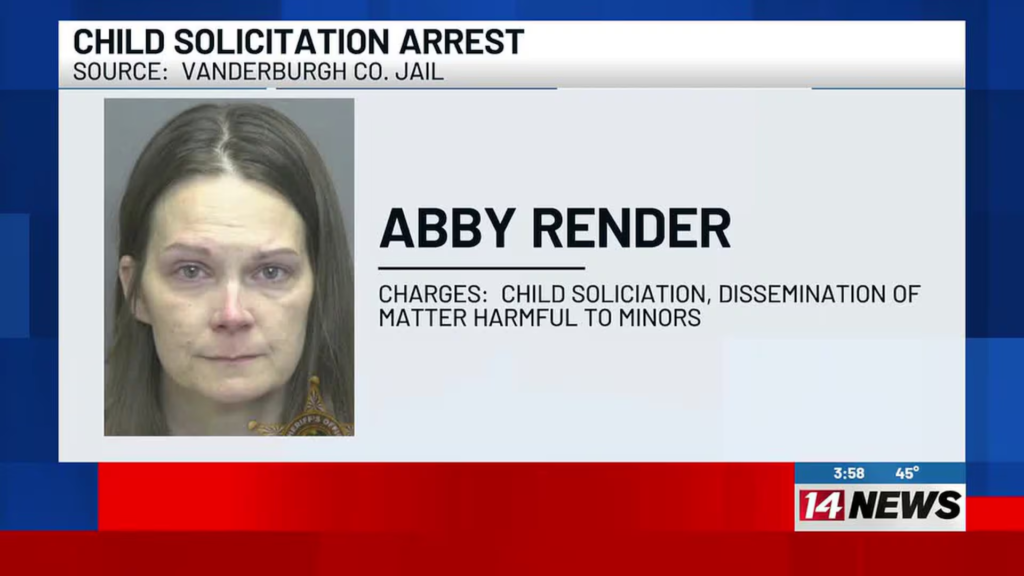
The school district where Render had been employed also issued a statement acknowledging the situation. While specific details of the statement were not disclosed in full, the response indicated that the institution was aware of the allegations and taking them seriously. Cases involving school employees and minors often prompt internal reviews and policy evaluations, particularly when they involve breaches of trust and professional conduct.
The charges against Render carry significant legal consequences if she is found guilty. A Level 5 felony in Indiana can result in substantial prison time, while a Level 6 felony also carries potential penalties including incarceration and fines. Beyond the legal implications, the case has raised broader concerns about safeguarding practices within educational settings and the responsibilities of staff members who interact with students.
As the case progresses, it is expected that additional details may emerge through court proceedings. Prosecutors will likely rely on digital evidence, witness testimony, and investigative findings to build their case, while the defense may challenge the interpretation of the communications and the intent behind them. The outcome will ultimately depend on how the court evaluates the evidence and the credibility of the accounts presented.
The situation highlights the serious nature of allegations involving minors and authority figures, particularly in environments where trust and safety are essential. It also underscores the role of digital communication in modern investigations, as text messages, social media interactions, and other electronic records increasingly serve as key pieces of evidence in criminal cases involving inappropriate conduct.