

Artificial intelligence continues to redefine the boundaries of what technology can offer, and now it has entered a space that once seemed beyond its reach: predicting life expectancy.
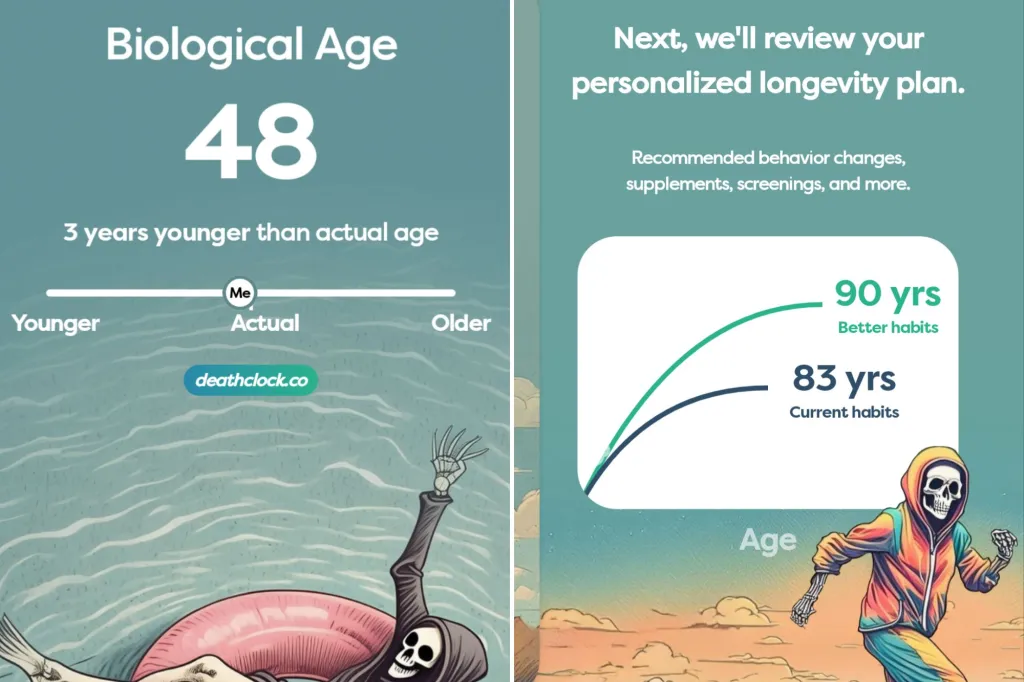
Enter Death Clock, an AI-powered application that forecasts a person’s likely date of death based on their lifestyle habits.
Since its launch in July, the app has garnered over 125,000 downloads, catching the attention not only of health enthusiasts but also of financial planners and economists.
Developed by Brent Franson, Death Clock aims to offer more than just morbid curiosity; it provides actionable insights into health and financial planning.
How Death Clock Works: Science Behind the App
Death Clock utilizes a sophisticated AI algorithm powered by a vast dataset comprising over 1,200 life expectancy studies and information from 53 million participants.
This extensive data pool allows the app to deliver highly personalized predictions, taking into account various lifestyle factors such as diet, exercise, stress levels, and sleep patterns.
The accuracy of its forecasts is rooted in the depth of the data and the complexity of the AI model, which continuously learns and improves based on new information.
Read : Supermodel Luciana Curtis and Her Family Kidnapped in Brazil
The process begins with users inputting their lifestyle information into the app. Questions cover various aspects of daily life, including eating habits, frequency of physical activity, mental health status, and sleep quality.
Read : X Achieves Record Milestone with 417 Billion User Seconds: Elon Musk
The AI then cross-references this data with findings from life expectancy studies to generate a predicted “death date.” While the concept may seem grim, the app is designed to encourage users to reflect on their habits and make healthier lifestyle choices.

The app’s interface includes a “fond farewell” death-day card featuring the Grim Reaper—a tongue-in-cheek touch that underscores the serious yet somewhat lighthearted approach to a weighty topic.
By presenting the information in this manner, Death Clock aims to reduce the fear surrounding mortality and instead focus on the actionable insights it offers.
Financial Planning: A Revolutionary Tool
Beyond personal health, Death Clock has profound implications for financial planning. Life expectancy is a crucial factor in various economic calculations, influencing decisions related to retirement savings, insurance policies, and pension funds.
Traditional methods of estimating life expectancy, such as the Social Security Administration’s mortality tables, provide generalized predictions.
For instance, these tables suggest that an 85-year-old man in the U.S. has a 10% probability of dying within a year and an average of 5.6 years to live. However, such averages can be misleading, as they do not account for individual differences in lifestyle and health.

Death Clock addresses this limitation by offering tailored predictions. Financial planners can use these personalized insights to help clients better prepare for retirement. Ryan Zabrowski, a financial expert who has written extensively on the topic, highlights the importance of accurate life expectancy predictions.
“A huge concern for elderly people, our retirees, is outliving their money,” Zabrowski notes. With the help of AI-powered tools like Death Clock, individuals can make more informed decisions about their savings and investments.
Moreover, the app’s predictions can influence the strategies of life insurance companies and pension funds. By incorporating AI-driven data into their calculations, these institutions can offer more precise policy coverage and pricing. This could lead to more sustainable financial models that better serve both providers and consumers.
Recent research by the National Bureau of Economic Research underscores the significance of accurate life expectancy data. One study, “On the Limits of Chronological Age,” argues that many economic behaviors are not adequately captured by calendar age alone.
Another study, “The Value of Statistical Life for Seniors,” found that the “value per statistical life” (VSL) varies significantly based on factors like age and health status. These findings suggest that personalized life expectancy predictions could lead to more nuanced and effective economic policies.
Broader Implications for Society and Ethics
The potential impact of Death Clock extends beyond individual health and financial planning. On a societal level, the app raises important questions about how we approach longevity and mortality.
By providing a clearer picture of life expectancy, AI has the potential to reshape our understanding of aging and encourage proactive measures to improve quality of life.
For healthcare systems, tools like Death Clock could help allocate resources more efficiently. Predictive analytics could identify high-risk individuals who may benefit from early interventions, reducing the burden on healthcare providers and improving patient outcomes. Similarly, public health campaigns could be tailored to address the most significant risk factors affecting life expectancy in different populations.
However, the technology also raises ethical considerations. Predicting a person’s death date involves sensitive information, and there are concerns about privacy and data security.
Developers must ensure that users’ data is protected and that predictions are delivered responsibly. There is also the risk of psychological distress; not everyone may be prepared to confront their mortality in such a direct manner.
Brent Franson, the app’s developer, acknowledges these challenges but believes that the benefits outweigh the risks. He argues that the prediction of one’s death date is likely the most important and impactful date in a person’s life. By confronting this reality, individuals can make more conscious choices about their health, finances, and overall well-being.

Moreover, the app’s success highlights a broader trend: the growing role of AI in our daily lives. From healthcare to finance, artificial intelligence is increasingly being used to solve complex problems and offer new insights. Death Clock is just one example of how AI can be applied in unexpected ways, opening up new possibilities for innovation.
In the future, we may see similar applications that predict other aspects of health or life events, further integrating AI into personal decision-making. As the technology evolves, it will be essential to address the ethical and societal implications to ensure that these tools are used responsibly and equitably.
Death Clock may seem like a morbid novelty, but its implications are far-reaching. By harnessing the power of AI, the app provides personalized life expectancy predictions that can influence health behaviors and revolutionize financial planning.
For individuals, it offers a tool to make informed decisions about their lifestyle and future. For financial planners and economists, it represents a new frontier in accurate, data-driven forecasting.
As we continue to explore the potential of AI, tools like Death Clock remind us of the profound impact technology can have on our lives. By confronting our mortality, we may find new ways to live healthier, more financially secure lives.
The key lies in using these insights responsibly, ensuring that the benefits of AI are accessible to all and that the ethical challenges are carefully managed.