

An Austrian neurosurgeon has become the focus of intense scrutiny and international outrage after allegedly Allowing 12-Year-Old Daughter to Drill Hole on a patient’s skull during a complex operation. The shocking case, which has drawn widespread attention for its ethical and professional implications, stems from a January 2024 procedure at Graz Regional Hospital.
The surgeon, who has not been publicly named in accordance with Austrian privacy laws, stands accused of gross professional misconduct and endangering a patient’s life. Prosecutors claim she allowed her daughter to drill a hole in the skull of a 33-year-old man who had suffered a serious workplace head injury — an act they describe as a “flagrant violation of medical and moral boundaries.” The doctor, however, insists the accusation has been exaggerated, describing her earlier comments as an unfortunate joke and admitting only that her daughter should never have been near the operating table.
The case has since prompted debate over operating room protocols, parental judgment, and the sanctity of medical ethics in clinical environments. As the trial unfolds in Graz, Austria’s second-largest city, it has exposed deep divisions within the medical community and raised broader questions about the limits of professional discretion and oversight in hospital procedures.
Alleged Incident During a Routine Neurosurgical Operation
According to court documents and local media reports, the events took place at Graz Regional Hospital in January 2024, when a 33-year-old farm worker was admitted following a traumatic workplace injury. The patient, suffering from a severe cranial fracture, required an urgent surgical procedure to relieve pressure on the brain and assess internal damage. The operation was led by two doctors — a senior physician and a trainee neurosurgeon — under whom the accused neurosurgeon was working. During the course of the operation, the accused’s 12-year-old daughter was reportedly present in the operating theatre, a detail that would later become central to the controversy.
Prosecutors allege that, toward the end of the procedure, the neurosurgeon allowed her daughter to handle a surgical drill and bore a small hole in the patient’s skull, a task typically reserved for trained professionals with years of experience. The hole was intended for the insertion of a monitoring probe used to measure intracranial pressure, a delicate and high-risk step in neurosurgery. Following the incident, the surgeon allegedly made a comment to the nursing staff, stating that her daughter had “just completed her first gynaecological hysterectomy” — a remark that was widely interpreted as flippant and inappropriate.
Investigators would later cite this comment as evidence that the surgeon had treated the situation with alarming levity. Anonymous reports from within the hospital subsequently triggered an internal inquiry. Nursing staff, disturbed by what they had witnessed or heard, alerted administrators, who in turn referred the matter to legal authorities. The resulting investigation culminated in formal criminal charges being filed against the neurosurgeon for reckless endangerment and professional misconduct.
Read : 12-Year-Old Girl Eats Viral Smoky Paan: What Happened Next Will Give You a Death Scare
In court, prosecutor Julia Steiner described the alleged act as a profound breach of trust between doctor and patient, emphasizing that even under supervision, such a decision demonstrated “incredible disrespect towards the patient.” Steiner argued that the potential for catastrophic consequences — from infection to brain damage — made the alleged behavior indefensible, regardless of whether the patient suffered any physical harm as a result. “What would have happened if the drill had malfunctioned and failed to stop automatically after penetrating the skull?” she asked the court. “The risk cannot be downplayed.”
Conflicting Testimonies and the Surgeon’s Defence
During her testimony, the accused neurosurgeon vehemently denied ever allowing her daughter to perform any part of the procedure. She acknowledged that her daughter had been present in the operating theatre, but claimed that the child’s role had been limited to observation only. According to her account, the remark she made after the surgery — the one jokingly referring to her daughter performing a hysterectomy — was a “bloody stupid expression of maternal pride,” made without realizing how seriously it might later be taken.
“I deeply regret letting her go to the operating table at all,” the surgeon told the court. “That was my biggest mistake. But she did not handle the drill — I would never have allowed that.”
Her defense team argued that the entire case had been blown out of proportion, citing both the lack of physical evidence that the girl used the drill and the possibility that witnesses may have misunderstood the situation. They described the incident as a miscommunication exaggerated by gossip and moral panic within the hospital staff. The defense further emphasized that the patient, who has not been identified publicly, survived the operation without any reported complications and that no evidence of medical harm had been documented.
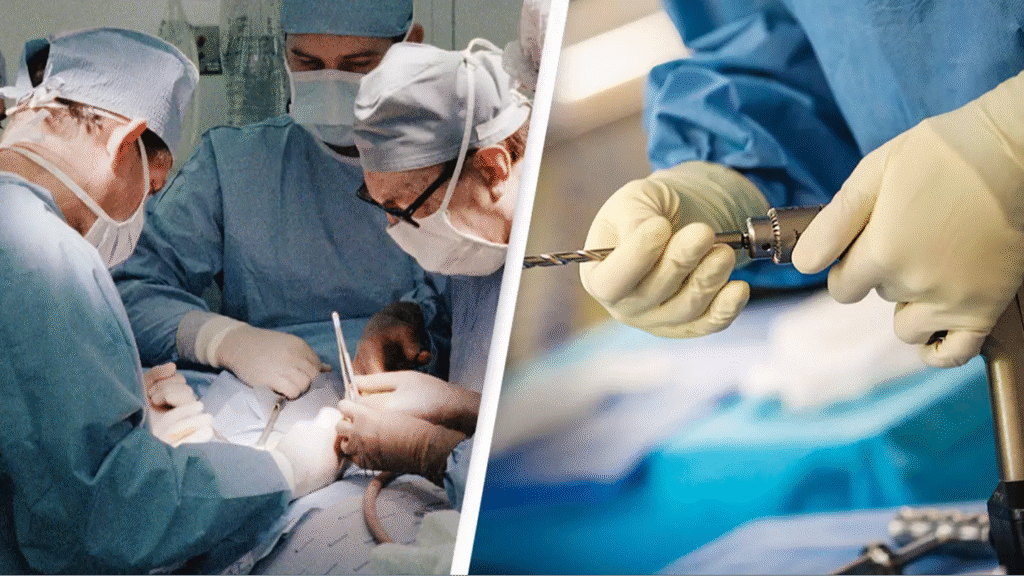
However, the prosecution’s case was bolstered by the testimony of a junior colleague present during the operation. The junior doctor stated that while he had been in control of the drill, the 12-year-old “had assisted” him in operating it — though he maintained that he was holding and guiding the instrument the entire time. His statement lent partial credibility to both sides: it supported the defense’s argument that the girl did not independently perform the drilling, but also reinforced the prosecution’s claim that she was actively involved in the process.
Medical experts who later reviewed the case described the scenario as “unthinkable,” stressing that even minimal participation of a non-medical individual, let alone a child, during surgery constitutes a gross violation of patient safety standards. Under Austrian medical law, operating theatres are considered restricted zones, and only licensed personnel with a direct role in the procedure may participate or even remain in the room during an active operation.
Ethical and Professional Repercussions in the Medical Community
The case has ignited a nationwide debate over ethics, supervision, and the boundaries of clinical discretion in hospital settings. For many in the medical profession, the very idea that a 12-year-old could have come close to handling a surgical instrument inside an operating theatre has been met with disbelief. The Austrian Medical Chamber has publicly condemned the alleged actions and emphasized the need for strict adherence to surgical protocols, regardless of the personal circumstances of medical staff.
“The operating theatre is not a classroom, and it is certainly not a place for family visits,” said a spokesperson for the Chamber. “Even if no physical harm was done, the principle of medical integrity has been violated. Every patient has the right to expect absolute professionalism and confidentiality from their medical team.”
Ethicists have noted that the case illustrates the fine line between human error and professional misconduct. While the neurosurgeon’s defenders argue that her comment was a misguided attempt at humor, others contend that her decision to bring her daughter into such an environment at all reveals a troubling lapse in judgment. “The presence of a child in a sterile, high-risk medical setting compromises both safety and ethics,” said Professor Johann Leitner, a bioethicist at the University of Vienna. “Even if she did not directly touch the equipment, the symbolic implications are severe. It erodes the fundamental trust that patients place in the medical system.”
The Graz Regional Hospital administration has since tightened its internal policies, reinforcing access controls and reminding staff of their ethical obligations. Officials have confirmed that the neurosurgeon has been suspended pending the outcome of the trial. They also stated that all staff members have undergone additional compliance training to prevent similar breaches in the future.

Beyond Austria, the story has resonated globally, prompting reflection on surgical ethics and the pressures faced by doctors balancing demanding careers with personal lives. Some commentators have suggested that the case, while extreme, highlights a broader cultural issue in the medical profession — the tendency for boundaries to blur under stress, familiarity, and authority. “Surgeons often operate in a world where hierarchy and confidence dominate,” noted Dr. Martina Rupp, a medical sociologist. “Sometimes, that environment allows small lapses to grow into major ethical violations. This case is an uncomfortable reminder of what can happen when professional norms are momentarily forgotten.”
While the outcome of the trial remains uncertain, legal experts predict that even if the neurosurgeon avoids criminal conviction, she is likely to face disciplinary action from medical regulators. A conviction could result in a suspension or permanent revocation of her medical license, as well as potential civil suits from the patient involved.
Public reaction in Austria has been mixed. Some citizens view the case as a tragic example of a mother’s misplaced pride rather than criminal intent, while others see it as an alarming breach of trust deserving of the harshest sanctions. Comment sections in Austrian newspapers have filled with debate, with many readers questioning whether a moment of poor judgment should end an otherwise accomplished career. Others, however, have argued that any professional who risks a patient’s wellbeing — even hypothetically — forfeits the right to continue practicing.
As proceedings continue, the case serves as a stark reminder of the weight of responsibility carried by medical professionals. The courtroom in Graz has become a stage for a broader conversation — not just about what may have happened in one operating theatre, but about the nature of trust, authority, and ethical discipline in medicine. Whether the surgeon’s actions were an ill-advised gesture of maternal pride or a serious violation of professional duty, the repercussions are likely to echo through Austria’s healthcare community for years to come.
Whatever the verdict, the case underscores the delicate balance between human fallibility and professional accountability — a balance that, in the high-stakes world of neurosurgery, leaves no room for error or indulgence.
**mitolyn official**
Mitolyn is a carefully developed, plant-based formula created to help support metabolic efficiency and encourage healthy, lasting weight management.