
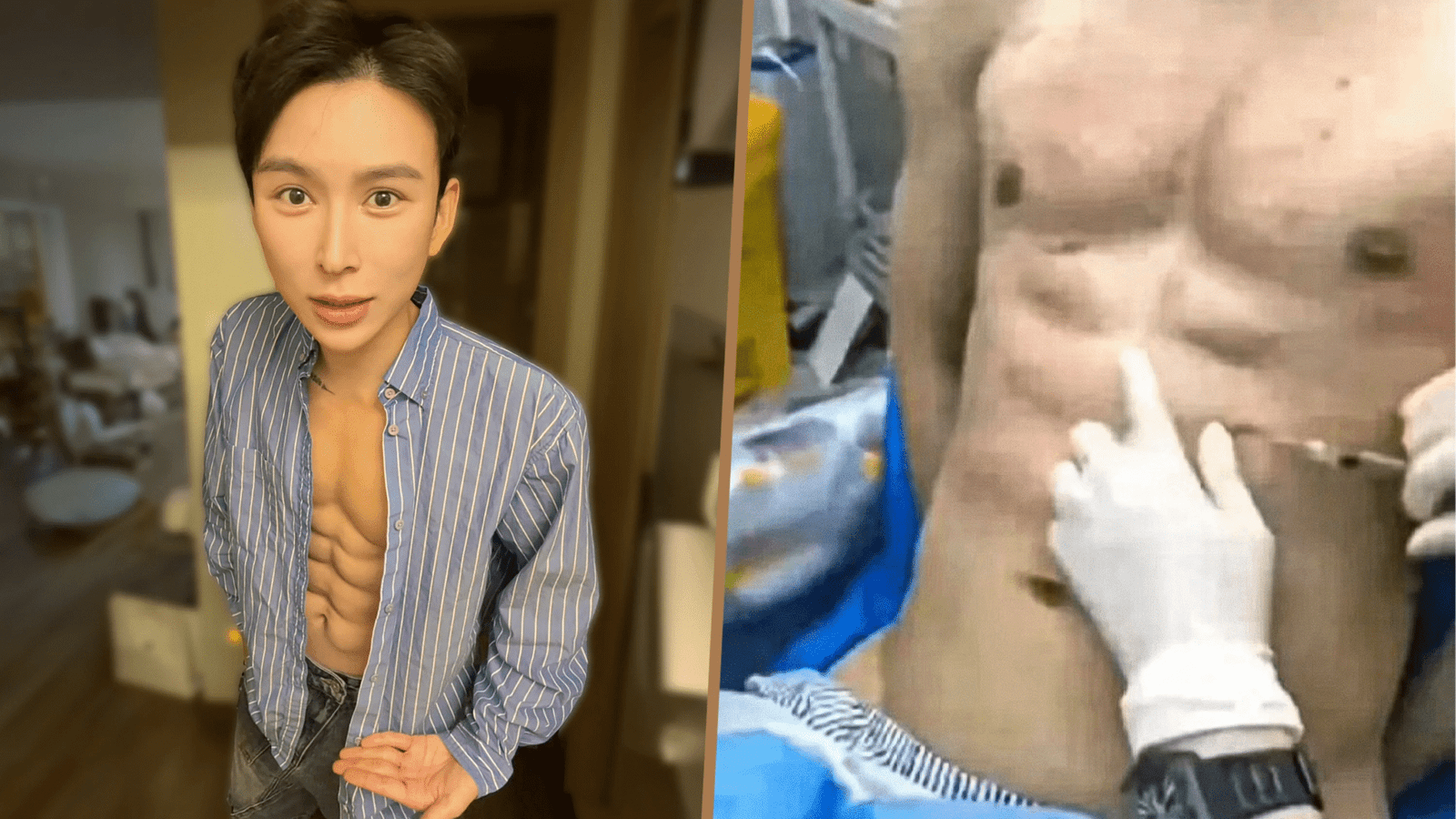
In an extraordinary display of cosmetic ambition and social media-driven aesthetics, Chinese influencer Andy Hao Tienan has ignited widespread discussion across China and beyond by revealing that he spent four million yuan, or approximately US$560,000, to create artificial eight-pack abs using hyaluronic acid injections.
The 30-something content creator from Heilongjiang province, known primarily for his fashion and beauty videos, has described himself as “the first such case in China,” claiming that nearly 20 per cent of his body now consists of hyaluronic acid. His story, complete with bold declarations and a planned Guinness World Record attempt, has sparked fascination, disbelief, and concern among both fans and medical professionals.
A Costly Pursuit of the ‘Perfect’ Physique
Andy Hao Tienan, who has around 100,000 followers on Douyin (China’s version of TikTok), has spent years cultivating an image focused on personal aesthetics and physical refinement. Dissatisfied with his natural build and frustrated by what he described as the inability to achieve an ideal muscular body through exercise, he decided to take a radical step toward constructing a sculpted torso — not through hours at the gym, but through injections.
The influencer claims to have already completed 40 per cent of his ultimate goal: a staggering 10,000 hyaluronic acid injections administered throughout various parts of his body, including his shoulders, collarbones, chest, and abdomen. His abdomen, in particular, has become the centrepiece of his online persona, featuring meticulously sculpted artificial muscles that he proudly shows off in videos and photos.
Andy Hao Tienan’s earlier procedures reportedly involved injecting 40 doses of hyaluronic acid, a naturally occurring substance found in the human body that helps lubricate joints and retain moisture in the skin. While commonly used in cosmetic medicine for facial fillers and skin rejuvenation, its application in muscle contouring—especially at such an extreme scale—is both unconventional and medically questionable.
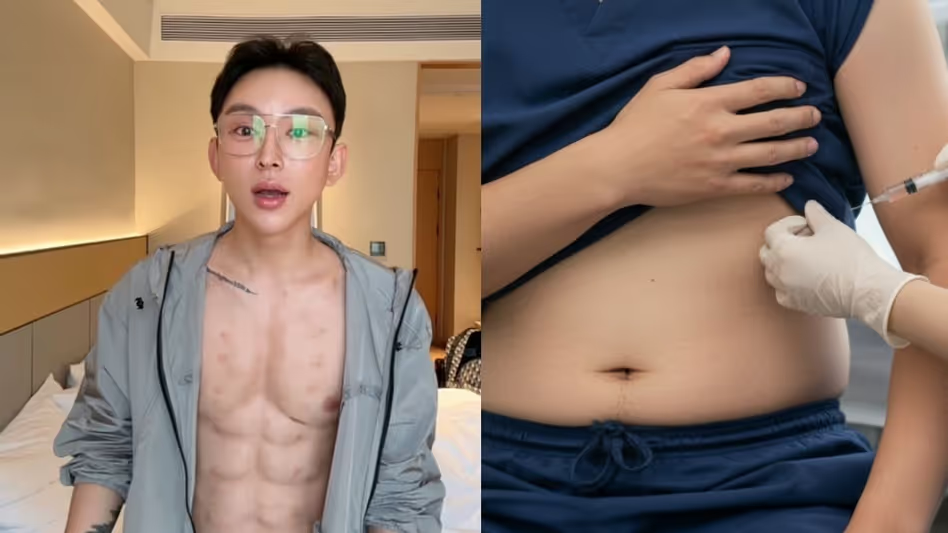
“I totally agree that muscles do not grow on cowards,” Andy Hao Tienan declared in one of his posts, responding to criticism that his transformation was a shortcut. “But you have to understand, I have had so many injections. I am no coward any more. Could you dare to do the same?” His remarks, delivered with characteristic bravado, capture the blend of self-confidence and shock value that has helped fuel his online fame.
He has even promised to take his transformation a step further by applying for a Guinness World Record for the “longest-lasting artificial abs made of hyaluronic acid” — provided that the sculpted muscles remain intact for at least three years. If successful, he says he will mark the occasion by performing a live-stream demonstration of himself “cracking walnuts” on his abs.
Reactions and Online Debate
News of Andy Hao Tienan’s injections has triggered a wave of reactions across Chinese social media platforms. Many users expressed astonishment at the sheer amount of money he spent, while others were critical or amused by the idea of creating muscles through artificial means. “Oh my god, is this really how rich people spend their money?” one user wrote. “Four million could buy me a lifetime supply of protein powder to build my muscle.” Another commented humorously, “You would need to walk around shirtless every day to show it off, or the four million would be wasted.”
While many saw Hao’s transformation as a bizarre extension of influencer culture—where shock value and physical perfection often translate into online engagement—others raised serious concerns about the physical risks associated with such procedures. Even as Andy Hao Tienan has showcased his apparent satisfaction with the results, medical professionals and plastic surgeons have warned that the practice could have dangerous long-term effects.
Read : Chinese Woman Throws Coffee at ZUS Employee Over Slow Service in Malaysia
In a video posted in late October, nearly five months after his initial injections, Andy Hao Tienan reiterated his happiness with the outcome, saying that his abs remained well-defined and natural-looking. “You never get any muscle swelling—it’s just how I like it,” he said. “A lot of people say the hyaluronic acid will dissolve in a few months, and doctors say it might shift or clump together. But it actually looks more natural and better over time. Even the lines between the abs are still distinct, and they have not merged into a single lump.”
Read : Unveiling the Mystery of Ghost Marriage in Chinese Culture
Such confidence has only added to the intrigue surrounding Hao’s body modification journey. Yet his claims contradict much of what is known about how fillers behave in the human body, particularly when injected in such large quantities. The majority of hyaluronic acid fillers are temporary, gradually dissolving over several months as the body naturally breaks down the substance. Moreover, the possibility of migration, clumping, or uneven distribution poses ongoing risks, especially in areas subjected to regular movement and pressure, such as the abdomen.
Expert Warnings and Health Risks
Medical professionals have been quick to caution against following in Hao’s footsteps. Among the most prominent voices is Dr. Li Jialun, an attending doctor in the Department of Plastic Surgery at Union Hospital, Tongji Medical College, Huazhong University of Science and Technology, in Wuhan. Li, who has more than 1.7 million followers online, has used his platform to explain why such an extensive injection regime could be medically dangerous.
According to Dr. Li, injecting large volumes of hyaluronic acid into the skin can have severe consequences. “Injecting 40 doses of hyaluronic acid could very likely crush the skin, potentially causing necrosis of blood vessels,” he warned. Skin necrosis occurs when tissue dies due to a lack of blood flow, which can result from vascular compression or blockage—a known risk in filler procedures, even when performed in smaller amounts by trained professionals.
Li further pointed out that while the artificial muscles might appear realistic when static, they would inevitably look distorted during movement because true muscles are dynamic and contract in ways that fillers cannot replicate. “While the muscles may appear realistic in a static state, the dynamic appearance will definitely be distorted because all muscles are dynamic units,” he said. This means that while Hao’s abs may look defined in photos or videos, the illusion could break down in real life during normal physical activity.
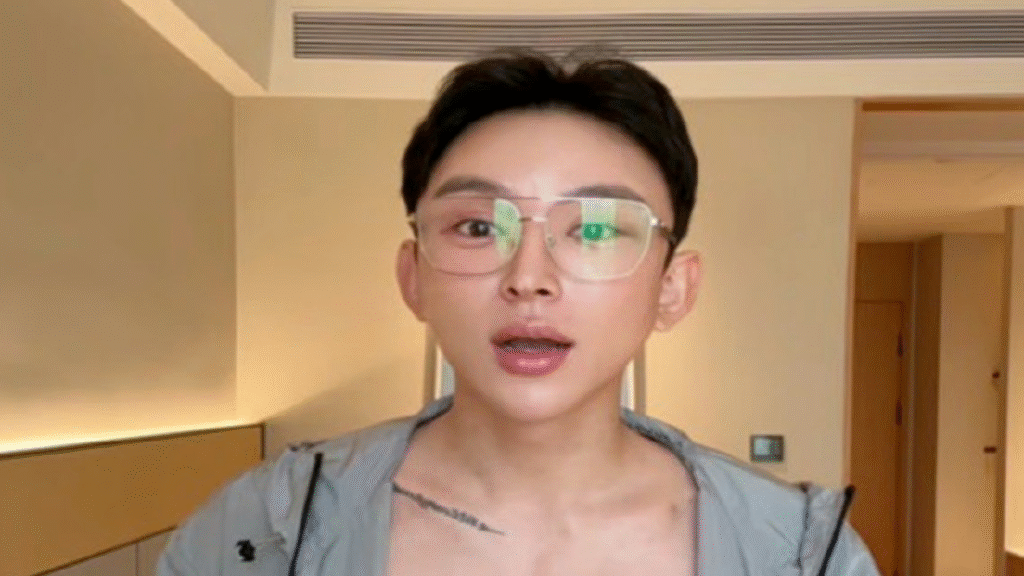
The doctor also raised concerns that long-term filler use could negatively impact Hao’s natural musculature. “After the injection, your natural muscles may actually decrease because hyaluronic acid and fillers can erode bone and exert pressure on the muscles, making them thinner,” Li explained. Once the fillers dissolve, the underlying tissue may appear weaker or misshapen, leading to an overall deterioration of the natural body structure.
Furthermore, filler displacement—a phenomenon where the substance shifts from its original position over time—is a likely side effect, which could cause visible deformities or unevenness in the body. Despite these warnings, Hao remains undeterred. He insists that his artificial abs continue to look natural and even improve with time. His unwavering confidence, combined with his willingness to take extreme measures in pursuit of a certain aesthetic, highlights the growing tension between medical caution and social media-fueled self-expression in modern beauty culture.
The Culture of Extreme Body Modification
Hao’s case reflects broader trends emerging in East Asia’s beauty and influencer industries, where cosmetic enhancement has become increasingly normalized, and even celebrated, as a form of self-expression and status. South Korea, Japan, and China have all seen a boom in aesthetic procedures over the past decade, driven by advances in cosmetic medicine, growing wealth, and the rise of influencer culture.
However, Hao’s approach represents an extreme outlier—a fusion of vanity, performance art, and technological experimentation that pushes the boundaries of what cosmetic medicine is meant to achieve. Social media has amplified these tendencies by rewarding visual transformation and spectacle. In an environment where likes, shares, and comments are the currency of attention, physical perfection—whether natural or constructed—becomes a competitive advantage.
Read : Chinese Student Suffers Mental Breakdown After Watching Horror Film at School
For influencers like Hao, radical body modification is not merely about personal satisfaction; it is a form of content creation that draws views, debate, and notoriety. His declaration that he will “crack walnuts” on his abs during a live broadcast if they remain intact after three years is emblematic of this performative aspect, turning his body into both a canvas and a stage.
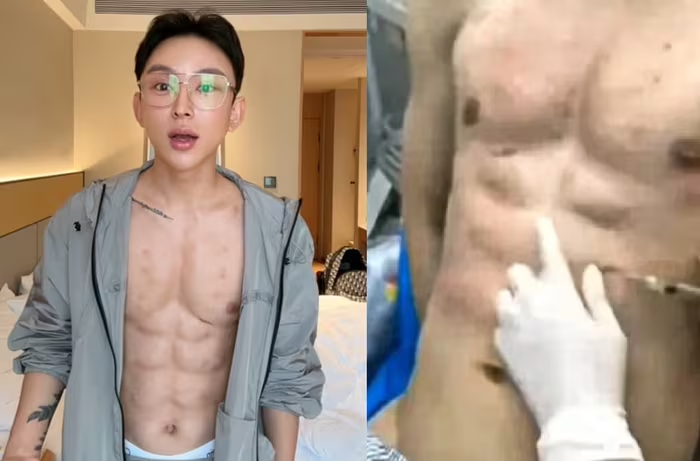
Psychologists and sociologists studying influencer culture argue that this pursuit of aesthetic extremes is partly rooted in the pressures of digital validation. In a media ecosystem saturated with idealized bodies, the incentive to stand out can drive individuals toward increasingly risky or unconventional methods. Hao’s decision to spend the equivalent of more than half a million dollars on artificial abs reflects not only personal ambition but also a wider cultural obsession with appearance, amplified by the reach and immediacy of social media platforms.
From a medical ethics perspective, Hao’s case also raises questions about the responsibilities of practitioners who perform such procedures. While it remains unclear whether his injections were conducted under professional supervision or as part of an experimental regime, the scale and cost of his transformation suggest significant resources and planning. The absence of detailed medical disclosure has prompted speculation about the safety and legality of the process.
Nonetheless, the fascination surrounding Hao underscores a modern paradox: the same society that celebrates technological progress in beauty and medicine also grapples with the psychological and ethical boundaries of those innovations. His story captures the collision between human creativity, vanity, and risk in an era when personal transformation is both accessible and performative.
As of now, Andy Hao Tienan continues to share updates about his unconventional body modification journey, maintaining a confident and unapologetic stance. Whether his artificial abs will stand the test of time—or serve as a cautionary tale about the dangers of extreme cosmetic enhancement—remains to be seen. What is certain is that his experiment has sparked a conversation far larger than his own reflection in the mirror, one that challenges both medical science and cultural notions of beauty in the digital age.
Đặc biệt hơn, nhà cái 188v còn hợp tác với 24+ NPH Slots khác nhau như: TTG, NETENT, 93 CN, FastSpin, BOLE,… Bạn có thể thử sức với hơn 2.300+ trò chơi quay hũ siêu hot được phát hành mỗi ngày. Tối đa 50 dòng thanh toán có thể giúp bạn hốt về bộn tiền từ game slots. TONY12-26
**mitolyn**
Mitolyn is a carefully developed, plant-based formula created to help support metabolic efficiency and encourage healthy, lasting weight management.