
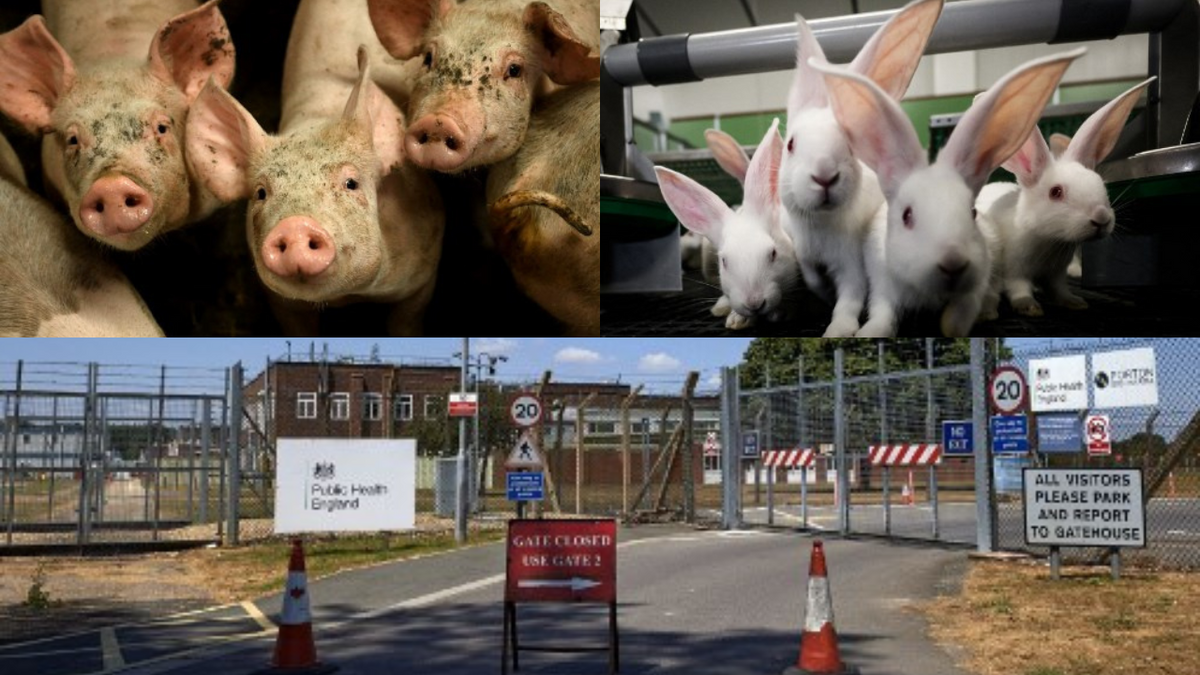
The secretive Porton Down laboratory in Wiltshire, England, has come under scrutiny after revelations about its animal testing practices. Reports indicate that thousands of animals have been subjected to experiments involving poison, deadly nerve agents, and even explosive devices in the last three years.
These experiments, conducted as part of chemical and biological weapons research, have sparked outrage among animal rights activists and raised questions about ethical standards in military research.
A Controversial Legacy of Animal Testing
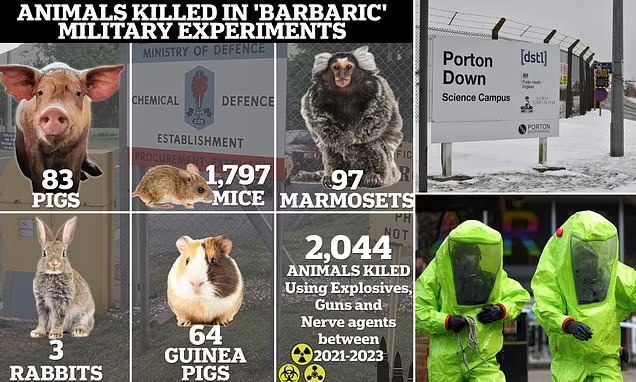
Porton Down, a secluded and highly classified military research facility, has long been associated with studying chemical and biological threats. Between 2021 and 2023, over 2,000 animals, including pigs, rabbits, monkeys, guinea pigs, and mice, were used in experiments aimed at understanding the effects of various weapons and diseases.
Data obtained through a Freedom of Information request revealed that 2,044 animals were killed during this period, often under conditions described as barbaric by critics.
The experiments included shooting live pigs, exposing monkeys to anthrax, and forcing guinea pigs to inhale deadly nerve agents. One particularly contentious test involved dressing pigs in body armor and detonating explosives to evaluate the effectiveness of protective gear.
Read : Chinese Scientists Create Mutant Ebola Virus in the Lab That Causes Horrible Symptoms
The Ministry of Defence (MoD) has defended these practices, arguing that such research is crucial for developing life-saving measures to protect soldiers and civilians from potential threats.
Read : NASA Scientist Re-Creates Martian Spiders’ in the Lab for the First Time
Animal rights groups, however, have condemned the experiments as outdated and unnecessary. Dr. Julia Baines from PETA has called the tests “cruel” and labeled the MoD’s justification as reprehensible. Campaigners argue that modern alternatives, such as computer simulations and synthetic tissues, could replace the need for live animal testing.
The Role of Porton Down Laboratory in Chemical and Biological Research
Porton Down is one of the most secretive and controversial research facilities in the world. Established during World War I, it has been at the forefront of developing defenses against chemical and biological warfare.
The laboratory houses some of the deadliest pathogens known to science, including anthrax, Ebola, and the plague, and its research has played a pivotal role in understanding these threats.
While the MoD maintains that animal testing at Porton Down is conducted under strict ethical guidelines, the secrecy surrounding the facility has fueled concerns about transparency and accountability.
The use of animals in experiments involving mustard gas, nerve agents, and other lethal substances highlights the moral dilemmas inherent in such research.
The recent increase in the number of animals used—rising from 605 in 2021 to 644 in 2023, with a peak of 795 in 2022—has further intensified the debate.
Critics question whether the escalation in testing correlates with global tensions, such as Russia’s invasion of Ukraine, and whether alternative methods could achieve the same outcomes without causing harm to animals.
Ethical Concerns and the Call for Change
The revelations about Porton Down’s animal testing practices have reignited discussions about the ethics of using live animals in scientific research. Animal rights organizations argue that these experiments are not only inhumane but also scientifically flawed, as results obtained from animal models may not always accurately translate to human applications.

Dr. Julia Baines has been particularly vocal, condemning the injection of deadly viruses into the brains of monkeys and the exposure of other animals to nerve agents. PETA and other advocacy groups have called on the MoD to adopt modern, non-animal research methods that are both ethical and effective.
Despite these criticisms, the MoD has remained steadfast in its defense, citing the ongoing threats posed by chemical and biological weapons and battlefield injuries.
In a statement, the ministry emphasized the necessity of these experiments for ensuring the safety and preparedness of British troops. However, it refused to provide detailed information about the deaths of the animals involved, citing national security concerns.
The public reaction to these revelations has been polarized. While some view the research as a necessary evil in the face of potential threats, others see it as a stark reminder of the need to prioritize ethical considerations in scientific and military endeavors.