
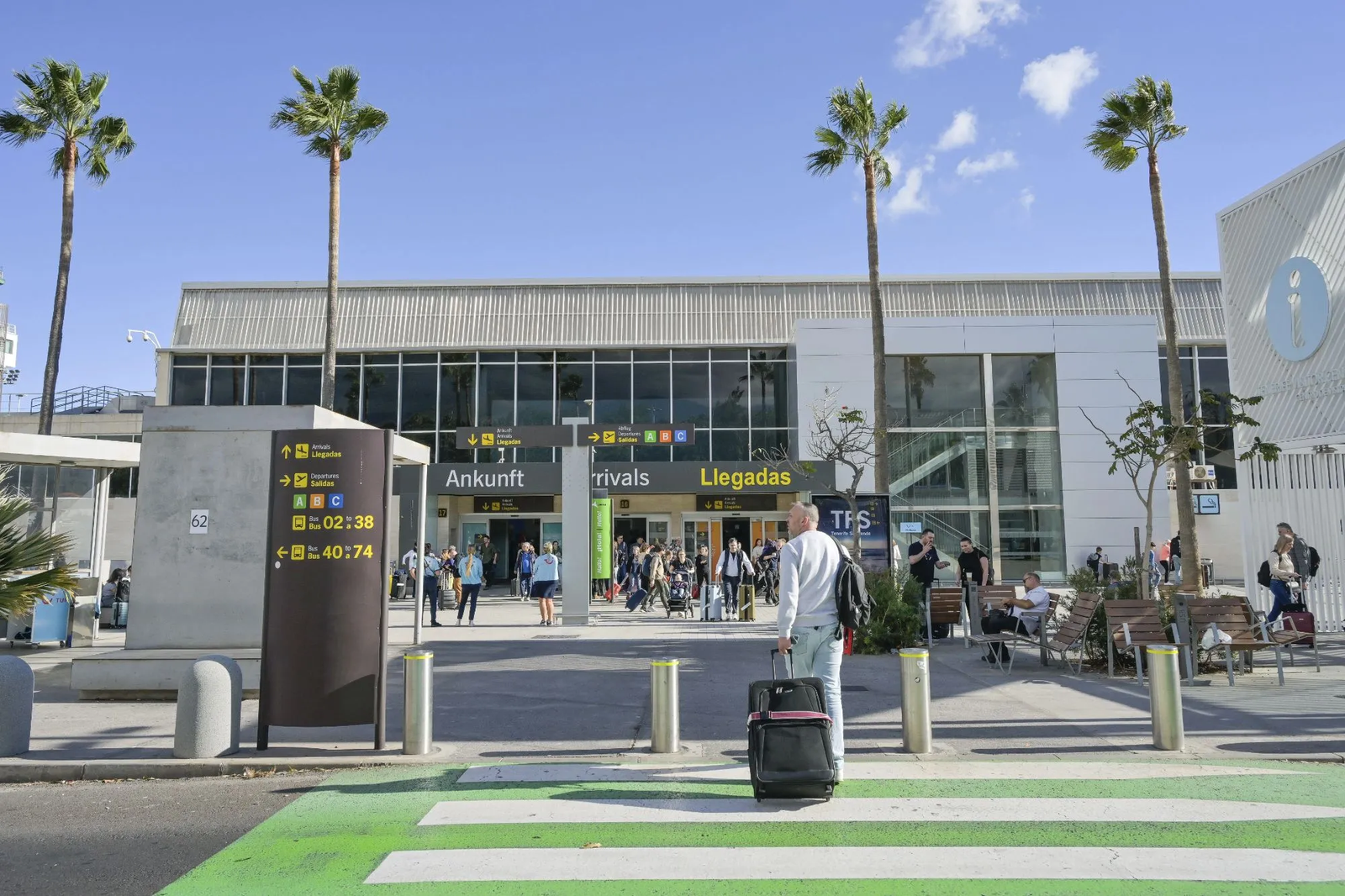
An extraordinary and disturbing incident at Tenerife South Airport has drawn international attention after an elderly man was arrested while attempting to board a flight with the body of his deceased wife seated in a wheelchair. The episode unfolded during routine security procedures and quickly escalated into a major police investigation, prompting questions about airport safety protocols, passenger screening, and the responsibilities of travellers in medical emergencies. Authorities in Spain are now examining the circumstances surrounding the woman’s death and the actions taken by her husband in the hours that followed.
The incident occurred on Tuesday at one of Spain’s busiest tourist airports, a major hub for international travel between the Canary Islands and mainland Europe. According to reports cited by The Metro and Spanish media outlets, the man, aged 80, arrived at the airport pushing his wife in a wheelchair and proceeded through parts of the terminal as if preparing to board a flight. It was only when airport staff noticed irregularities that the alarming reality came to light.
Discovery During Security Checks and Immediate Emergency Response
Airport security personnel first became suspicious during standard screening checks when they observed that the woman in the wheelchair appeared completely unresponsive. Staff noted her lack of movement and an unusual pallor, prompting closer inspection. When a security guard attempted to interact with her, including taking her hand, it became apparent that her body temperature was abnormally low and that she was not breathing.
An airport employee later described the moment to Spanish newspaper Diario de Avisos, explaining that the guard immediately sensed something was wrong and alerted a supervisor. Within minutes, emergency protocols were activated, triggering a coordinated response involving airport security agents, the Guardia Civil, medical responders, and forensic teams. The area was secured as investigators began assessing the situation.
Medical personnel confirmed that the woman had been dead for several hours. Officials did not immediately release her age publicly, but reports identified her as the wife of the detained man. Forensic teams were brought in to conduct an initial examination at the scene, while the terminal experienced temporary disruption as authorities worked to determine whether there was any immediate threat to public safety.
Read : Colombian Singer Yeison Jimenez Dies In Plane Crash Hours Before Concert
The discovery caused shock among airport staff and passengers alike. Tenerife South Airport handles millions of travellers each year, and while medical emergencies are not uncommon, the presence of a deceased passenger being unknowingly transported through the terminal was unprecedented for many employees. The incident was quickly reported to higher authorities, and police began questioning the man about the events leading up to the discovery.
Read : Botswana’s Natural Wonders: Top Ten Selfie Spots to Capture Safari Adventures
According to officials, the man claimed that his wife had died at the airport itself and suggested that the airport’s facilities or response were somehow responsible for her death. These claims, however, have not been substantiated, and investigators are treating them cautiously. Authorities noted inconsistencies in his account, which contributed to the decision to place him under arrest pending further inquiry.
Arrest, Investigation, and Possible Criminal Liability
Following preliminary questioning at the airport, the Guardia Civil arrested the man on suspicion of possible criminal conduct. While no formal charges have yet been publicly detailed, police confirmed that a full investigation is underway to establish the cause and time of death, as well as the man’s actions before and after his wife passed away.
Investigators are examining whether there was any delay in seeking medical assistance, whether the woman died of natural causes, and whether any form of negligence or concealment occurred. Spanish law requires individuals to report deaths promptly, particularly in public places, and transporting a deceased person without notifying authorities can carry legal consequences depending on the circumstances.
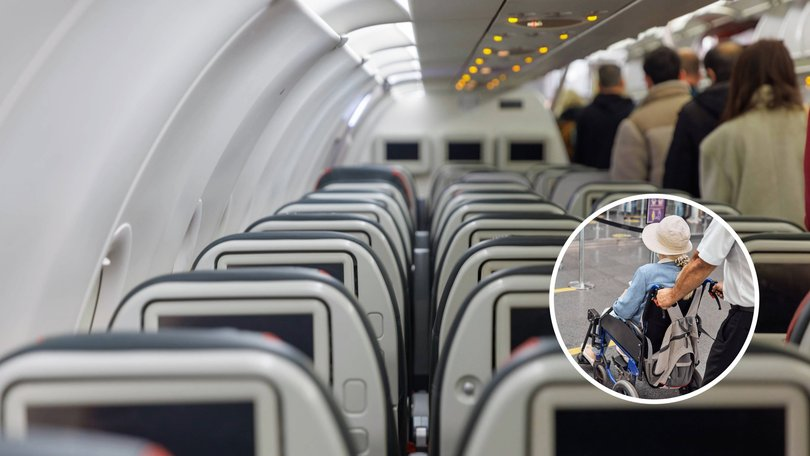
Forensic analysis will play a central role in determining the next steps in the case. An autopsy is expected to clarify whether the woman died from natural causes or if there were contributing factors that warrant criminal charges. Police are also reviewing CCTV footage from the airport to trace the couple’s movements and to establish a clear timeline of events from their arrival at the terminal to the moment security intervened.
Authorities have emphasized that the arrest does not automatically imply guilt, noting that investigations of this nature are complex, particularly when involving elderly individuals and potential medical issues. Nevertheless, the unusual nature of the case has placed it under intense public scrutiny, both in Spain and internationally.
Legal experts in Spain have noted that cases involving the transport of deceased individuals in public settings are rare but not entirely without precedent. Depending on the findings, potential charges could range from failure to report a death to more serious offences if evidence suggests intentional wrongdoing. At the same time, investigators are also considering the possibility that confusion, distress, or impaired judgment may have influenced the man’s actions.
Broader Context, Public Reaction, and Comparisons to Similar Cases
The Tenerife incident has sparked widespread discussion about airport screening procedures and how such a situation could progress as far as it did before being detected. Aviation security protocols are primarily designed to identify safety threats, prohibited items, and documentation issues, rather than medical conditions. As a result, responsibility often falls on airline staff and passengers to alert authorities when someone becomes seriously ill or dies within airport premises.
Public reaction has ranged from disbelief to concern, with many questioning how an individual could attempt to board a flight with a deceased person without seeking immediate help. Others have expressed sympathy for the elderly man, suggesting that shock or denial may have played a role. Authorities, however, have refrained from speculating publicly, stressing that conclusions will be based solely on verified evidence.

The case has also drawn comparisons to other incidents involving deceased passengers and air travel. In late 2025, reports emerged of a British family allegedly attempting to board a flight with a deceased relative in a wheelchair. That case generated significant media attention, although airline officials later disputed key details and stated that the individual had not been boarded in the manner initially described.
More recently, another high-profile incident involved an 89-year-old British woman who died aboard an easyJet flight. Initial reports suggested she may have already been deceased before boarding, but a fellow passenger later stated that she was alive at takeoff and became unresponsive during the flight. That account contradicted earlier claims and highlighted how quickly misinformation can spread in the absence of confirmed facts.
These cases collectively underscore the challenges airlines and airports face when dealing with medical emergencies involving elderly or vulnerable passengers. While airlines have protocols for in-flight medical incidents, situations occurring in terminals can fall into a grey area where responsibility is shared between airport authorities, airline staff, and emergency services.
In the Tenerife case, airport officials have defended their response, noting that emergency protocols were activated as soon as staff became aware of the situation. They emphasized that the woman’s condition was not immediately obvious from a distance and that staff acted promptly once physical checks revealed signs of death.
As the investigation continues, authorities are expected to release further information once forensic results are available. Until then, the case remains an unusual and unsettling reminder of the complexities surrounding death, travel, and legal responsibility in public spaces. The outcome may also prompt renewed discussion within the aviation industry about how to better identify and respond to medical emergencies before they escalate into situations of this nature.
**mitolyn**
Mitolyn is a carefully developed, plant-based formula created to help support metabolic efficiency and encourage healthy, lasting weight management.