

On a quiet Sunday morning, tragedy descended upon the Sunset Park neighborhood of Brooklyn, New York. The day began like any other, but by 7 AM, chaos had erupted at 3902 9th Avenue, where a fire had broken out in a residential apartment building.
Among those caught in the blaze was Ashiq Hussein, a 53-year-old Pakistani immigrant who had made a life for himself in the city, working hard to support his family back home. What followed was a heartbreaking incident that has left the community reeling and raised serious questions about emergency response protocols.
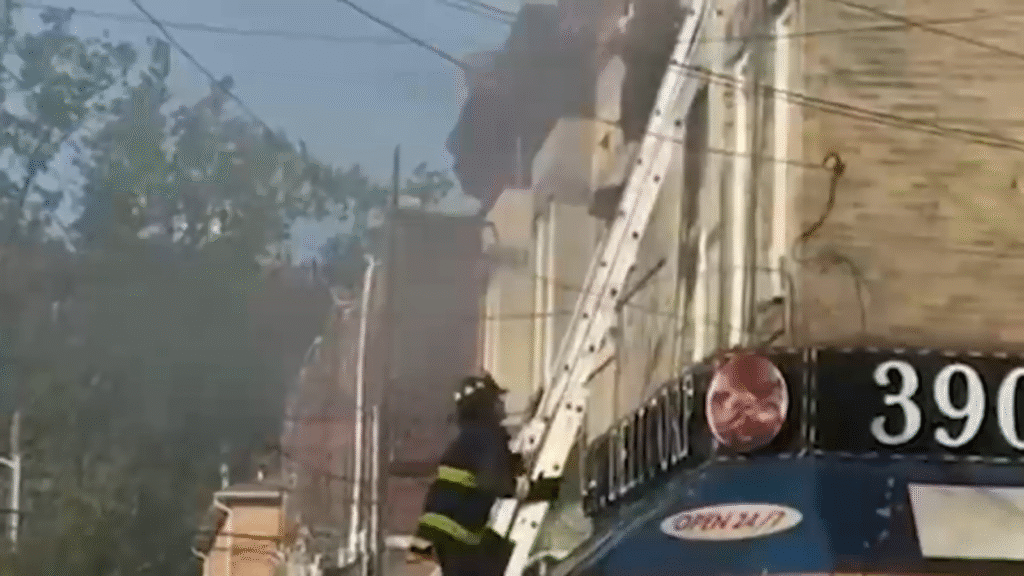
The fire spread rapidly through the second floor of the building. As thick black smoke billowed from the windows and frightened residents scrambled to find an exit, Hussein found himself trapped. Firefighters from the FDNY arrived promptly and began rescue operations, extending ladders and guiding residents to safety.
Hussein attempted to descend a ladder set up by the fire crew from a higher floor, but in a cruel twist of fate, the ladder malfunctioned. Just as he stepped onto it, the top section retracted, causing him to fall from a significant height.
The Fall and Its Aftermath
Eyewitnesses and video footage reveal the horrifying moments as Hussein lost his balance and plummeted. First, he hit a store awning below the apartment building, which may have softened the blow slightly, but he continued to fall further, ultimately landing on the hard sidewalk.
Emergency services rushed him to Maimonides Medical Center in Brooklyn, but the injuries were too severe. Doctors later confirmed that he had sustained fatal trauma to his head and chest. The city medical examiner ruled his cause of death as a result of the fall.
The news of Hussein’s death sent shockwaves through the local community, particularly among Brooklyn’s Pakistani immigrant population. Ashiq Hussein was known as a hardworking, humble man who drove a taxi to make ends meet. He had immigrated to the United States in hopes of building a better future not only for himself but for his family.
Read : Massive Fire Erupts at the Nottoway Resort Plantation in White Castle
According to friends, Hussein had been waiting for the day when his wife, three daughters, and a son could join him in New York. His dreams, however, were cut short in a matter of seconds on that tragic morning.
HORROR IN NYC: FDNY probes fatal ladder failure in Brooklyn fire rescue. Ashiq Hussain (53) Pakistani immigrant, fell from a 2nd floor window while escaping a fire on Monday. The ladder collapsed, causing Hussain to strike his head on the pavement. He later died at the hospital. pic.twitter.com/DhaxYgZHch
— Breaking911 (@Breaking911) May 22, 2025
One friend shared with the media that Hussein was deeply devoted to his family. He didn’t just want to provide for them financially; he wanted to give them a life of dignity and opportunity.
“He just wanted them to be successful and be able to contribute toward not just their own family but also toward humanity in some way,” the friend said. “He was an awesome dad. It’s a loss that I don’t think anyone is going to get over any time soon.”
FDNY and Community Response
The FDNY issued a statement shortly after the incident, acknowledging the death and confirming that an investigation was underway. “We are aware of an incident that took place at an all-hands fire in Brooklyn earlier this week. As is standard practice, we began a proactive investigation of the facts and circumstances surrounding the tragic death of a civilian immediately,” said the department.
The investigation involves Fire Marshals, Fire Operations, and the Division of Safety. This tragic case raises numerous questions about the safety and reliability of fire escape procedures.

How and why did the ladder retract? Was it a mechanical fault, or was it not properly secured? These are the questions that the FDNY is now trying to answer. While firefighting is inherently dangerous and complex, incidents like these spotlight the need for stringent safety protocols, especially when civilians are attempting to use emergency equipment under extreme stress.
Two other people were injured in the fire, and one firefighter suffered a leg injury during the rescue operation. The firefighter is reported to be in stable condition. The cause of the fire remains under investigation. Preliminary reports do not yet indicate whether faulty wiring, negligence, or some other cause led to the outbreak of the blaze, but it is clear that the building’s residents were caught off guard by the sudden eruption of fire.
The Pakistani community in New York and beyond has expressed profound grief over Hussein’s death. Candlelight vigils and prayer services are being organized in local mosques to honor his memory. Community leaders are also calling on local officials to ensure thorough investigations and to hold accountable any parties whose negligence may have contributed to the tragedy.
The Life and Legacy of Ashiq Hussein
Ashiq Hussein’s story is not uncommon among immigrant workers in the United States. Like many others, he came to the country seeking a better life for his loved ones. He took on demanding work, often for long hours and low pay, without complaint. He lived modestly and sent whatever he could to support his family in Pakistan. For Hussein, America represented not just a land of opportunity but a beacon of hope for the future of his children.
It is especially heartbreaking to consider that Hussein died alone, just months or perhaps weeks before he could have reunited with his family. He had waited patiently, followed the process, and fulfilled his responsibilities. Yet, a malfunctioning ladder, a desperate escape, and a misstep during an emergency took it all away.
His friend’s words linger in the minds of many: “He was an awesome dad.” In those words, one sees the true nature of Hussein — a man whose priority was always his family, whose ambition was to give his children a life full of possibilities.
That dream will now have to be carried forward by those who survive him. His children, once they arrive in the United States, will inherit not just the financial remnants of his life, but also the resilience, love, and sacrifice that defined their father’s journey.
In the larger narrative of immigration, labor, and survival in New York City, Ashiq Hussein’s death is a painful reminder of the vulnerabilities that immigrants face. It is a call to action for better safety measures, more humane policies, and a deeper appreciation of the people who keep the city running — often silently, often in the background, and often without recognition.
As the investigation continues, it is hoped that answers will emerge, and lessons will be learned to prevent such tragedies in the future. But for now, a family grieves across the oceans, a community mourns the loss of one of its own, and a city reflects on the high cost of an avoidable accident.
Ashiq Hussein’s life and death should not be forgotten. His story is one of hope, struggle, and ultimately, a deep and tragic loss. And for those who knew him and those who now know of him, his legacy is a poignant chapter in the ongoing story of immigrants striving to make a better world.