
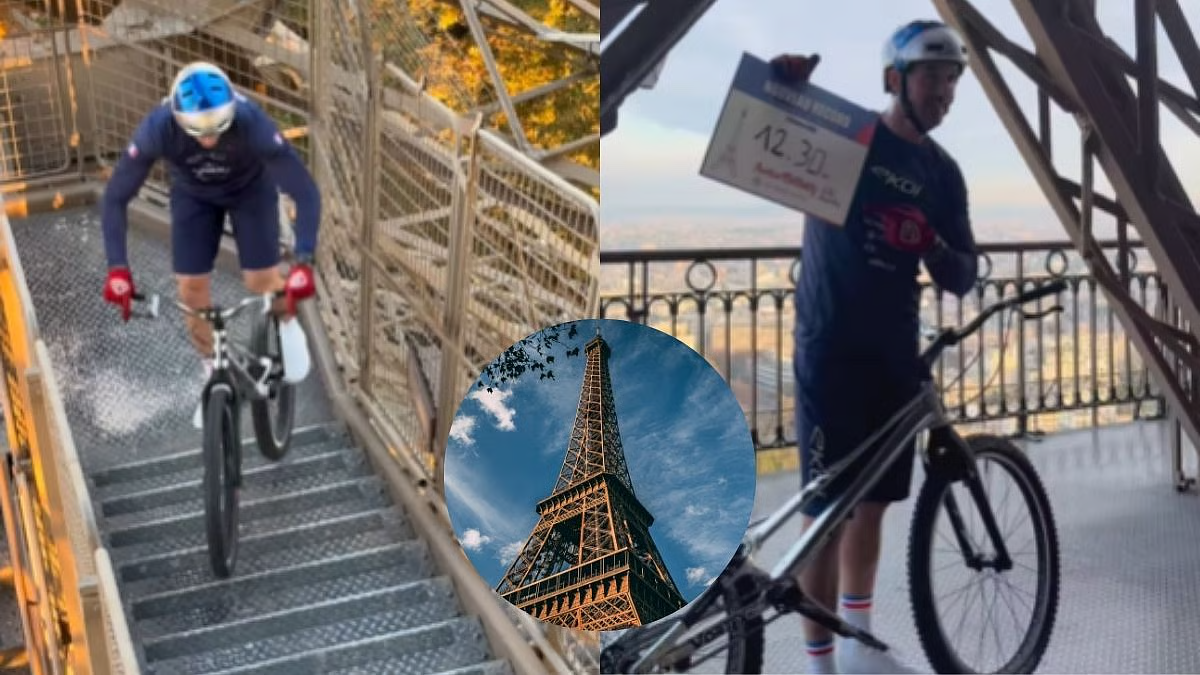
PARIS – In a display of extraordinary athleticism and endurance, French cyclist Aurélien Fontenoy has shattered the world record for the fastest ascent of the Eiffel Tower’s stairs on an all-terrain bike. The 34-year-old professional mountain biker completed the grueling 686-step climb to the second-floor platform in just 12 minutes and 30 seconds on October 2, 2025, eclipsing the previous mark by nearly seven minutes. The achievement, confirmed by the Société d’Exploitation de la Tour Eiffel (SETE), the monument’s official operator, marks a pinnacle in Fontenoy’s ongoing “The Climb” project, which challenges athletes to conquer iconic vertical landmarks using unconventional means.
Fontenoy’s feat took place under strict rules to ensure legitimacy: his feet were not permitted to touch the ground at any point, forcing him to rely entirely on pedaling power and precise bike handling to navigate the narrow, winding staircases. The second floor, at approximately 115 meters above ground, represents the highest point accessible by stairs, as elevators serve the summit. This record-breaking attempt comes at a time when the Eiffel Tower, freshly repainted in time for the 2024 Paris Olympics, continues to draw global attention as a symbol of French ingenuity and resilience.
The event underscores a growing trend in extreme sports, where athletes push the boundaries of human performance in urban environments. Fontenoy, known for his viral social media presence with millions of followers across platforms like TikTok and Instagram, turned the climb into a live spectacle that captivated online audiences. His success not only highlights personal triumph but also spotlights the Eiffel Tower’s role as a venue for innovative athletic challenges, following years of logistical hurdles including COVID-19 disruptions and ongoing renovations.
Record-Breaking Ascent: Details of the Eiffel Tower Challenge
The climb demanded a unique combination of strength, balance, and strategy from Fontenoy. The Eiffel Tower’s South Pillar staircase, used for the attempt, features 686 concrete steps spiraling upward through the iron lattice structure designed by Gustave Eiffel in 1889. Each step required Fontenoy to “bunny hop” his 12-kilogram all-terrain mountain bike, a technique involving explosive lifts to clear obstacles while maintaining forward momentum. The path’s tight turns, varying step heights, and occasional landings posed constant risks of slippage or loss of control, making the no-feet-touch rule a critical safeguard against cheating.
Fontenoy started at the base at 10:15 a.m. local time, under clear autumn skies that allowed for optimal visibility. Witnesses, including SETE officials and a small crew of videographers, noted his steady pace from the outset. By the midpoint—around 343 steps—he had maintained an average speed equivalent to climbing at over 55 steps per minute, a pace that would exhaust most elite runners. Fatigue set in during the final third, where the stairs narrow and the air thins slightly due to elevation. “Pulling a bike 686 times starts to get tough after a while,” Fontenoy remarked post-climb, emphasizing the repetitive strain on his legs and core.
Read : Indian Motorcyclist Yogesh Alekar’s Dream Round-the-World Journey Halted After Bike Stolen in UK
The previous record, set in 2019 by an unnamed amateur cyclist, stood at 19 minutes and 18 seconds. Fontenoy’s time represents a 35% improvement, achieved through targeted training that included simulated stair sessions on Paris rooftops and weighted bike carries. Official timing was handled by a certified chronometer from the French Athletics Federation, with video footage reviewed to verify compliance. No injuries were reported, though Fontenoy underwent immediate medical checks, including hydration and muscle recovery assessments.
French cyclist and mountain bike champion Aurelien Fontenoy became the fastest person to ascend the Eiffel Tower on a bicycle, completing the climb to the second-floor platform in 12 minutes and 30 seconds https://t.co/OLNaeX4YsI pic.twitter.com/n8LbKMAgAh
— Reuters (@Reuters) October 3, 2025
This ascent aligns with SETE’s recent push to diversify visitor experiences beyond sightseeing. The tower, which welcomed 6.3 million visitors in 2024, has hosted similar events like speed-running challenges and yoga sessions at altitude. Fontenoy’s record adds to its legacy of innovation, echoing historical feats such as François Lecoq’s 3-minute-59-second stair run in 1986. By integrating modern sports with heritage sites, such events boost ticket sales and social engagement, with Fontenoy’s climb already generating over 5 million views in its first 48 hours online.
Aurélien Fontenoy: From Mountain Trails to Monumental Records
Aurélien Fontenoy, born in 1991 in the French Alps, transitioned from competitive mountain biking to record-breaking urban exploits over the past decade. A former enduro world champion contender, he retired from full-time racing in 2018 to focus on content creation, amassing 4.2 million TikTok followers through high-adrenaline videos of bike tricks and adventure challenges. His signature style—blending technical skill with humor—has made him a go-to influencer for brands like Red Bull and Salomon, sponsoring his “The Climb” initiative.
Fontenoy’s project, launched in 2020, aims to redefine vertical conquest by scaling man-made towers on bikes, promoting accessibility in extreme sports. His breakthrough came on January 17, 2021, when he tackled Paris’s Trinity Tower, a 140-meter skyscraper in the La Défense business district. There, he ascended 768 steps and 33 floors in 18 minutes and 42 seconds, setting an initial benchmark and drawing 10 million views. The effort required special permissions from building owners and highlighted Fontenoy’s negotiation skills, as he secured access amid pandemic restrictions.
This year, Fontenoy expanded internationally by climbing Estonia’s Tallinn TV Tower, a 314-meter structure, in July 2025. The 1,030-foot ascent took 45 minutes, navigating glass-enclosed stairs and high winds, and earned him a Guinness World Record nomination for tallest urban bike climb. Back in Paris, the Eiffel Tower was always the ultimate goal. “I started four years ago at the Tour Trinity and was supposed to go to the Eiffel Tower after,” Fontenoy explained. Delays from COVID-19, the 2024 Olympics security measures, and the tower’s three-year repainting project—completed in March 2025 at a cost of 60 million euros—pushed the date to October.
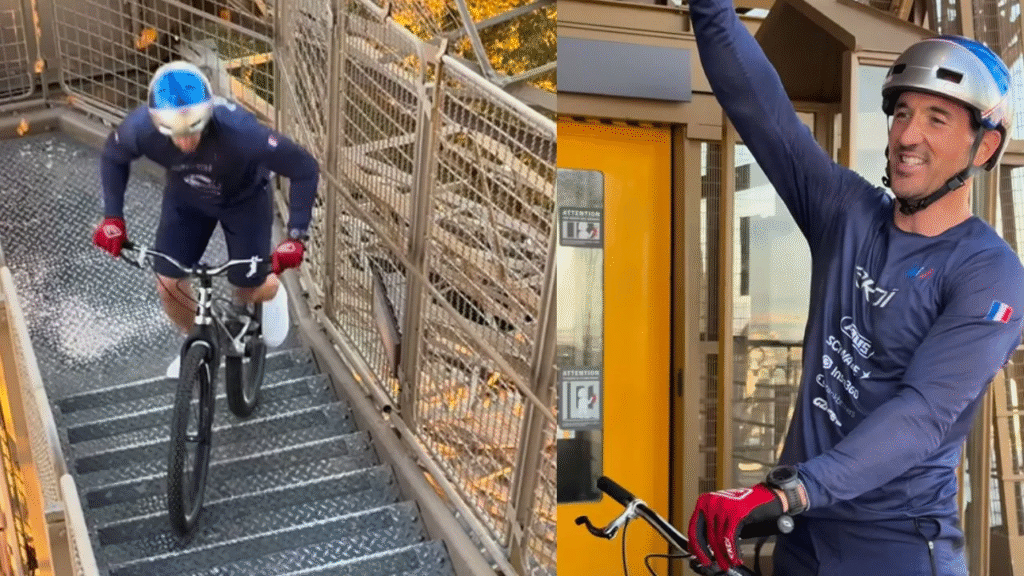
Fontenoy’s training regimen for the Eiffel attempt was meticulous. Over six months, he logged 500 hours on stair simulators, focusing on endurance via interval sessions that mimicked the 140-meter elevation gain. Nutrition played a key role: a high-carb diet with 4,000 calories daily, supplemented by electrolyte gels during the climb. Mentally, he drew from mindfulness techniques learned during his competitive years, visualizing each hop to combat the psychological toll of repetition. At 34, Fontenoy remains at peak fitness, with a VO2 max of 68 ml/kg/min—elite marathoner territory—measured in pre-event tests.
Beyond athletics, Fontenoy advocates for urban cycling infrastructure. His climbs raise awareness for bike-friendly policies in Paris, where Mayor Anne Hidalgo has pledged 100 kilometers of new protected lanes by 2026. Through “The Climb,” he partners with nonprofits to donate bikes to underprivileged youth, having distributed 2,000 units since 2022. This blend of sport, media, and social impact positions Fontenoy as a multifaceted figure in France’s outdoor community.
Broader Impact: Elevating Extreme Sports and Iconic Landmarks
Fontenoy’s Eiffel Tower record reverberates across the extreme sports landscape, inspiring a surge in stair-climbing variants. In the U.S., athletes are eyeing similar feats at the Empire State Building, whose 1,576 steps could host a bike event by 2026. Globally, the International Stair Climbing Association reported a 25% membership increase in 2025, attributing it to viral challenges like Fontenoy’s. His success validates all-terrain bikes as tools for hybrid disciplines, merging MTB agility with urban endurance.
For the Eiffel Tower, the event is a tourism boon. SETE noted a 15% uptick in second-floor ticket bookings post-announcement, as fans seek to experience the “record route.” The climb’s timing aligns with Paris’s post-Olympics recovery, where visitor numbers dipped 10% earlier this year due to construction. Economically, it generates ancillary revenue: Fontenoy’s crew spent 50,000 euros on permits, lodging, and equipment, supporting local vendors.
Safety protocols during the attempt were rigorous, reflecting lessons from past tower incidents. Barriers prevented public interference, and a medical team with defibrillators stood ready. Fontenoy’s no-ground-contact rule, enforced by spotters, sets a precedent for future records, ensuring purity while minimizing injury risks—crucial given the tower’s 1,800 annual stair users.
Looking ahead, Fontenoy eyes the Burj Khalifa in Dubai, whose 2,909 steps would dwarf his current mark. “The Eiffel was the dream; now it’s about going higher,” he said. His project fosters inclusivity, with adaptive versions for wheelchair users planned for 2026. In an era of digital escapism, feats like this ground viewers in real-world wonder, reminding us that even iron giants can be summited on two wheels.
This record cements Fontenoy’s legacy while invigorating the Eiffel Tower’s narrative—from World’s Fair marvel to modern athletic arena. As Paris evolves, so do its challenges, proving that with grit and gears, no height is unconquerable.