

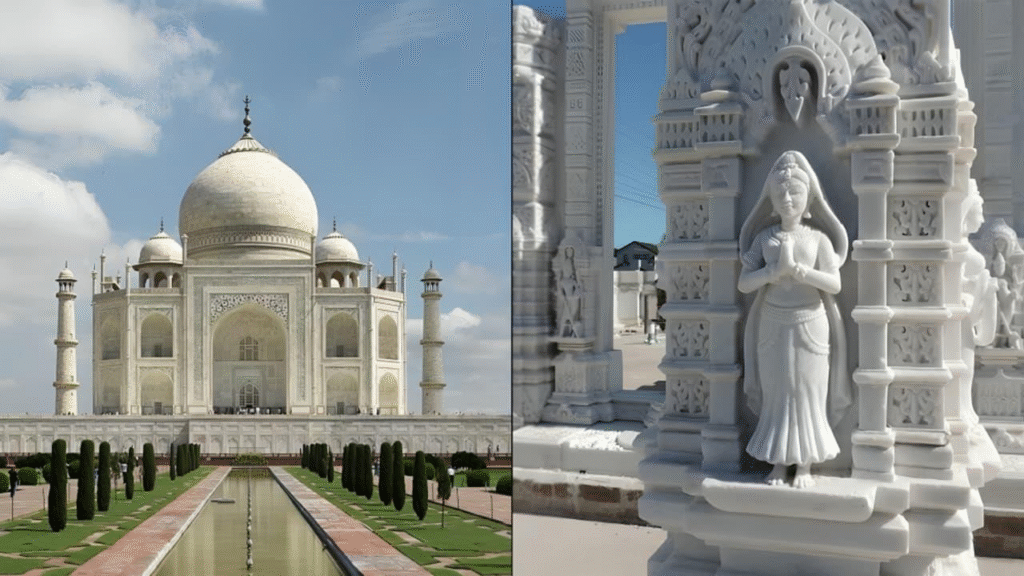
In a remarkable fusion of ancient Indian heritage and modern multicultural ambition, nearly 3,000 tonnes of pristine marble from Rajasthan—the very stone that adorns the iconic Taj Mahal—is set to journey across oceans to Australia. This monumental shipment will form the backbone of two groundbreaking Jain temples in Melbourne and Sydney, fulfilling a cherished dream for the nation’s 6,000-strong Jain community. Announced by the Australian High Commission in India on September 18, 2025, the project symbolizes not just spiritual devotion but also the enduring ties between India and Australia.
As construction ramps up, these temples promise to stand as beacons of faith, non-violence, and cultural preservation in the heart of Down Under. The news, shared enthusiastically by Australian High Commissioner to India Philip Green on social media, highlights the community’s resilience and commitment to their roots. “Rajasthan’s timeless marbles—the same stone that built the Taj Mahal—are heading to Australia. Nearly 3,000 tonnes will soon shape new Jain temples in Melbourne and Sydney, as Australia’s 6,000-strong Jain community builds a legacy of faith and heritage,” Green posted.
This isn’t merely a construction update; it’s a narrative of migration, adaptation, and the quiet power of a minority faith carving out its space in a diverse society. For Jains, who trace their origins to ancient India over 2,500 years ago, these temples represent a physical anchor for principles like ahimsa (non-violence) and aparigraha (non-attachment) in a land far from their ancestral homelands.
Jainism, one of the world’s oldest religions, emphasizes ethical living, spiritual independence, and respect for all life forms. With roots in the Indus Valley civilization, it has flourished through figures like Mahavira, the 24th Tirthankara, whose teachings continue to guide over 4 million Jains globally today. In Australia, the community has grown steadily since the mid-20th century, fueled by immigration waves from India, particularly Gujarat and Maharashtra. According to the latest census data, around 6,000 Jains call Australia home, forming tight-knit groups in major cities like Melbourne and Sydney. These families, often professionals in fields like medicine, engineering, and business, have balanced career pursuits with a deep-seated desire to nurture their faith amid secular surroundings.
Historically, Jains in Australia have relied on makeshift prayer spaces in community halls or homes, a far cry from the ornate marble mandirs of India. The push for dedicated temples began in earnest in the early 2000s, as the diaspora matured and second-generation Jains sought ways to instill cultural identity in their children. Organizations like the Melbourne Shwetambar Jain Sangh (MSJS), founded in 2007, emerged as pivotal forces.
Read : Divine Journeys: Ten Must-Visit Hindu Temples Around the Globe
MSJS, a not-for-profit entity, has organized festivals, educational programs, and youth initiatives to keep the flame of Jainism alive. Their efforts culminated in this ambitious project, blending traditional architecture with contemporary needs. The choice of Rajasthan marble isn’t arbitrary; Makrana white marble, quarried from the arid hills of Nagaur district, is revered for its translucency, durability, and symbolic purity—qualities that echo the ethereal grace of the Taj Mahal, built in the 17th century by Mughal Emperor Shah Jahan.
The Marble Journey: From Rajasthan Quarries to Australian Shores
At the heart of this story lies the marble itself—a material that has whispered tales of empires and devotion for centuries. Sourced from the sun-baked quarries of Makrana in Rajasthan, this stone has been the canvas for some of India’s greatest architectural wonders. The Taj Mahal, a UNESCO World Heritage site and one of the Seven Wonders of the World, was crafted from over 1,000 elephants’ worth of this marble, inlaid with semi-precious gems in intricate pieta dura work. Its ability to glow ethereally at dawn and dusk made it the emperor’s tribute to eternal love, and now, it will lend the same luminescence to structures of spiritual enlightenment halfway around the globe.
The logistics of transporting 3,000 tonnes are nothing short of Herculean. Marble blocks, weighing several tons each, are first extracted using age-old techniques refined over generations—hand-chiseling to minimize waste and preserve the stone’s integrity. In Makrana, over 1,200 quarries dot the landscape, employing thousands of artisans who live in a symbiotic rhythm with the earth. The selected marble for the Australian temples is the premium white variant, prized for its fine grain and near-flawless veining, ensuring it can withstand carving into detailed motifs like lotus blooms, celestial beings, and the symbolic swastika of Jain cosmology.
Read : Shaolin Temple Abbot Shi Yongxin Accused of Improper Relationships with Women
Shipping this volume requires meticulous planning. Loaded onto specialized vessels at ports like Mumbai or Kandla, the cargo will traverse the Indian Ocean, enduring weeks at sea before docking in Melbourne or Sydney harbors. Environmental considerations are paramount; modern freighters use efficient routing to cut emissions, aligning with Jain ethos of minimal harm. Upon arrival, the blocks will be offloaded and transported to construction sites, where expert stonemasons—many flown in from Rajasthan—will sculpt them on-site.

This process isn’t just about material transfer; it’s a cultural bridge, with artisans passing down skills honed in the shadow of forts like those in Jodhpur and Jaipur. The total shipment, valued in the millions, underscores the community’s fundraising prowess, with donations pouring in from Jains worldwide, often tied to vows of generosity during festivals like Paryushan Parv.
For the Melbourne temple, 1,500 tonnes have already arrived, signaling the project’s momentum. The remaining portion will bolster the Sydney endeavor, ensuring both sites reflect authentic Solanki-style architecture—characterized by towering shikharas (spires), pillared halls, and sanctums housing idols of Tirthankaras like Adinath and Parshvanath. This marble’s journey symbolizes the global flow of heritage, where a stone born in the Thar Desert finds new life amid eucalyptus groves and urban skylines.
Building Bridges of Faith: Community and Construction Insights
Construction is well underway in Melbourne, where the MSJS has transformed a modest plot into a hive of activity. Led by president Nitin Doshi, the team has raised millions through grassroots campaigns, corporate sponsorships, and diaspora networks. “This temple isn’t just a building; it’s our way of staying connected to our dharma while embracing Australia’s inclusive spirit,” Doshi shared in recent interviews. Volunteers, spanning generations, contribute labor and ideas, from designing eco-friendly features like solar panels to curating libraries on Jain texts. The site buzzes with the rhythmic clink of chisels and chants of mantras, a soundtrack of progress.
Architecturally, these temples will adhere to strict Vastu Shastra principles, with east-facing entrances to welcome the rising sun’s blessings. Interiors will feature murtis (idols) hand-carved from the marble, depicting serene figures in kayotsarga (meditative) poses. Community halls will double as educational hubs, hosting classes on vegetarianism, yoga, and environmental stewardship—core Jain values resonating with Australia’s growing sustainability focus. In Sydney, the project is slightly behind but gaining steam, with local councils approving permits that celebrate the multicultural addition to the city’s fabric.
The temples’ completion, slated for late 2026 in Melbourne and mid-2027 in Sydney, will coincide with major Jain observances, amplifying their significance. During Paryushan, the 18-day festival of introspection observed in September, devotees fast and reflect; imagine these events in a dedicated space, fostering unity among scattered families. Community leaders like Parul Mehta and Raina Jain emphasize how the builds have galvanized youth, reducing assimilation pressures and sparking pride. “Our kids will grow up knowing the stories of Mahavira, not just from books but from walls that breathe history,” Mehta noted.
This endeavor also strengthens India-Australia ties. The High Commission’s endorsement reflects diplomatic warmth, especially post the 2023 Comprehensive Strategic Partnership. Trade in natural stones between the nations could see a boost, with Rajasthan’s exporters eyeing sustainable partnerships. For Jains, it’s a testament to aparigraha in action—renouncing material excess while investing in eternal values.
A Legacy Etched in Marble: Cultural Impact and Future Horizons
As these temples rise, their ripple effects will extend far beyond worship. In a nation where multiculturalism is a cornerstone—home to over 300 ancestries—these structures will enrich Australia’s religious landscape, joining Sikh gurdwaras, Hindu mandirs, and Buddhist viharas as testaments to diversity. Melbourne’s temple, Victoria’s first, will draw tourists intrigued by its Taj-like allure, potentially boosting local economies through guided tours and cultural festivals. Sydney’s, envisioned as a larger complex, might include a museum on Jain contributions to mathematics, vegetarian cuisine, and non-violent philosophy, educating the public on a faith often overshadowed by its Indian counterparts.
The choice of marble ensures longevity; Makrana stone has weathered monsoons and invasions for 400 years at the Taj, promising these temples a similar endurance. In an era of climate anxiety, the projects incorporate green elements like rainwater harvesting and native landscaping, embodying Jain ecology. For the diaspora, they offer solace—a refuge for weddings, initiations, and quiet contemplation amid fast-paced lives.
Looking ahead, this could inspire similar initiatives globally, from Canada to the UK, where Jain pockets thrive. It reaffirms that faith isn’t static; it migrates, adapts, and blooms. As the first shiploads dock, the 3,000 tonnes of marble carry not just weight but whispers of eternity—from Rajasthan’s quarries to Australia’s horizons, forging a legacy that unites past and future. In the words of High Commissioner Green, it’s a “symbol of dedication, heritage, and the strength of Australia’s diverse, multicultural fabric.” These temples will stand tall, inviting all to pause, reflect, and connect.