
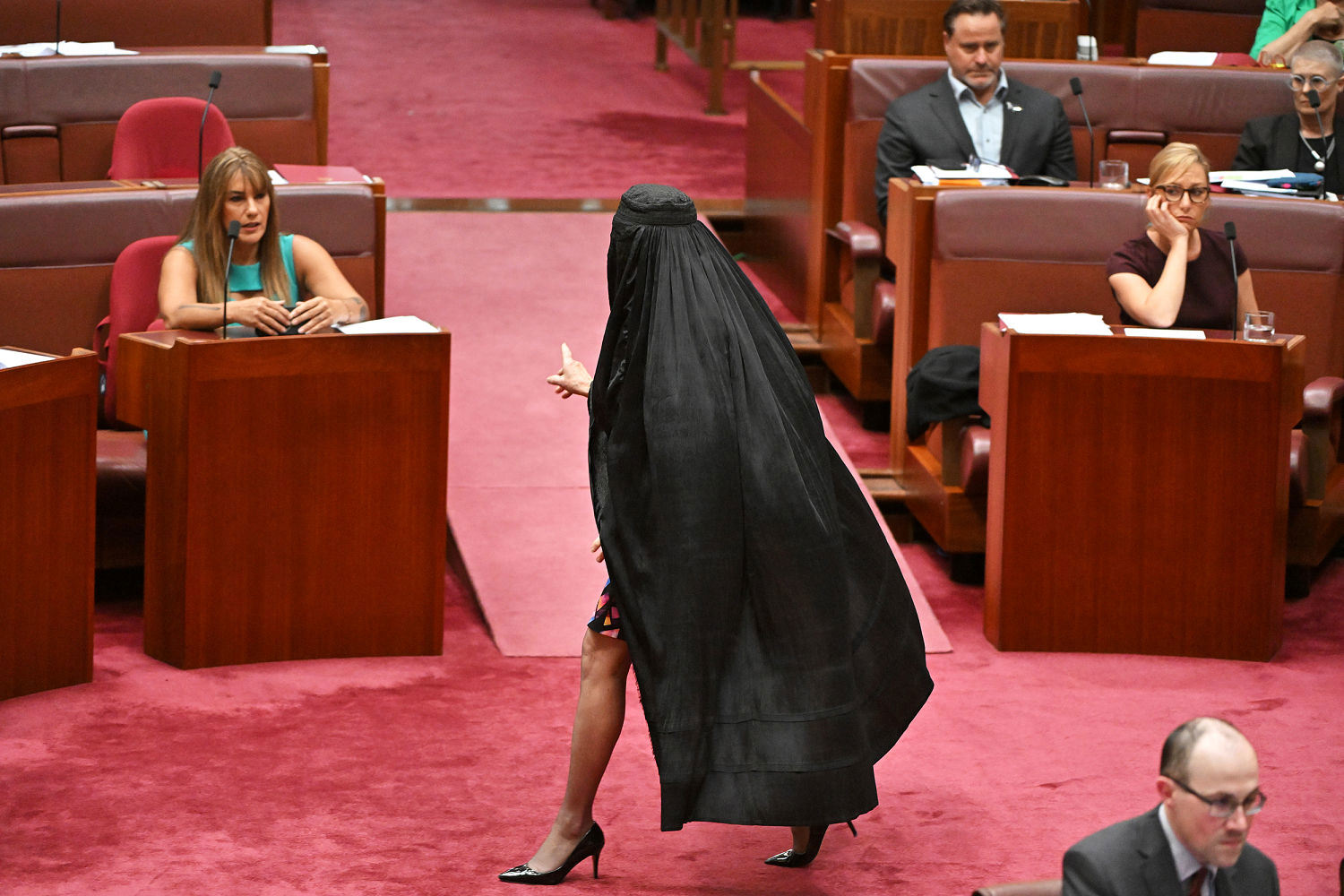
Pauline Hanson’s decision to once again enter the Australian Senate wearing a burqa has triggered widespread condemnation across the political spectrum, reigniting a national debate around religion, cultural expression, and parliamentary conduct. The One Nation leader repeated her 2017 stunt in an attempt to revive her push for a nationwide ban on the burqa, arguing that full-face coverings pose a threat to national security.
Her inability to cite any actual incidents, however, combined with the deeply provocative nature of the gesture, has produced a storm of criticism from senators, community figures, and the government-appointed special envoy for Islamophobia. The episode has forced Parliament House to suspend Senate proceedings, drawn renewed attention to issues faced by Australian Muslim women, and raised questions about the boundaries of political expression within a democratic institution.
Political Reactions to Hanson’s Repeat Burqa Stunt
Pauline Hanson wore the full-body black garment shortly after being denied leave to introduce her private senator’s bill that proposed outlawing the burqa in Australia. By entering the chamber covered head-to-toe, she directly contravened parliamentary rules requiring that senators’ faces remain visible, prompting the Senate president to order her removal. Hanson refused to comply, leading to her forced ejection and a subsequent hour-long suspension of proceedings while senators discussed how to respond to what many labelled a disgraceful and inflammatory act.
The condemnation was immediate and bipartisan. Nationals senator Matt Canavan delivered one of the sharpest critiques, warning that Pauline Hanson had “debased” the parliament and was “ridiculing” Muslim Australians. He emphasised that such theatrics attracted attention only from fringe elements within society and did not reflect the values of the broader Australian public, who expect a higher standard of conduct from elected officials.
Independent senator Fatima Payman, herself a Muslim woman who wears a hijab, expressed visible frustration in the chamber. She argued that Pauline Hanson’s actions constituted a direct affront to Muslim Australians and their faith, describing the stunt as “disrespecting a faith, disrespecting Muslim Australians”. Payman urged immediate intervention from parliamentary authorities, calling the gesture “disgraceful” and harmful to the inclusive values that Parliament should uphold.
Senator Lidia Thorpe, also sitting as an independent, repeatedly interjected and demanded Pauline Hanson’s removal from the chamber. Labor’s Senate leader, Penny Wong, criticised the conduct as “not worthy” of the parliament, stressing the importance of maintaining respect within Australia’s highest legislative forum. The Greens leader, Larissa Waters, also weighed in, describing the act as an “insult” aimed not only at Muslim women but at the dignity of the institution itself.
Breaking: The Senate has been suspended after One Nation Senator Pauline Hanson entered the chamber wearing a burqa and refused to remove it despite objections from multiple senators and the President of the Senate.
— Rukshan Fernando (@therealrukshan) November 24, 2025
Pauline Hanson remained defiant, refusing to comply with the… pic.twitter.com/sQvOsCCVaE
Across the chamber, from Liberals to Nationals to Labor and Greens, MPs expressed frustration that Pauline Hanson had chosen to perform a political stunt long known to be offensive, unnecessary, and potentially harmful. This bipartisan unity in denouncing the action stood in stark contrast to the divisive nature of the stunt itself. Senators reportedly discussed the possibility of a formal censure motion, an indication of how serious the breach of standards was perceived.
Hanson’s Security Claims and Lack of Supporting Evidence
At a fiery press conference held shortly after her ejection, Pauline Hanson defended the stunt as a legitimate demonstration meant to highlight what she insists is a national security problem. She argued that if Australians are required to remove helmets or face coverings in banks and businesses, similar expectations should apply to religious garments that obscure the face. She positioned her bill as a matter of public safety rather than cultural or religious discrimination, portraying the burqa as an “oppressive” and “radical” garment that facilitates mistreatment of women.
Yet when pressed by journalists for specific examples of burqa-related security incidents in Australia, Pauline Hanson was unable to provide a single case. Asked how many incidents she knew of, she deflected by suggesting: “Can I suggest you call Asio?” When questioned further, she conceded: “I can’t answer you that question.” This inability to provide evidence severely undermined the factual basis of her proposal, raising doubts about whether the argument is grounded in genuine security concerns or political strategy.
The government’s special envoy for Islamophobia, Aftab Malik, offered a sharply different perspective. In statements released on social media, Malik argued that Pauline Hanson’s actions would heighten risks for Muslim women at a time when they already face harassment, threats, and discrimination.

He warned that linking religious clothing with national security reinforces harmful stereotypes and fuels bigotry. Veiled Muslim women, he said, often become easy targets for intolerance, making them disproportionately vulnerable to violence or intimidation. By reintroducing her burqa ban campaign in such a sensationalised manner, Pauline Hanson risked further stigmatising an already marginalised community.
Malik stressed that all women should have the right to choose what they wear without fear of political interference, judgment, or coercion. His comments drew attention back to the broader social issues that accompany public debate around religious garments, including the lived experiences of Muslim women who face consequences far more personal and immediate than parliamentary debate.
Impact on Australian Muslim Communities and Public Response
The reactions from Muslim community leaders and everyday Australians have reflected deep concern about the broader implications of Pauline Hanson’s actions. Many view the stunt not simply as a misguided political statement, but as one that actively endangers and alienates women who choose to wear religious coverings. In recent years, Muslim women in Australia have reported verbal harassment, physical threats, and discrimination based solely on their appearance. The fear, expressed by multiple organisations, is that sensationalised political gestures risk normalising this behaviour.
Read : Labour MSP Colin Smyth Charged Over Secret Camera Placed in Toilets Inside the Scottish Parliament
The stunt also rekindles memories of Pauline Hanson’s earlier political campaigns. Her 2017 appearance in a burqa on the Senate floor led to an extraordinary rebuke from then–attorney general George Brandis, who stated passionately that she was “appalling” for mocking the Islamic community. Despite the widespread backlash at the time, the repeat of the act in 2025 suggests a strategic doubling-down on divisive politics rather than a reconsideration of its impact.

Furthermore, the political context raises questions about intent. Pauline Hanson had earlier skipped parliamentary sessions to attend and speak at a conservative conference at Donald Trump’s Mar-a-Lago in the United States. Her alignment with global far-right networks and the timing of her renewed burqa ban push may reflect an effort to amplify issues that resonate with certain ideological bases. Such moves often succeed in drawing attention, but they risk destabilising social harmony and undermining public trust in democratic institutions.
For many Australians, the images shared by Pauline Hanson on Facebook—showing her in full burqa in her office before a large portrait of herself—were emblematic of political theatre rather than serious legislative concern. Her caption stating that if Parliament refused to ban the garment she would “display” it on the chamber floor only reinforced the perception of the act as confrontational performance rather than policy advocacy.
For Muslim Australians, however, the consequences are more personal. Community advocates warn that such stunts fuel hostility in public spaces, embolden harassers, and create an atmosphere where religious expression becomes framed as suspicious or dangerous. Muslim women, particularly those who wear the hijab or burqa, often carry the heaviest burden of these debates, facing increased scrutiny and social pressure while simply going about their daily lives.
The re-emergence of this controversy also illustrates a wider challenge facing multicultural societies—how to balance freedom of expression with respect for diversity, and how to address legitimate security concerns without unfairly targeting specific communities. In this case, Pauline Hanson’s inability to cite any actual security incidents significantly weakens the argument that the burqa itself presents an imminent threat. Critics argue that focusing on clothing distracts from real security challenges and unfairly singles out religious minorities.
At the parliamentary level, the handling of the incident has underscored the importance of maintaining standards of conduct. The Senate’s decision to suspend proceedings, consider censure, and reaffirm rules around facial visibility in the chamber represents an effort to defend the dignity of the legislative process. Many senators emphasised that disagreements about policy must occur within the bounds of respectful debate, not through provocative displays that risk inflaming societal tensions.
Ultimately, Hanson’s renewed push for a burqa ban raises broader questions about the role of symbolic gestures in Australian politics. For some, such acts are attempts to spark necessary debate; for others, they are cynical manoeuvres that exploit sensitive issues for political gain. What remains clear is that the impact reverberates far beyond Parliament House, affecting communities across the country and shaping public perceptions about inclusion, religious freedom, and the responsibilities of elected leaders.