
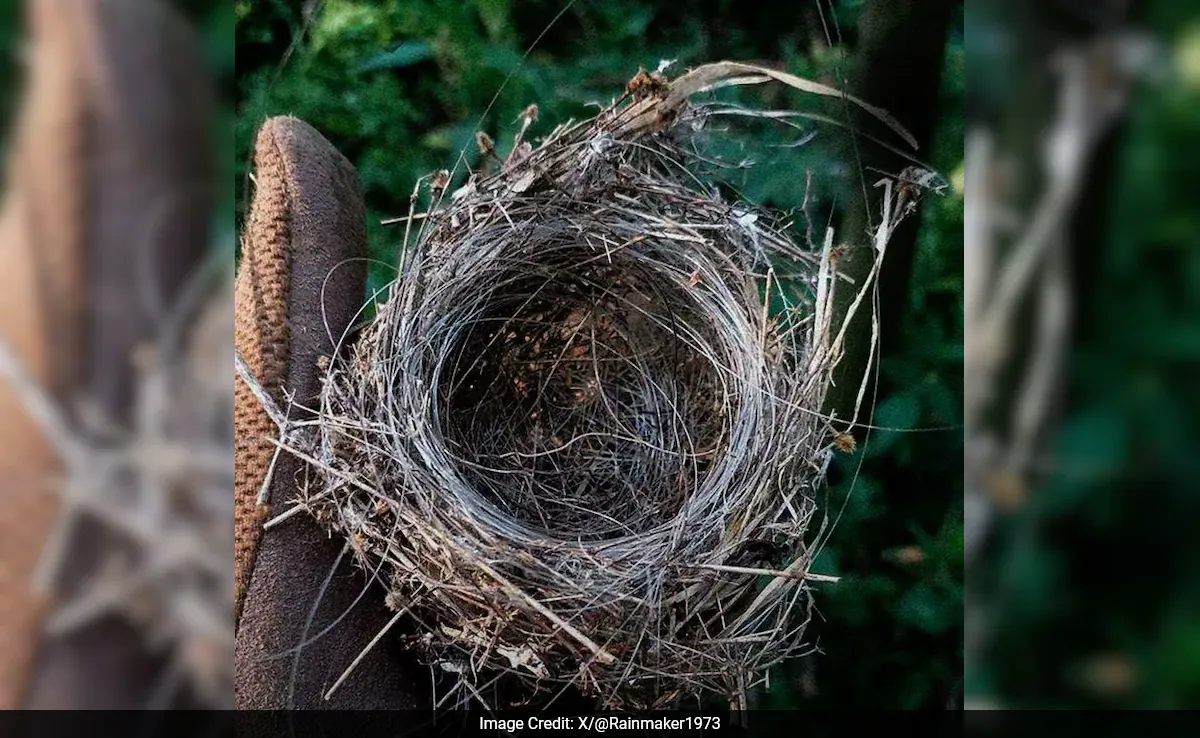
In a powerful symbol of adaptation and survival, in Ukraine Birds Use Fibre Optics from War-Damaged Drones to Build Nests—specifically, fibre optic cables used in FPV drones. This phenomenon has captured global attention, as nature finds a way to persist amid destruction.
A nest built almost entirely from fibre optic strands has recently been discovered near the front line in Toretsk, Donetsk region, showcasing how avian species are adapting to a war-scarred environment. As the war between Russia and Ukraine continues into its third year, stories like this illuminate unexpected ways life continues, even in the harshest of conditions.
Nature’s Resilience in a War Zone
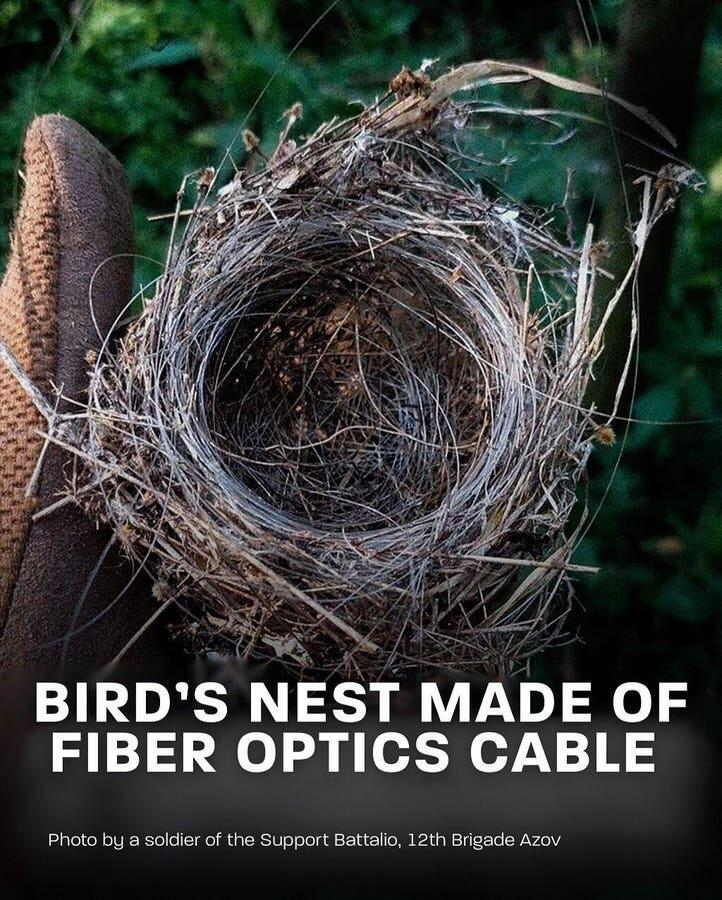
In a scene that could have been lifted from a dystopian film, the nest made from fibre optic cable serves as a striking image of adaptation. The 12th Azov Brigade of the National Guard of Ukraine discovered the nest in eastern Ukraine. The intricate weave of bright, synthetic fibre optics mimicked the usual natural materials like grass, fur, or twigs that birds traditionally use. But in the absence of peace and untouched nature, these birds have ingeniously substituted technology for tradition.
This nest isn’t just a curiosity—it’s a living metaphor for nature’s will to endure. “Birds were the first after people to use the remains of fibre optic for their own needs,” said the brigade in a statement. The brigade pointed to the nest as one of “dozens of manifestations of how nature survives in the flames of war.” It’s a reminder that life doesn’t pause in wartime; it adapts, evolves, and finds new paths to continue.
With the landscape of eastern Ukraine now heavily marked by debris, broken technology, and remnants of combat, birds and other wildlife are forced to adjust. In this case, fibre optics—once a tool of destruction—have been repurposed into something life-sustaining.
Birds on the front lines weave their nests from fiber optics. pic.twitter.com/vwdLXg3Wyy
— Saint Javelin (@saintjavelin) June 5, 2025
This example adds to a growing body of evidence that animals, particularly birds, are remarkably resilient and able to use urban or altered materials to their advantage. From cigarette butts and plastic to human hair and now drone remnants, the natural world continues to surprise observers with its ingenuity.
The Growing Presence of FPV Drones and Fibre Optics in the War
The use of fibre optic-guided FPV (first-person view) drones has surged in the Ukrainian-Russian conflict, playing a significant role on the battlefield. These drones, which rely on physical fibre optic cables rather than wireless connections, are able to operate despite aggressive electronic warfare countermeasures. As a result, they’ve become increasingly favored for missions requiring precise targeting and stealth.
According to Mykhailo Fedorov, Ukraine’s Minister of Digital Transformation, 15 companies are now manufacturing fibre drones domestically. This rapid industrial advancement was bolstered by former US Marine Troy Smothers, who brought his expertise and designs to Ukraine, helping to jumpstart local drone production. With such a robust push for technological innovation, it is no surprise that these drones have left behind significant material residue scattered across battlefields and urban zones alike.
Read : HopeFull that Served More Than 2.5 Million Free Pizzas in War-Torn Ukraine Reached to Halt
These fibre optic-guided drones are a double-edged sword: they empower the military with unprecedented tactical advantage, but also contribute to the environmental detritus of modern war. Unlike traditional wireless drones, fibre drones often leave behind long trails of physical wire, creating a web-like footprint in the areas they are used. This web of cables has become part of the physical landscape, entwining itself not only in military operations but now in the very fabric of nature itself.

The fibre optics’ prominence in nesting behavior highlights how ubiquitous this material has become. It suggests a new, unintended environmental consequence of technological warfare—an ecological shift where artificial materials replace natural ones due to sheer availability. What was once battlefield debris now serves as building material, signifying how human activity, even in its most violent form, reshapes ecosystems.
Drone Warfare and the Changing Battlefield
The discovery of the fibre optic nest coincides with Ukraine’s increasingly bold and far-reaching drone campaigns. Just recently, Ukraine launched one of its most ambitious drone offensives to date—codenamed “Spider’s Web.” In this operation, 117 drones were deployed across vast distances, targeting Russian airbases located thousands of kilometers away from the front line. The name of the mission itself now carries a poetic weight, considering the actual fibre optic “webs” being spun by nature in the war’s wake.
These attacks targeted high-value Russian military assets in areas such as Belaya in eastern Siberia, Olenya near the Arctic Circle, and Ivanovo and Dyagilevo east of Moscow. These weren’t mere skirmishes; they were calculated strikes aimed at degrading Russia’s strategic air capability. Videos circulating online show Ukrainian operators calmly guiding their drones through enemy airspace, pinpointing and destroying aircraft. It was a display of precision, planning, and technological mastery.
While the military significance of such operations cannot be understated, the environmental aftermath of these drone strikes is becoming increasingly apparent. As drones are used more frequently and in greater numbers, they leave behind not only physical wreckage but also a changing ecological footprint. The nests built from fibre optics might be beautiful and resourceful, but they also speak to the scale and persistence of war materials in the environment.
This convergence of advanced warfare and ecological impact opens up new questions for both military strategists and environmentalists. What will be the long-term environmental consequences of these modern weapons? Can battlefields ever return to a pre-war ecological state? And how will animals continue to adapt to this hybrid world of nature and war-driven technology?
In a world where high-tech warfare is the new norm, this small act of nesting—so commonplace, yet so profoundly altered by its context—invites reflection. It’s a sign that nature is watching, adjusting, and surviving, even when humanity’s priorities veer toward destruction.
In Ukraine today, a simple bird’s nest tells a complex story. It’s a story of war and technology, of innovation and adaptation, of destruction and resilience. The fibre optic cables from FPV drones—intended for battlefield advantage—have become threads of survival for another species entirely.
This convergence of human conflict and natural instinct forms a poignant snapshot of the times we live in. One in which the unintended by-products of warfare become tools for life, and where, amid the smoke and ruins, nature quietly reclaims its place.