

The removal of an exhibit panel honoring the contributions and sacrifices of Black American soldiers at the Netherlands American Cemetery in Margraten has sparked wide debate, disappointment, and calls for reinstatement from families, local officials, and historians. The panel, titled “African American Servicemembers in WWII: Fighting on Two Fronts,” highlighted the essential but often overlooked role of Black soldiers who carried out the harrowing work of burying thousands of fallen Americans during World War II.
Its sudden disappearance, following an internal review by the American Battle Monuments Commission (ABMC), has raised new questions about how historical memory is curated and whose stories are prioritized in US military commemorations. For months, visitors to the cemetery have been unable to view the display — a gap that many, including the family of the late 1st Lt. Jefferson Wiggins, see as a troubling omission in telling the full history of the site.
The cemetery, located in the southern Netherlands, is the final resting place for nearly 8,300 American service members. Yet the experiences of the Black soldiers who built it, maintained it, and performed its most painful duties remain largely invisible without the panel. The issue extends beyond a single biographical display and touches on the broader historical tendency to sideline the stories of African American troops who served with distinction while facing segregation, discrimination, and denial of equal status in their own armed forces.
The Historical Work of Black Soldiers at Margraten
In the winter of 1944, while some of the most brutal fighting of World War II raged across Europe, young Black soldiers of the 960th Quartermaster Service Company were assigned one of the war’s darkest responsibilities: burying the dead. Among them was 19-year-old 1st Sgt. Jefferson Wiggins, who would later rise to the rank of first lieutenant. Wiggins and hundreds of others worked in bitter cold, rain, and snow, armed only with pickaxes and shovels as they transformed an orchard in the village of Margraten into a military cemetery.
The work was grueling and traumatic. Wiggins recalled how members of his company cried as they lowered bodies into graves — the bodies of young American men, many of whom were the same age as the soldiers burying them. Trucks delivered the fallen continually, seven days a week, as Allied forces advanced through German-occupied territory. One of the first bodies Wiggins buried was that of a young German girl, her body destroyed by gunfire and explosions. The memory would stay with him for decades.
Wiggins’ reflections revealed the painful paradox of the era. Black soldiers could be trusted with the responsibility of burying white American troops, but they could not share the same facilities with them while alive. Segregation permeated every aspect of military life, from assignments to barracks to recreational spaces. For many, including Wiggins, the burial detail became both a service to their country and a stark reminder of the racial inequalities they endured.
Read : Black Panther Cub Seen Sitting with Its Leopard Mother in Rare Sighting at Pench Tiger Reserve
For most of his life, Wiggins did not speak openly about what he had witnessed. Only in the late 2000s, after learning he was the last surviving Black member of his unit, did he agree to record an oral history with Dutch historian Mieke Kirkels. He believed the story of the Black soldiers at Margraten needed to be preserved. When the cemetery’s modern visitor center opened in 2023, however, none of its exhibits mentioned the African American troops whose labor had built and sustained the site. Wiggins’ widow, Janice, advocated for the inclusion of their story, eventually helping to develop the panel that was installed in 2024.
The Removal of the Display and Growing Public Outcry
In March, the ABMC removed the panel following what it called an internal review of interpretive content. The agency has stated that the decision was made because portions of the panel were deemed outside the scope of its commemorative mission. According to the ABMC, four other displays honoring individual African American troops buried at the Netherlands American Cemetery remain in rotation, though these are smaller and not focused on the burial companies’ broader contributions or on the systemic discrimination Black soldiers faced.
However, the explanation has been met with skepticism and frustration. Former ABMC secretary Charles Djou, who served under the Biden administration but was dismissed by President Donald Trump, told CNN that the removal occurred at the prompting of the Trump administration, though the ABMC denies any external political influence. For many observers, the dispute illustrates a larger uncertainty within the agency about how to portray historical injustices and whether acknowledging racial discrimination is compatible with traditional modes of commemoration.
Local reactions in the Netherlands have been strong and swift. The mayor of Eijsden-Margraten formally requested that the panel be reinstalled, emphasizing that the region deeply values the Black American soldiers who helped liberate the Netherlands. The governing body of Limburg Province echoed this sentiment, warning that erasing the stories of marginalized groups from public memory undermines understanding of both the past and present. Several regional politicians and historians have joined the call for reinstatement, emphasizing that the exhibit conveyed essential history, not political commentary.

The removal has also caused personal anguish for Wiggins’ family. His widow has stressed that the issue is not about her husband being individually recognized but about acknowledging the collective sacrifice of men whose contributions have been overlooked for generations. She has also emphasized that the panels were never meant to be temporary, despite the ABMC’s recent claim that they were part of a rotating exhibit. Their development, she said, was intended to fill a permanent omission in the historical record of the cemetery.
The controversy has drawn renewed attention to the fragility of historical memory and the ease with which important narratives can be displaced. For decades, the documentation of Black servicemembers’ contributions has been incomplete, in part due to the 1973 fire at the National Personnel Records Center, which destroyed millions of military personnel files. Oral histories like Wiggins’ have become crucial sources for reconstructing the stories of units that were often relegated to labor roles and denied the recognition given to white combat troops.
Preserving the Full Story of Service and Sacrifice
The debate over the removed panel reflects broader tensions in how nations remember their wars. Military cemeteries, by design, honor heroism, sacrifice, and national unity. Yet World War II was also fought within the shadow of segregation, and the experience of Black soldiers was fundamentally shaped by discrimination. Many historians argue that telling the full story requires acknowledging this dual reality — the dual fight that so many African American servicemembers faced, against fascism abroad and racism at home.
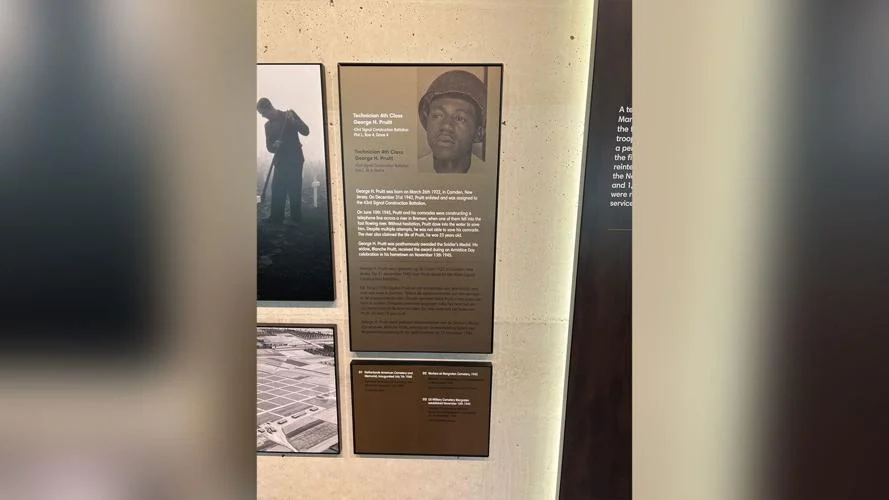
The panel at Margraten sought to present this fuller history. It acknowledged both the vital work Black troops performed and the injustices they endured. For families like the Wigginses, for the Dutch communities who preserve the memory of the wartime liberation, and for visitors seeking a comprehensive understanding of the Netherlands American Cemetery’s origins, this narrative is essential.
The ABMC has insisted that it remains committed to preserving inclusive historical interpretation. Yet the removal has raised concerns about transparency and consistency in how the agency decides which histories to foreground. The dispute over whether the Pruitt panel and other displays are “in rotation” or permanently intended further underscores the ambiguity surrounding the cemetery’s exhibits.
At its core, the controversy is about visibility — whose stories are told, whose sacrifices are acknowledged, and how the complexities of wartime history are presented to the public. The burial units at Margraten performed emotionally devastating work under harsh conditions. Their contributions shaped the cemetery that thousands visit each year. Omitting their story risks overlooking an essential chapter of both American and Dutch wartime history.
For Jefferson Wiggins, sharing his memories late in life was an act of duty. He believed that future generations should know what happened in Margraten and understand the human cost behind the quiet rows of white crosses and stars. The push to restore the display reflects a growing recognition that historical memory must be comprehensive, even when it includes difficult truths.
Your writing is not only informative but also incredibly inspiring. You have a knack for sparking curiosity and encouraging critical thinking. Thank you for being such a positive influence!
I enjoyed reading this article. Thanks for sharing your insights.