
Belfast Crown Court heard harrowing testimony on Friday from Malachy Coyle, a former teenager who witnessed the chaos of Bloody Sunday in 1972. Coyle, then just 15 years old, described urging a wounded man on the ground in Derry’s Glenfada Park North to feign death moments before a fatal shot rang out. The account forms part of the ongoing non-jury trial of Soldier F, a former Parachute Regiment member accused of murders and attempted murders during the infamous civil rights march. As the prosecution nears the end of its case, Coyle’s evidence underscores the raw terror experienced by civilians on January 30, 1972, when 13 unarmed protesters were killed and many more injured by British forces.
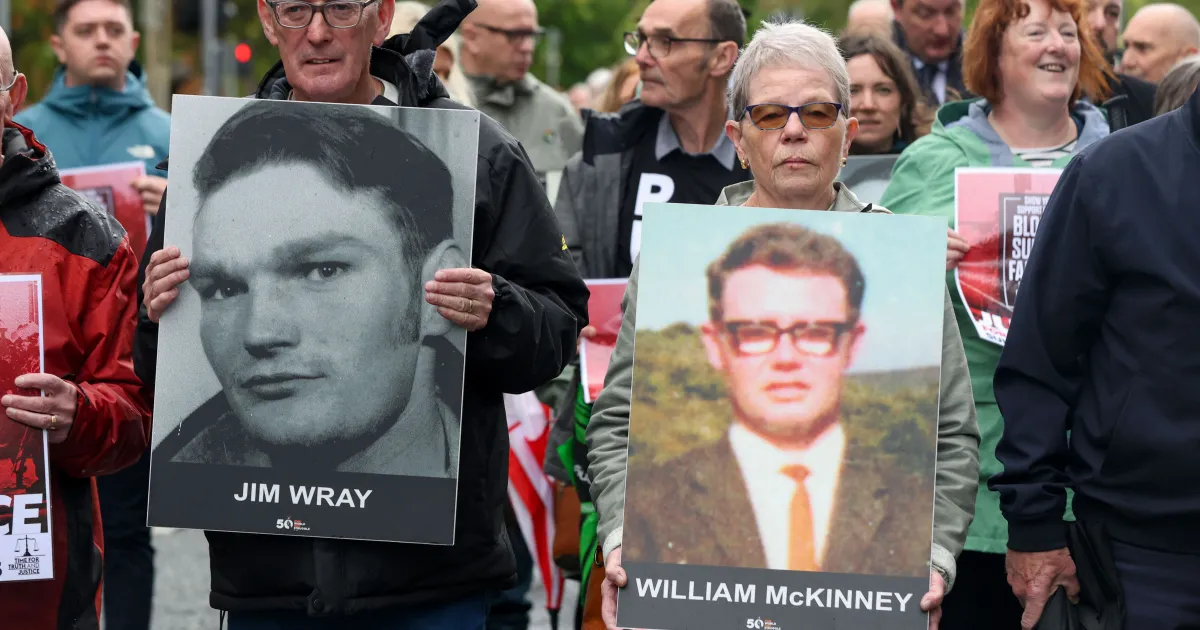
The trial, which began last month, has drawn intense scrutiny from victims’ families and human rights advocates. Soldier F faces charges related to two of the deaths—those of James Wray, 22, and William McKinney, 26—both shot in the Glenfada Park area where Coyle’s testimony is set. He is also accused of attempting to murder four other men and an unidentified individual. Malachy Coyle’s words, delivered calmly but with evident emotional weight, paint a vivid picture of indiscriminate violence amid a peaceful demonstration against internment without trial.
Revisiting Bloody Sunday: From Massacre to Courtroom Reckoning
Bloody Sunday remains one of the darkest chapters in Northern Ireland’s Troubles, a conflict that claimed over 3,500 lives between 1969 and 1998. On that frigid afternoon in Derry—then Londonderry—thousands gathered for a banned civil rights march organized by the Northern Ireland Civil Rights Association. The protesters, largely Catholic nationalists, sought an end to housing discrimination, electoral gerrymandering, and the practice of detaining suspects without charge. British Army troops, deployed since 1969 to maintain order, were positioned at barricades along the route.
As the march deviated toward the Bogside neighborhood, tensions escalated. Soldiers from the 1st Battalion, Parachute Regiment, fired into the crowd, killing 13 immediately and mortally wounding a 14th man who died months later. Eyewitnesses and subsequent inquiries described unarmed civilians—many shot in the back while fleeing or aiding the injured—falling under a hail of high-velocity rounds. The official British narrative initially branded the victims as bombers or gunmen, a claim that fueled outrage and boosted IRA recruitment.
Decades of legal battles followed. The 1972 Widgery Tribunal, led by Lord Chief Justice Widgery, largely exonerated the soldiers, prompting accusations of whitewash. Families persisted, culminating in Prime Minister Tony Blair’s 1998 commitment to a full inquiry. The Saville Inquiry, spanning 12 years and costing £200 million, concluded in 2010 that the dead were innocent civilians and the shootings unjustified. It found no evidence of a nail bomb threat and criticized the Parachute Regiment’s aggressive tactics. David Cameron, then UK prime minister, issued a formal apology, calling the events “unjustifiable and wrong.”
Read : Kim Jong Un Pays Tribute to North Korean Soldiers Killed Fighting for Russia in Ukraine
This trial marks the first criminal prosecution arising from Saville. In 2019, the Northern Ireland Public Prosecution Service charged Soldier F, the only one of 18 investigated soldiers to face court, following a Police Service of Northern Ireland review. The case nearly collapsed in 2021 amid broader controversies over legacy prosecutions of veterans, but a High Court ruling revived it in 2022.
After decades of campaigning, the families of those murdered on Bloody Sunday will finally see “Soldier F” stand trial for his actions. It is a testament to their tireless efforts over many decades. pic.twitter.com/cmlTB6aN6g
— Lasair Dhearg (@LasairDhearg) October 3, 2025
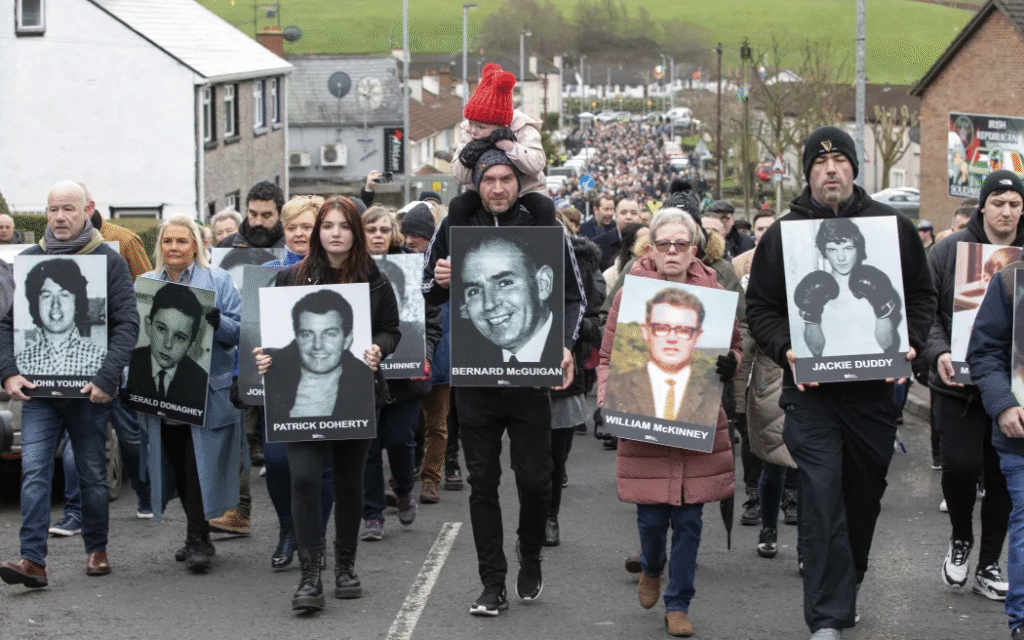
Now, under Judge Justice John O’Hara in a judge-only format to shield sensitive evidence, the proceedings have revisited forensic details, ballistic reports, and survivor statements. Families of the victims, including those of Wray and McKinney, have attended daily, carrying photographs as symbols of unresolved grief. Malachy Coyle’s appearance fits into a week of civilian testimonies, many read as hearsay statements to expedite the process. His live evidence, however, provided a firsthand bridge to 1972, emphasizing the human cost beyond statistics.
Coyle’s Account: Whispers of Survival Amid Gunfire
Malachy Coyle, now in his late 60s, took the stand with the poise of someone who has carried these memories for over half a century. A schoolboy from Derry’s nationalist community, he joined the march that day with two friends, drawn by the call for equality. “It was a family outing, really,” he recalled, evoking the festive mood before violence erupted. But rumors of a shooting near the city center shifted the atmosphere, and CS gas—deployed by troops to disperse the crowd—left him gasping and vomiting in the street.
Stumbling into Glenfada Park North, a residential enclave of low-rise flats, Malachy Coyle sought refuge from the choking fumes. The air cracked with gunfire, distinct from the lower rumble of rioters’ improvised weapons. “It was high-velocity shots. A high crack, not like a shotgun in a film—a high-pitched crack,” he testified, mimicking the sound that still haunts him. Panic gripped the crowd; people sprinted in all directions as bullets whined off walls.
An older man, a stranger, yanked Coyle into a backyard behind a garden fence, their hiding spot offering slatted views of the park. What they saw froze them: three figures sprawled on the bloodied grass. The two farthest lay motionless, presumed dead. But the closest—a man whose face Malachy Coyle could glimpse—stirred. He turned his head upward, eyes pleading, and whispered, “I can’t move my legs.” Paralyzed from the waist down, likely from an earlier wound, he was alive but exposed.
In that split-second calculus of survival, Coyle leaned closer through the fence. “Don’t move,” he urged softly. “Pretend you’re dead.” The advice, born of youthful instinct amid slaughter, echoed the grim tactics of war zones. Seconds later, another shot pierced the air. Malachy Coyle watched in horror as sparks flew from the pavement beneath the man’s head—a telltale sign of a bullet striking concrete after passing through flesh. A low groan escaped the victim’s lips; his head slumped forward. “He was gone,” Coyle said flatly, his voice steady but eyes distant.
The scene didn’t end there. Peering out, Coyle spotted a British soldier, bareheaded and striding with purpose across the park. Unlike his helmeted comrades, this one exuded rage—face flushed, demeanor unstable. “He looked dangerous,” Coyle recounted. The soldier pivoted toward a cluster of young men cowering behind the flats, perhaps a dozen in all, frozen in fear. Leveling his rifle, he bellowed, “I’m going to shoot you, you Irish bastards.”
Terror propelled action. The soldier fired toward one youth attempting a desperate dash for cover. Coyle didn’t see a body fall—no casualty was recorded there—but the shot’s intent was clear: to kill without quarter. Fearing the worst, Coyle and his protector emerged from hiding, hands raised high in surrender. Eight to ten soldiers milled nearby, their presence a wall of menace. No one approached to aid the dying; the park became a killing field.
Coyle’s testimony aligns with Saville’s findings of soldiers firing recklessly into populated areas. Though he couldn’t identify the shooter of the man he tried to save—nor link it directly to Soldier F—his proximity places the events squarely in the zone of the defendant’s alleged actions. Cross-examination was brief, focusing on visibility through the fence and the sequence of shots, but Coyle held firm, his recall unshakeable after years of reflection.
Legacy on Trial: Justice Delayed, Memory Enduring
As Coyle stepped down, the courtroom hung heavy with the weight of what might have been. Soldier F, shielded behind a curtain per court order, remained impassive—a ghost from a regiment once hailed as elite but now synonymous with atrocity. The prosecution, led by Louis Mably KC, expects to wrap its case next week, paving the way for the defense. Over 50 witnesses have testified, from forensic experts tracing bullet trajectories to medics who treated the wounded, building a mosaic of culpability.
The charges against Soldier F are precise: two counts of murder for Wray, shot twice in the back while crawling wounded, and McKinney, struck in the back as he bent to help another victim. Both deaths occurred in Glenfada Park North within minutes, per ballistic evidence. The attempted murder counts stem from shots fired at fleeing civilians, including Patrick O’Donnell, who survived a leg wound. If convicted, Soldier F—now in his 70s—faces life imprisonment, a rare outcome for Troubles-era prosecutions.
Yet the trial transcends one man. It tests the UK’s commitment to accountability, amid government moves to limit legacy cases via the 2023 Northern Ireland Troubles (Legacy and Reconciliation) Act, which halted many inquiries. Victims’ groups decry it as an amnesty in disguise, while veterans’ advocates argue for closure after decades. Wray’s family, who learned of his death via radio reports, and McKinney’s relatives, who buried him amid rioting, see this as vindication long overdue.
Coyle’s story, raw and unadorned, humanizes the abstract. It recalls not just a boy’s fear but a community’s fracture—trust in state forces shattered, cycles of violence ignited. As the trial resumes Monday, his words linger: a reminder that pretending to be dead was no metaphor, but a child’s gambit against the unthinkable. In Derry’s streets today, murals honor the dead; in Belfast’s courts, their echoes demand justice. Whether it arrives remains the verdict’s open question.