
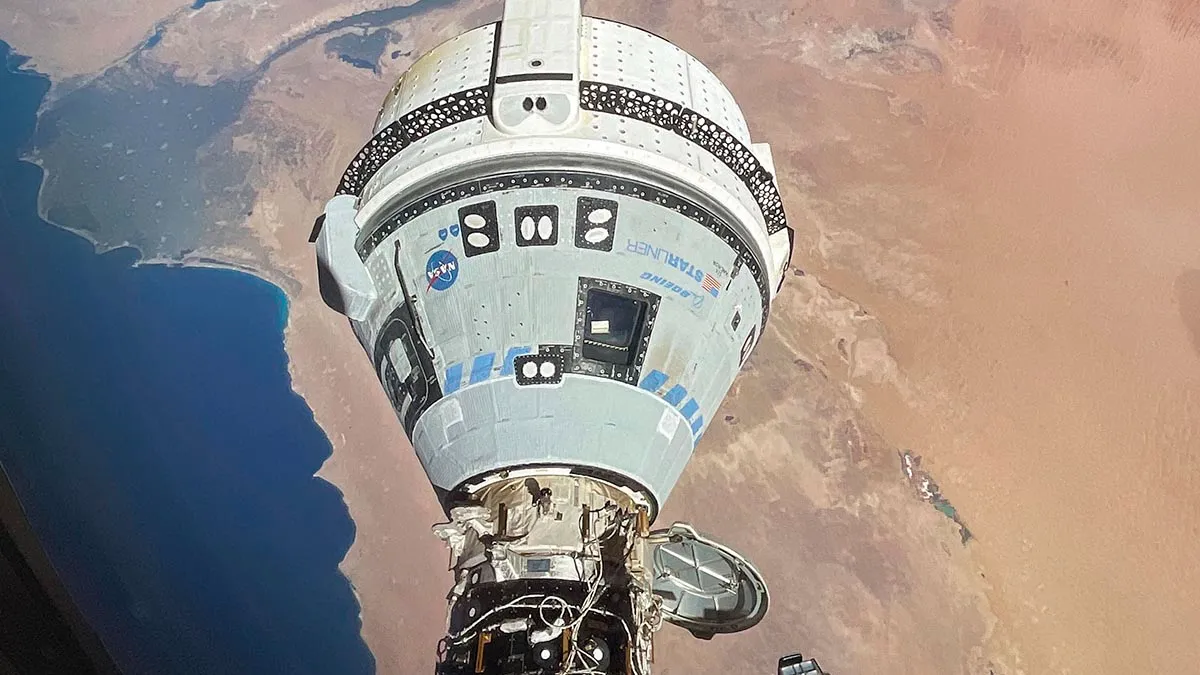
The Boeing Starliner spacecraft, currently docked at the International Space Station (ISS), has been generating an unexpected sound that has captured the attention of NASA astronauts and mission control.
This “strange” sonar-like ping was first reported over the weekend by NASA astronauts Suni Williams and Butch Wilmore, who are aboard the ISS as part of Boeing’s crew flight test. The test is a crucial step in certifying the Starliner spacecraft for future human missions.
The peculiar noise was detected coming from inside the Starliner spacecraft. On Saturday, astronaut Butch Wilmore informed mission control in Houston about the unusual sound emanating from the speaker inside the spacecraft.
To allow mission control to assess the situation, Wilmore placed his microphone near the speaker, enabling them to hear the pulsing noise firsthand. Mission control described the sound as resembling a “sonar ping,” a noise that is not typically associated with spacecraft operations.
Boeing Starliner

“Why don’t ya’ll scratch your heads and see if you can figure out what’s going on,” Wilmore quipped, leaving the investigation to the ground team.
The Starliner spacecraft’s mission has been marred by a series of technical issues since its arrival at the ISS in early June. Originally launched as part of Boeing’s crew flight test, the spacecraft was intended to carry NASA astronauts Suni Williams and Butch Wilmore back to Earth.
However, due to ongoing problems with helium leaks and reaction control thrusters, the decision was made to return the spacecraft to Earth without any astronauts onboard. This return is scheduled for September 6.
There are several noises I'd prefer not to hear inside my spaceship, including this one that @Boeing Starliner is now making. pic.twitter.com/NMMPMo5dtt
— Chris Hadfield (@Cmdr_Hadfield) September 1, 2024
NASA astronauts Wilmore and Williams, who were initially supposed to return on the Starliner, will now remain on the ISS until February 2025. They will eventually return to Earth aboard a SpaceX Dragon spacecraft as part of NASA’s SpaceX Crew-9 mission.
The strange sound from the Starliner has also drawn the attention of former Canadian astronaut Chris Hadfield. Over the weekend, Hadfield commented on the noise, stating, “There are several noises I’d prefer not to hear inside my spaceship, including this one that Boeing Starliner is now making.”
His reaction underscores the potential concern that such unexpected noises can create in a space environment, where every detail is crucial to the safety of the crew and the success of the mission.
Despite these issues, the Boeing Starliner remains a key part of NASA’s efforts to maintain a robust human spaceflight program, providing an alternative to SpaceX’s Dragon spacecraft for transporting astronauts to and from the ISS.
The spacecraft’s performance during this crew flight test will be critical in determining whether it can be certified for regular crewed missions in the future.
To accommodate the delayed return of Wilmore and Williams, NASA has made adjustments to its crew rotations. NASA opted to launch astronauts Nick Hague and Russian cosmonaut Aleksandr Gorbunov while leaving two seats open on the Crew-9 mission for Wilmore and Williams.
As a result, NASA astronauts Zena Cardman and Stephanie Wilson, who were initially scheduled for Crew-9, have been bumped and are expected to fly on a future mission.
The Boeing Starliner’s mission has been anything but smooth, with technical issues and now an unexpected sonar-like sound adding to the challenges faced by the program.
As Boeing Starliner prepares for its return to Earth, NASA and Boeing will continue to monitor the situation closely, ensuring that the Boeing Starliner can safely complete its mission and contribute to the future of human spaceflight.