

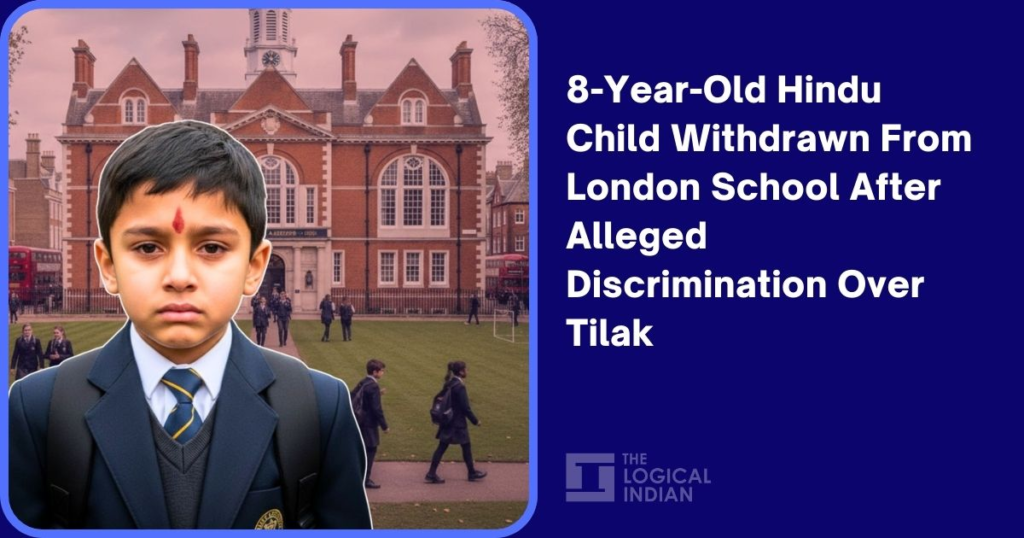
An eight-year-old Hindu student was compelled to leave his primary school in London after a series of incidents linked to his practice of wearing a Tilak-Chandlo, a sacred Hindu symbol traditionally applied to the forehead. The case, brought to public attention by Insight UK, has raised serious questions about how religious diversity is understood and accommodated within British schools, particularly when the beliefs and customs involved are unfamiliar to school leadership.
The child’s experience, as described by his parents and advocacy representatives, reflects a pattern of scrutiny, exclusion, and institutional imbalance that ultimately resulted in his withdrawal from the school environment. According to information shared by Insight UK, the child attended Vicar’s Green Primary School, where staff reportedly questioned him about the Tilak-Chandlo and asked him to justify its presence.
The advocacy organisation characterised this approach as entirely inappropriate for a minor, especially given the age of the pupil and the deeply personal nature of religious observance. The situation reportedly escalated beyond questioning, affecting the child’s sense of safety, belonging, and participation in school life. What began as a matter of religious expression developed into an experience that the family describes as emotionally distressing and educationally disruptive.
The case has attracted attention not only because of the age of the pupil involved but also because of the legal and ethical frameworks governing religious freedom in the United Kingdom. Under the Equality Act 2010, religion is a protected characteristic, and direct or indirect discrimination on religious grounds is prohibited in educational settings. The allegations surrounding Vicar’s Green Primary School suggest potential failures in upholding these protections, with implications that extend beyond a single pupil to the broader Hindu community and other minority faith groups navigating similar environments.
Religious Expression, Authority, and the Experience of the Child
Central to the case are allegations that the school’s headteacher monitored the child during break times in a manner that the pupil found intimidating. According to Insight UK, this monitoring led the child to withdraw from play activities and isolate himself from his peers. Break times are widely recognised as critical periods for social development, particularly for younger children, and any perceived surveillance by authority figures can have a significant impact on a child’s willingness to engage freely with classmates.
The parents allege that this monitoring was directly connected to the child’s religious practice rather than to any behavioural concerns. If accurate, such conduct raises questions about proportionality and intent, as well as the safeguarding responsibilities of school leadership. Insight UK noted that no child should feel watched or singled out because of their faith, especially not by someone in a position of authority whose role includes ensuring the emotional wellbeing of pupils.
Further allegations suggest that the child was removed from positions of responsibility within the school solely because of his continued application of the Tilak-Chandlo. Positions of responsibility in primary schools often serve as opportunities for confidence-building and inclusion, reinforcing a child’s sense of belonging within the school community. The removal of these roles, if linked to religious observance, would constitute direct discrimination under the Equality Act 2010, where religion is explicitly listed as a protected characteristic.
Read : Exploring Varieties of Rice: Finding the Healthiest Grain for You
The cumulative effect of these experiences, according to those representing the family, created an environment in which the child no longer felt comfortable or safe attending the school. Over time, the emotional strain reportedly became unsustainable, leaving the parents with little option but to withdraw their son and seek education elsewhere. This outcome underscores how institutional responses to religious practices, even when framed as neutral or procedural, can materially alter a child’s educational trajectory.
Engagement Attempts and the Alleged Breakdown in Dialogue
Insight UK reports that the parents of the pupil, along with other Hindu parents connected to the school, made repeated and reasonable attempts to engage with the headteacher and school governors. These efforts were aimed at explaining the religious significance of Hindu practices, including the Tilak-Chandlo, and clarifying that such observances are a normal and integral part of Hindu identity. The parents reportedly sought dialogue rather than confrontation, hoping to foster understanding and accommodation within the school environment.
Read : Parents of 8-Year-Old Autistic Boy Plan to Sue School Over Alleged Use of Wooden Box for Confinement
According to the advocacy group, these attempts were met with dismissive responses and what they describe as an unwillingness on the part of school leadership to acknowledge or understand Hindu religious observance. Rather than being treated as an opportunity for mutual learning, the discussions allegedly reinforced an imbalance of power, with school authorities positioned as arbiters of acceptable expression and parents placed in a defensive posture regarding their faith.
Insight UK characterised this dynamic as a failure of good-faith dialogue, noting that Hindu practices were scrutinised, minimised, and ultimately rejected. In educational settings, constructive engagement with parents is widely regarded as essential, particularly when cultural or religious differences arise. The reported refusal to engage meaningfully has therefore drawn criticism not only for its immediate consequences but also for what it suggests about institutional readiness to support diversity.
The advocacy group further stated that the situation at Vicar’s Green Primary School is not isolated. According to their findings, religious discrimination at the school has reportedly forced at least four children to leave. While details of the other cases have not been publicly elaborated, the claim points to a broader pattern rather than a single misunderstanding. If substantiated, such a pattern would raise systemic concerns about governance, training, and accountability within the school.
Legal Context, Community Impact, and Wider Implications
The allegations surrounding this case intersect with established legal protections in the United Kingdom. The Equality Act 2010 obliges schools to ensure that pupils are not treated less favourably because of their religion and to make reasonable accommodations for religious practices where necessary. Direct discrimination, such as penalising a pupil for wearing a religious symbol, is unlawful, as is indirect discrimination arising from policies that disproportionately disadvantage a particular faith group without justification.
Read : Parkland Student Arrested for Assaulting Teacher
Beyond the legal framework, the case has resonated within the British Hindu and Indian community, many of whom view it as indicative of a lack of awareness about Hindu practices in mainstream institutions. Insight UK, which represents segments of this community, has framed the incident as part of a wider pattern in which Hindu religious expressions are misunderstood or marginalised. The organisation has also raised safeguarding questions, particularly regarding the emotional impact on young children subjected to scrutiny because of their faith.

From an educational perspective, the case highlights the importance of cultural competence among school leaders and staff. Britain’s classrooms are increasingly diverse, and effective inclusion requires not only adherence to legal standards but also proactive efforts to understand and respect different traditions. When such understanding is absent, routine administrative decisions can take on discriminatory effects, even if discrimination is not explicitly intended.
The forced transfer of a young pupil due to unresolved issues around religious expression represents a significant disruption, both academically and socially. For families, such outcomes can erode trust in public institutions and create a sense of vulnerability regarding the preservation of cultural and religious identity. For schools, these cases can undermine their stated commitments to inclusion and equal opportunity, exposing gaps between policy and practice.
The situation at Vicar’s Green Primary School continues to be cited by advocacy groups as an example of why clearer guidance, better training, and stronger accountability mechanisms are needed. While the school itself has not publicly responded to all the specific allegations detailed by Insight UK, the case has already contributed to a wider conversation about religious freedom, child safeguarding, and the responsibilities of educational authorities in a pluralistic society.
As discussions continue, the experience of the eight-year-old boy remains central to the issue. His case illustrates how abstract principles of equality and inclusion manifest in the daily realities of school life, and how failures at that level can lead to profound personal and community consequences.