
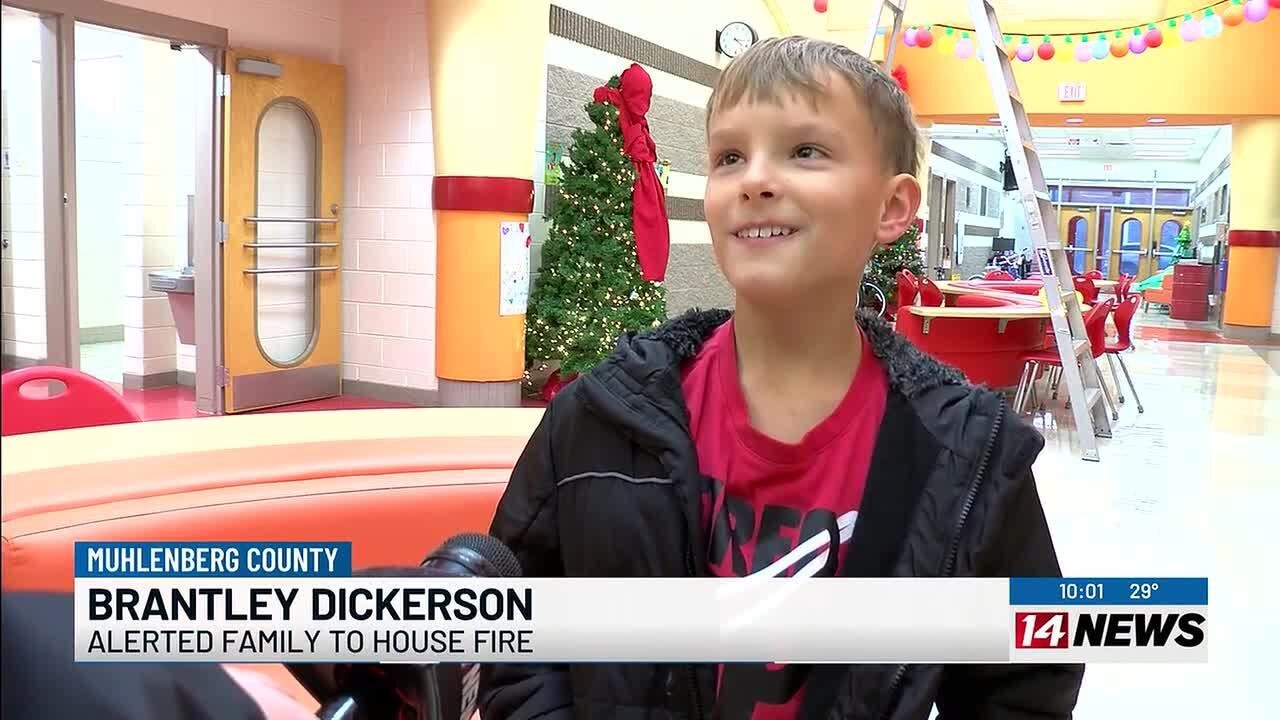
In the quiet early hours of the morning, when most households are wrapped in deep sleep, a sudden emergency in the small town of Cleaton, Kentucky, could have ended in tragedy. Instead, it became a story of courage, presence of mind, and the extraordinary impact one child’s actions can have in a moment of crisis. Just before 3 a.m., a house fire broke out along Kentucky State Road 2107 in Muhlenberg County, turning an ordinary night into a life-altering experience for the Dickerson-Haire family.
At the center of this incident was 11-year-old Brantley Dickerson, whose quick thinking and decisive action ensured that his family escaped safely. Brantley was asleep in the living room of the family’s home when the danger began to unfold. Unlike many emergencies that escalate unnoticed, this one was interrupted by a child who trusted his instincts and acted without hesitation.
The fire originated in his younger sister’s bedroom, an area of the house that could have quickly become inaccessible if the flames had spread further. The situation demanded immediate awareness and calm judgment, qualities not often associated with someone so young, yet demonstrated clearly that morning. What followed was a sequence of events that underscored how awareness, even learned indirectly, can translate into life-saving action.
The town of Cleaton, like many small communities in rural Kentucky, is closely knit, and news of the incident quickly spread. Yet beyond the local impact, the story carries a broader message about preparedness, responsibility, and the unpredictable ways in which knowledge can surface when it is needed most. Brantley Dickerson’s actions did not come from formal training or emergency drills but from lessons absorbed through everyday exposure, particularly television programs depicting emergency responses. In a moment when fear could have taken control, he instead relied on what he remembered and did what he believed was right.
A Sudden Awakening and a Critical Decision
The fire did not announce itself with alarms or loud disturbances that might have woken the entire household. Instead, it was Brantley Dickerson who first realized something was wrong. Sleeping in the living room, he became aware that his younger sister’s bedroom was on fire. The exact moment of realization was crucial, as fires that start during the night are among the most dangerous due to delayed detection and disorientation upon waking. In many cases, precious minutes are lost before occupants fully understand the severity of the situation. For Brantley, those minutes were replaced by immediate action.
He later explained that upon realizing the fire, he ran toward the room and yelled to wake his family. His response was instinctive but purposeful. Rather than freezing or attempting to handle the fire himself, he focused on alerting the adults in the house. This decision reflects an understanding of priorities in emergencies: people first, property second. His voice, raised with urgency, cut through the stillness of the night and ensured that the danger was recognized before it could escalate.
According to his account, Brantley Dickerson believed he knew what to do because he had seen similar situations portrayed on television. While fictional or dramatized, such portrayals often emphasize the importance of quick response, warning others, and getting out safely. In this instance, those lessons were recalled under pressure. His actions were not reckless but measured, aimed at ensuring everyone was aware and able to respond.
His parents later noted that his younger sister was not in the room at the time, as she was staying with her grandfather. This detail, while relieving, does not diminish the seriousness of the situation. The fire still posed a threat to Brantley Dickerson, his younger brother, his parents, and the family’s dogs. The potential for smoke inhalation, rapid fire spread, or structural damage was significant, especially given the early hour and the electrical nature of the fire.
By waking the adults promptly, Brantley Dickerson allowed the family to escape without injury. Fires caused by electrical issues can be unpredictable, sometimes spreading through walls or ceilings before flames are visible. Early warning is often the difference between a controlled escape and a catastrophic outcome. In this case, that warning came from an 11-year-old who chose action over fear.
Composure Beyond His Years
One of the most striking aspects of this incident, as described by Brantley’s family, was his composure. Fear is a natural response to danger, particularly for children, yet those present observed that Brantley Dickerson did not panic. Brian Haire, his stepfather, emphasized that although Brantley was scared, he remained calm and focused when it mattered most. According to Haire, when Brantley entered the room to wake them, he did not appear frantic or overwhelmed. Instead, he was composed, clear, and purposeful.
This level of emotional control is not easily achieved, even by adults. Emergencies often trigger confusion, denial, or impulsive behavior, all of which can worsen outcomes. Brantley’s ability to manage his fear and communicate effectively speaks to a maturity that impressed his family deeply. It also highlights the role that environment and upbringing can play in shaping a child’s responses. While bravery is often viewed as an innate trait, it is frequently supported by guidance, observation, and reinforcement of responsible behavior over time.
Haire described his stepson’s actions as deserving of significant praise, noting that being able to assess the situation and take the right steps at such a young age was remarkable. His words reflected both pride and astonishment, acknowledging that many adults might struggle to act as decisively under similar circumstances. The fact that Brantley Dickerson did not outwardly show panic made it easier for the rest of the household to respond effectively, reducing chaos and facilitating a safer exit.
Read : Colby Jennings Charged with Stabbing Woman and Setting Home on Fire in Wright City
The family’s dogs were also part of the escape, another detail that underscores the thoroughness of the response. Pets are often overlooked in emergencies, yet they are integral members of many households. Ensuring their safety requires additional awareness and time, both of which were available because the fire was detected early. This outcome further demonstrates how one quick decision can have a ripple effect, protecting not only people but also animals that might otherwise be trapped.
Read : Livie Rose Henderson Loses DoorDash Job Over Viral Video of Alleged Delivery Assault
While Brantley Dickerson himself downplayed his actions, insisting that he was not a hero, those closest to him disagreed. His mother, Tylor Haire, expressed immense pride, repeatedly referring to him as her hero despite his modest protests. Her reaction reflects a common parental perspective, recognizing that heroism is not defined by age or intention but by impact. In her view, and in the eyes of many who heard the story, Brantley’s actions fit that definition clearly.
Life After the Fire and a Story of Gratitude
In the aftermath of the fire, the Dickerson-Haire family has had to adjust to significant changes. The house sustained damage, and because the fire was electrical in nature, there is currently no power. As a result, the family is not living in the home while repairs and assessments are underway. This period of displacement is challenging, bringing uncertainty and logistical concerns about what can be salvaged and what must be replaced.
Read : Bizarre! 22-Year-Old Woman Fired For Arriving Early To Office Routinely
Despite these difficulties, the family has emphasized their gratitude that everyone survived without injury. Material losses, while stressful, are secondary to the preservation of life. This perspective has guided their approach as they take each day as it comes, focusing on recovery rather than dwelling on what could have happened. Their experience serves as a reminder that while fires can disrupt lives, outcomes can still be positive when warning signs are recognized early.

The incident has also prompted reflection on fire safety, particularly in residential settings. Electrical fires are a common cause of house fires and can occur without obvious warning. Ensuring that wiring is up to code, avoiding overloaded circuits, and having functioning smoke detectors are all critical preventive measures. While the Dickerson-Haire family’s escape was aided by Brantley Dickerson’s alertness, not every household is as fortunate. Their story highlights the importance of layered safety, combining preventive measures with awareness and preparedness.
Community response to the story has been one of admiration and support. In small towns like Cleaton, such events resonate deeply, reinforcing shared values of looking out for one another and recognizing acts of courage wherever they appear. Brantley Dickerson’s actions have become a point of pride not only for his family but also for the wider Muhlenberg County community. His story is likely to be shared as an example of how responsibility and awareness can emerge at any age.
For Brantley Dickerson, the experience may remain a defining moment, though he himself seems reluctant to embrace the attention. His humility adds another dimension to the story, reminding observers that genuine courage often comes without a desire for recognition. Whether he accepts the title of hero or not, the outcome of that early morning is undeniable: lives were protected because he acted when it mattered.
As the family continues to rebuild and adjust, their focus remains on gratitude and resilience. The fire altered their routine and temporarily displaced them, but it also reinforced the strength of their bond and the importance of readiness. In a situation where fear could have dominated, clarity prevailed, guided by the actions of a child who trusted what he knew and chose to speak up.
The story of Brantley Dickerson stands as a powerful example of how moments of crisis can reveal unexpected leadership. It underscores that preparedness does not always come from formal instruction but can be shaped by observation, communication, and the confidence to act. In Muhlenberg County, a quiet early morning was transformed into a testament to courage, reminding all who hear it that heroism can emerge in the most ordinary settings, carried out by those least expected.
I genuinely enjoy reading through on this site, it has superb articles.
Almost all of the things you point out is astonishingly legitimate and it makes me wonder the reason why I had not looked at this in this light before. Your piece really did switch the light on for me personally as far as this particular subject goes. But at this time there is one particular factor I am not too comfortable with so while I make an effort to reconcile that with the actual central idea of your issue, permit me see what the rest of the visitors have to point out.Well done.