
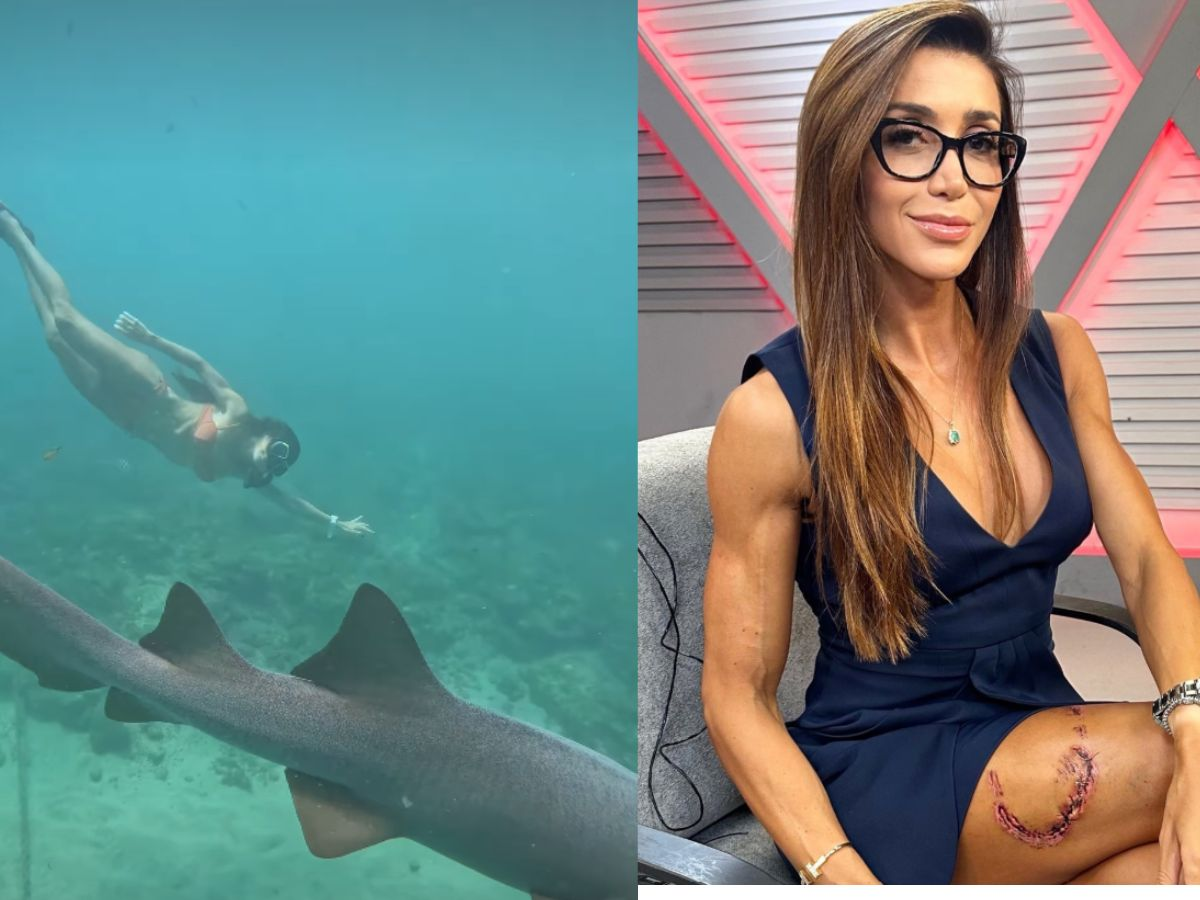
The ocean has long been a place of both serenity and unpredictability, offering moments of breathtaking beauty alongside reminders of nature’s raw power. Earlier this year, a striking incident captured global attention when a Brazilian surfer and social media personality, Tayane Cachoeira Dalazen, experienced an unexpected encounter with a nurse shark while diving in the clear waters of Fernando de Noronha. The initial video of the event spread rapidly across social platforms, drawing curiosity and concern due to its unusual nature. Now, months later, a newly surfaced video provides a clearer and more detailed perspective of what truly happened, reigniting discussion about the relationship between humans and marine life.
Dalazen, 36, is known for her active lifestyle and deep connection to the ocean, making the incident all the more surprising. The footage shows her diving confidently into the vibrant blue sea, appearing relaxed and at ease in the environment she frequently explores. What unfolds next, however, is a rare moment that contrasts sharply with the typical behavior associated with the species involved. While the injury she sustained was minor, the visual of a shark bite—no matter how brief—left a lasting impression on viewers worldwide. The newly released clip now allows for a more accurate understanding of the sequence of events, offering clarity where there was once speculation.
A Rare Encounter with a Typically Docile Species
Nurse sharks are widely regarded as one of the more docile species in the ocean. Often referred to as the “puppy dogs of the sea,” they are generally slow-moving and non-aggressive, posing little threat to humans under normal circumstances. Encounters between humans and nurse sharks are relatively common in regions where diving tourism is popular, and such interactions rarely result in injury. This context makes Dalazen’s experience particularly unusual, as it deviates from the expected behavioral patterns of the species.
In the clearer video, the shark’s approach appears calm rather than predatory. It moves toward Dalazen shortly after she enters the water, seemingly driven by curiosity rather than aggression. The bite itself is brief, more of an investigative nibble than a sustained attack. This aligns with scientific understanding of nurse shark behavior, as they sometimes use their mouths to explore unfamiliar objects in their environment. Despite the shock factor of the moment, there is no indication of a prolonged or deliberate attack.
Read : Rare Bright Orange Nurse Shark with White Eyes Discovered Off Costa Rica Coast
Dalazen herself addressed the nature of the encounter, emphasizing that the incident was isolated and not reflective of typical nurse shark behavior. Her clarification is important in preventing the spread of misinformation or unnecessary fear surrounding these animals. While any shark bite is serious, experts often stress that such occurrences are extremely rare and should be understood within the broader context of marine ecology. The incident serves as a reminder that even the most docile creatures can behave unpredictably under certain conditions, particularly when humans enter their natural habitat.
The Viral Impact and the Emergence of New Footage
The original video of the incident quickly went viral, capturing attention due to its dramatic nature despite its relatively low quality. Shot from a distance and at an unclear angle, the footage left much to interpretation. Viewers could see Dalazen diving and then reacting to something in the water, but the exact details of the shark’s movement and the moment of contact were difficult to discern. This ambiguity fueled speculation and heightened the sense of danger associated with the event.
No dia 9 de janeiro, a advogada Tayane Dalazen foi atacada por um tubarão durante um mergulho em Fernando de Noronha. Um novo vídeo divulgado recentemente mostra um ângulo mais claro do momento em que ela é mordida na perna por um tubarão-lixa. pic.twitter.com/M39gS5fkzc
— Portal Roma News (@RomaNewsOficial) April 10, 2026
The newly surfaced video has significantly changed the narrative by offering a front-facing and clearer view of the encounter. With improved visibility, it becomes evident that the interaction was brief and lacked the intensity often associated with shark attacks. The shark’s behavior appears measured rather than aggressive, and the sequence unfolds quickly without escalation. This additional perspective has helped shift public perception, providing a more balanced understanding of what occurred.
Dalazen shared the updated footage herself, using it as an opportunity to reiterate key points about the nature of the incident. She highlighted that diving with nurse sharks is a common activity in many parts of the world and typically involves minimal risk. Her decision to speak openly about the experience reflects an effort to educate rather than sensationalize, countering the tendency of viral content to amplify fear.
The role of social media in shaping public reaction cannot be overlooked. Viral clips often emphasize the most dramatic aspects of an event, sometimes at the expense of context. In this case, the initial video sparked widespread attention, but the clearer footage has contributed to a more nuanced conversation. It underscores the importance of accurate representation, particularly when dealing with wildlife interactions that can easily be misunderstood.
Recovery, Resilience, and Return to the Ocean
Despite the alarming nature of the incident, Tayane Cachoeira Dalazen’s injuries were relatively minor. She sustained visible bite marks on her thigh, which, while undoubtedly painful, did not result in long-term physical harm. Her recovery process was swift, allowing her to return to her usual activities within a short period. This outcome further reinforces the idea that the encounter, though dramatic, was not as severe as initial reactions might have suggested.

In the months following the incident, Dalazen resumed surfing and continued to engage with the ocean in the same way she had before. Her return to the water is a testament to her resilience and confidence, as well as her understanding of the risks involved in interacting with marine environments. Rather than allowing the experience to deter her, she embraced it as part of her journey, even showcasing the scar as a symbol of survival.
One of the most notable aspects of her response is her willingness to re-enter waters inhabited by the same species. She later documented a return dive in Fernando de Noronha, describing the experience as one of happiness rather than fear. This perspective highlights a broader message about coexistence with wildlife, emphasizing respect and awareness over avoidance. Her actions suggest a level of trust in the natural behavior of marine animals, even after a direct encounter.
The incident ultimately concludes on a positive note, with no lasting harm to either Dalazen or the shark. It serves as a reminder of the delicate balance between humans and nature, particularly in environments where the boundaries between the two are increasingly blurred. While such encounters are rare, they underscore the importance of understanding and respecting the ecosystems we choose to explore.
Through the emergence of clearer footage and Dalazen’s own reflections, the story evolves from a moment of shock to one of insight. It sheds light on the complexities of marine interactions and challenges common perceptions about sharks. Rather than reinforcing fear, the incident encourages a more informed and measured approach to understanding the ocean and its inhabitants.