
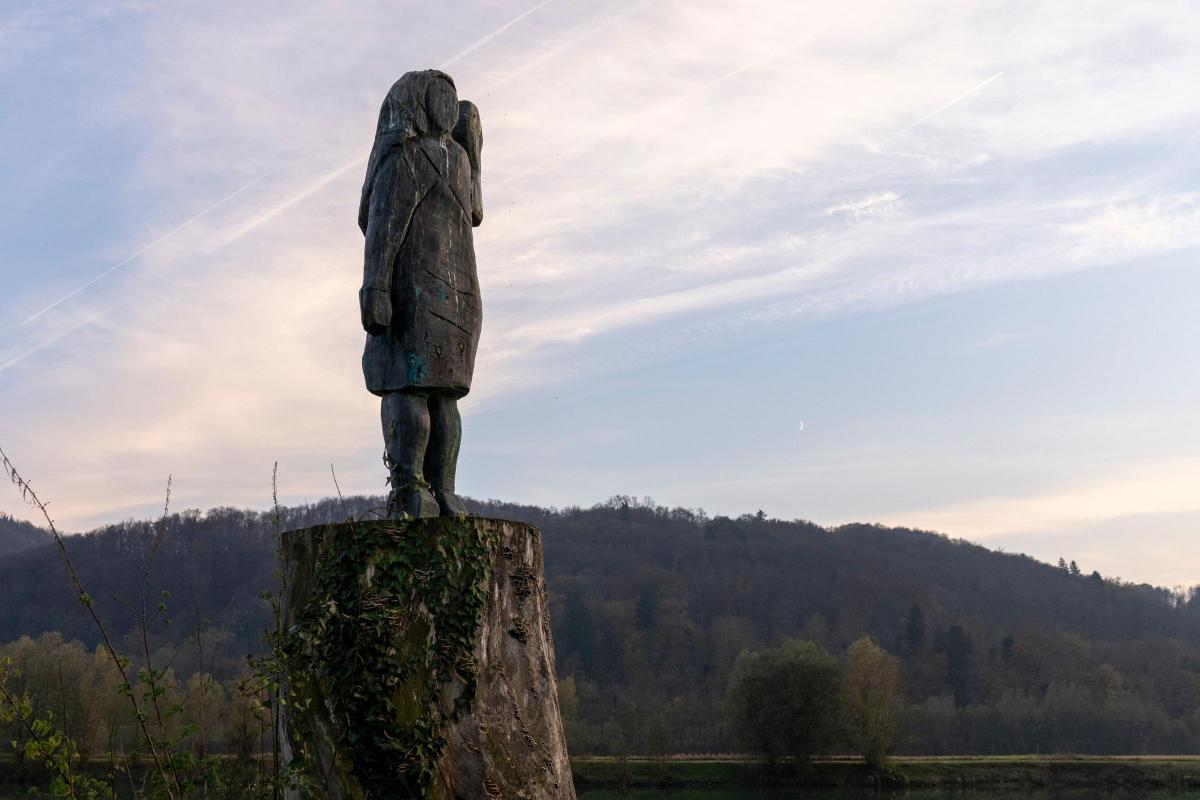
A peculiar art saga has once again unfolded in the quiet Slovenian town of Sevnica, drawing international attention. The lifesize bronze statue of Melania Trump, erected in her native country to commemorate her historic ascent to the White House as the first lady of the United States, has mysteriously disappeared.
The statue, already a replacement for a previous wooden version that had been destroyed by arson, was removed from its site earlier this month, chopped off at the ankles and taken away by unknown perpetrators.
This incident has reignited debate around the symbolism of public monuments, celebrity iconography, and the political sentiments that simmer in even the most unexpected corners of the world.
From Chainsaw to Bronze: A Tale of Two Statues
The story of Statue of Melania Trump in Sevnica began in 2019, when American conceptual artist Brad Downey commissioned a local chainsaw sculptor, Aleš Župevc, to create a wooden effigy of the first lady. Standing in a blue dress and high heels—a clear nod to the iconic outfit Melania wore during Donald Trump’s 2016 inauguration—the figure was placed near the Sava River, not far from Melania’s hometown of Sevnica, which lies roughly 90 kilometers east of Ljubljana.
The wooden statue was a blend of rustic craftsmanship and provocative commentary. Though it drew both curiosity and criticism, its presence was significant, serving as a rare public tribute to Melania in her homeland. The sculpture received widespread media attention and sparked lively discussions about art, identity, and politics. Some locals appreciated the tribute, while others found the piece awkward or even grotesque.
However, this first tribute met a sudden and symbolic end in July 2020, when unknown vandals set it ablaze, leaving behind a charred and hollowed-out stump. The incident caused a stir and was seen by many as an act of political vandalism or a commentary on the divisive legacy of Donald Trump.
Read : “My Son Barron is the King of the Internet”: Donald Trump
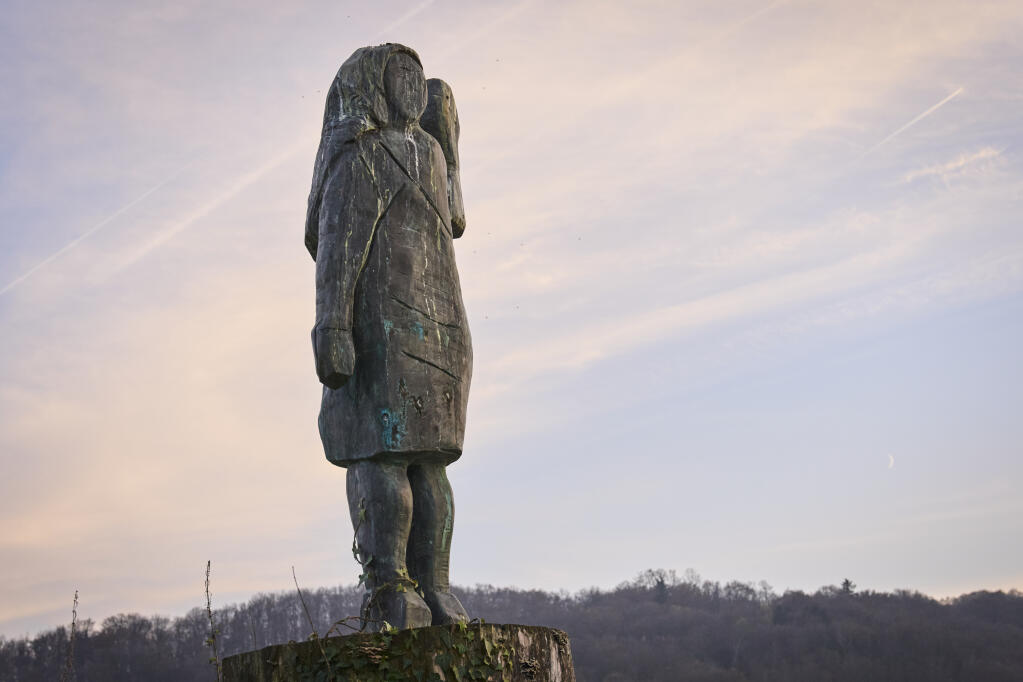
Downey, who had viewed the statue as an “anti-monument” challenging traditional notions of political commemoration, responded by creating a bronze replacement—a more permanent and durable symbol intended to weather both natural and societal tempests.
Read : Trump Challenges Biden to Golf Match with $1 Million Charity Bet
This bronze version was installed later that year on the same tree stump, secured with concrete and metal bars. It stood firm for several years, a silent observer of Sevnica’s serene landscapes and a testament to the strange intersection of celebrity, politics, and public art. But now, the statue is gone, chopped off and carried away, its absence prompting fresh questions and a police investigation.
An Artistic Statement or a Political Target?
Brad Downey, the artist behind both statues, has described the bronze Melania as a piece that resists glorification. He called it an “anti-propaganda” sculpture—an artwork that does not venerate but rather comments on the nature of political symbolism. In this light, the theft of the statue may not be just a criminal act but a form of dialogue, one that speaks volumes about public sentiment and cultural divisions.
Downey has speculated that the theft might be linked to Donald Trump’s renewed political ambitions, given that it occurred shortly after his nomination as the Republican candidate for the upcoming U.S. election.
“My feeling is that it has something to do with the new election, but who knows, right?” he remarked. Though the exact motivations remain unclear, the timing does seem uncanny. Art vandalism has long been used as a form of protest or expression, particularly in politically charged climates.
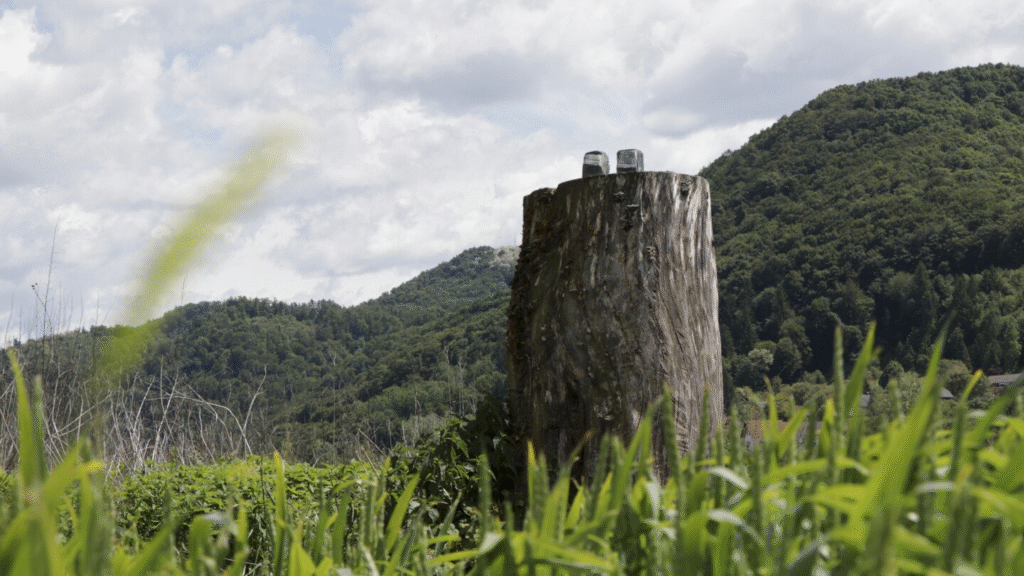
The statue’s theft may also reflect a broader discomfort within Slovenia itself regarding the Trump era. While Melania’s roots in Sevnica have become a point of interest, even a tourist draw, they also remind locals of a presidency that was polarizing both domestically and globally. Some may see the removal as an attempt to distance the town from that legacy.
Despite the fame Melania brought to Sevnica, especially among American tourists and curious journalists, her presence has always felt somewhat external. Donald Trump never visited Slovenia during his presidency, and Melania’s own visits have been sparse.
Meanwhile, businesses in Sevnica have capitalized on her image, branding local delicacies—cakes, chocolates, even wine—with her name, blending admiration with commercial interest.
The Legacy of Melania Trump in Her Homeland
Sevnica, a town of just a few thousand residents nestled amid the gentle hills of eastern Slovenia, has found itself unexpectedly thrust into the global spotlight thanks to Melania Trump. Born Melanija Knavs in 1970, Melania spent her early years in Sevnica before moving abroad to pursue a modeling career that would eventually lead her to New York and the Trump empire.
Her transformation from a Slovenian schoolgirl to First Lady of the United States is a narrative that seems ripped from the pages of a modern fairy tale—or a political screenplay. The town has embraced this unlikely heritage in a curious, sometimes ambivalent way.
Guided tours take visitors to Melania’s childhood home and the schools she attended. Restaurants offer “Melania menus.” But the fascination is often tinged with irony and hesitation. The statue incidents underscore that complexity. While some locals view the sculptures as proud markers of international recognition, others see them as awkward, unwanted symbols of a controversial political figure.
The disappearance of the bronze statue marks the latest chapter in this ongoing tension. It’s a reminder that monuments are never just about who they depict; they are also about who erects them, why, and how they are received.
In this case, the statue stood not merely as a tribute to a famous local daughter but as a lens through which Slovenia, and Sevnica in particular, grapples with its accidental association with a turbulent chapter in American history.
Police investigations are now underway, with authorities confirming that they were alerted to the theft on May 13. Officers visited the scene and began collecting evidence, but details remain scarce. It is not yet known whether the statue was stolen for its material value, for political reasons, or as part of a larger commentary.
For Downey, the statue was never meant to be permanent in the traditional sense. It was a statement, a reflection of fleeting fame and the fragility of constructed icons. Its vanishing, while regrettable to the artist, also seems to affirm the very themes he sought to explore. As he put it after learning of the incident from Germany, “I’m a bit sad that it’s gone,” though he didn’t express outrage or shock.
The fate of the missing statue remains uncertain. Will it reappear in an unexpected place? Will its destruction be revealed as another act of symbolic erasure? Or will it join the long list of lost art pieces whose absence tells a story just as powerful as their presence? Only time—and perhaps the findings of local police—will tell.
In the meantime, Sevnica continues to live its quiet life, its fields green and its hills tranquil. But somewhere, perhaps in a hidden storage space or melted down for scrap, the bronze Melania is no longer watching over her birthplace. And in that absence, a new narrative is being shaped—one of loss, ambiguity, and the curious life of art in the public eye.