
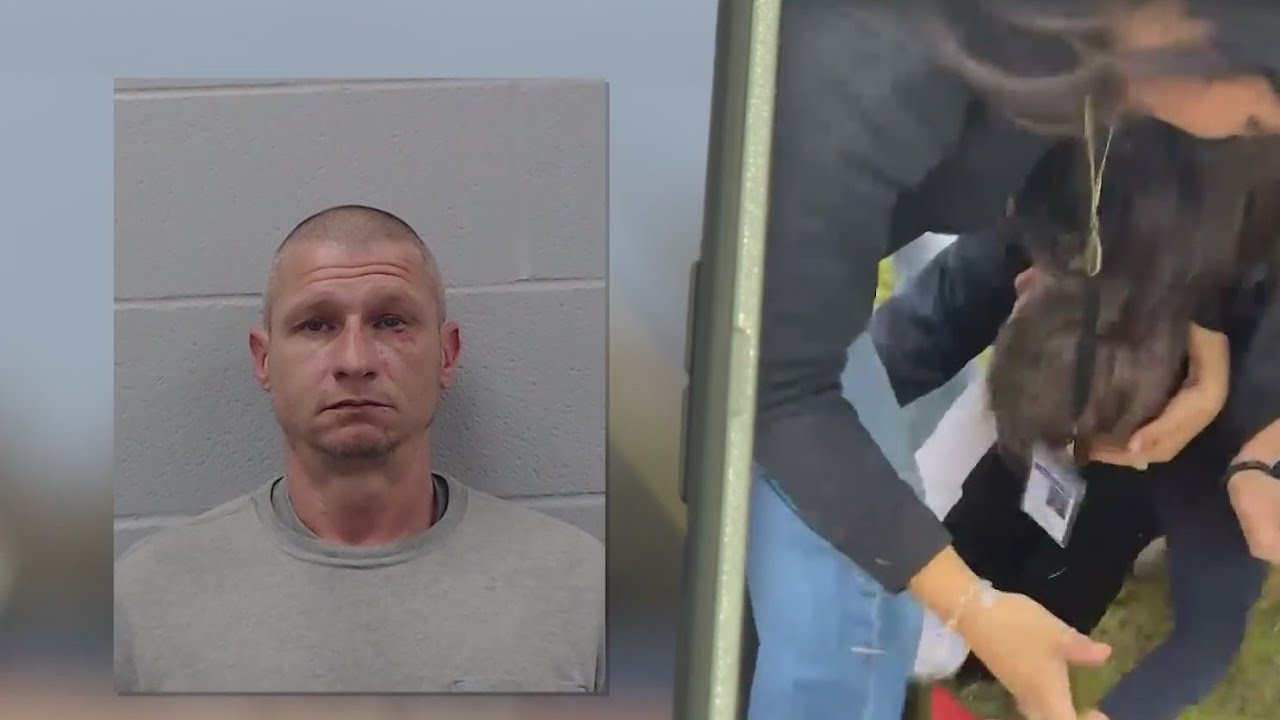
The arrest of a 45-year-old Texas man following a physical confrontation with high school students during a campus walkout has drawn national attention, intersecting issues of immigration policy, student activism, public order, and the responsibilities of adults during youth-led demonstrations. The incident occurred outside Moe and Gene Johnson High School in Buda, Texas, where students had left class as part of a protest against Immigration and Customs Enforcement operations associated with the Trump administration’s immigration enforcement agenda.
While the walkout itself was largely peaceful and aligned with similar demonstrations across the country, a confrontation captured on video escalated into violence, prompting a police investigation and criminal charges. According to law enforcement officials, the altercation began as a verbal dispute between the adult man, later identified as Chad Michael Watts, and a female juvenile student who was participating in the protest.
Video footage that circulated widely on social media shows Watts exiting his vehicle and engaging with students on the sidewalk, some of whom were holding protest signs criticizing ICE. What followed was a brief but intense physical exchange that involved multiple students and resulted in minor injuries.
After reviewing video evidence and witness accounts, police concluded that Watts was the primary aggressor, leading to his arrest on assault charges nearly a day later. The episode has since become part of a broader political and legal debate in Texas over student protests, immigration enforcement, and the role of school authorities during politically charged demonstrations.
The Incident Outside Johnson High School
The confrontation took place during a student-organized walkout at Moe and Gene Johnson High School, located in Buda, a city south of Austin. Students walked out of class to protest what they described as aggressive immigration enforcement policies by the federal government, particularly actions carried out by Immigration and Customs Enforcement. The walkout mirrored similar protests planned or carried out by students across Texas and other parts of the United States, reflecting growing youth engagement with national immigration policy debates.
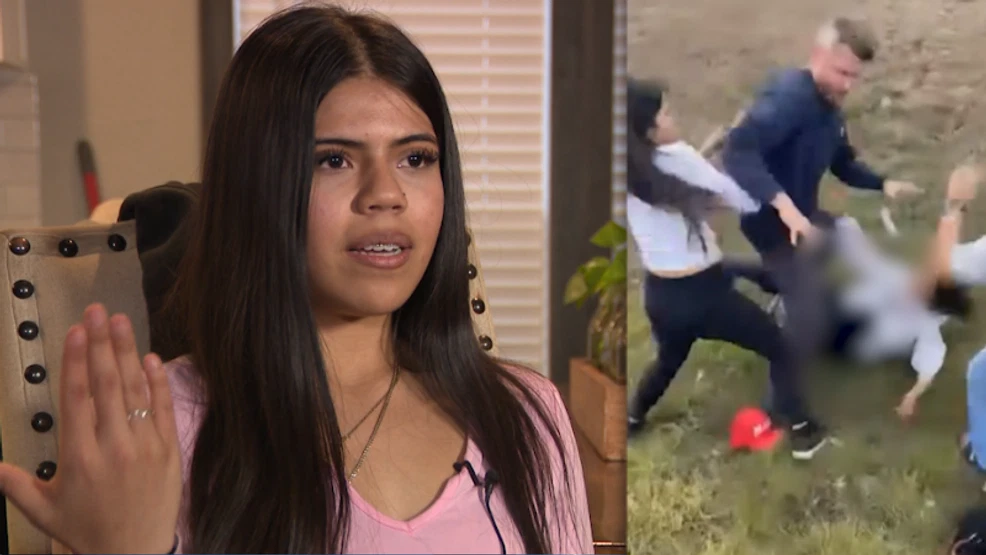
Video footage shared by local media and online platforms shows Chad Michael Watts in a vehicle near the protest area. At some point, a verbal exchange began between Watts and a female juvenile standing on the sidewalk with other students. Police later stated that Watts exited his vehicle and confronted the student, escalating the encounter from verbal to physical. In the video, Watts appears to push the student, knocking her to the ground. This action prompted an immediate reaction from other students nearby, several of whom physically confronted Watts in response.
The footage shows multiple students pushing, hitting, and pulling Watts as he fell to the ground, with one student jumping onto his back. The confrontation lasted only a short time before it broke up. Both Watts and the juvenile student sustained minor injuries, but neither required emergency medical attention at the scene. Law enforcement officers were not immediately present during the incident, and Watts was not arrested until nearly a day later, following a review of the evidence.
Chad Michael Watts, the magat who got arrested in Buda TX after picking a fight with protesting high school girls, and losing pic.twitter.com/1VOfWvfbs0
— Sean O'Neill (@SeanOhhhh) February 4, 2026
The Buda Police Department stated that it conducted a thorough investigation, including analysis of multiple videos and witness statements. Based on that review, investigators determined that Watts was the primary aggressor in the physical altercation. He was subsequently arrested and charged with two counts of assault causing bodily injury. Authorities indicated that the investigation remains ongoing and that additional charges could be considered depending on further findings.
Legal Response and Statements from Authorities
Following the arrest, both local law enforcement and the Hays County District Attorney’s Office issued statements addressing the incident and its legal implications. Police emphasized that the determination of Watts as the primary aggressor was based on evidence rather than political considerations, underscoring that the charges stemmed from physical actions captured on video and corroborated by witnesses.
The Hays County District Attorney’s Office confirmed that it is reviewing the case and echoed law enforcement’s assessment of the incident. In a public statement, the district attorney stressed that adults bear a heightened responsibility to exercise restraint, particularly when interacting with minors. While acknowledging the charged political environment surrounding immigration enforcement and student protests, the office emphasized that physical violence directed at a juvenile, especially during a lawful and peaceful demonstration, is unacceptable under the rule of law.
Read : Who Is Khaleed Oladipo, 20-Year-Old De Montfort University Student Stabbed to Death Near Campus?
Watts was booked into custody and held on the assault charges related to the altercation. The identity of the juvenile involved has not been released, consistent with legal protections for minors. Authorities have not indicated whether any students involved in the physical response to Watts will face charges, though they have stated that the investigation remains active.
The case also raises questions about the legal boundaries of self-defense and collective response when minors are involved. While video footage shows students physically attacking Watts after he pushed a fellow student, police have thus far focused their enforcement action on Watts’s conduct, citing his role in initiating the physical violence. Legal experts note that determinations of criminal liability in such cases depend heavily on who instigated the violence and whether subsequent actions were deemed proportional or defensive.
Political Reaction and Broader Context of Student Walkouts
Beyond the immediate legal proceedings, the incident has become part of a broader political debate in Texas over student activism and immigration policy. The walkout at Johnson High School was one of many student-led protests organized in response to federal immigration enforcement actions. Supporters of the protests argue that students are exercising their constitutional rights to free speech and assembly, while critics contend that walkouts disrupt educational environments and introduce partisan politics into schools.
Texas Attorney General Ken Paxton publicly criticized school districts that permitted or did not prevent student participation in the walkouts, accusing some administrators of imposing what he described as a radical political agenda. Paxton’s comments focused particularly on the Austin Independent School District, though the Johnson High School protest occurred within a different jurisdiction. His remarks reflect a broader concern among some state officials that student protests related to immigration enforcement are being encouraged or facilitated by school staff.
Governor Greg Abbott also weighed in on the protests, sharing an article that reported the arrest of two juveniles in Hays County on unrelated charges of alcohol possession and resisting arrest. Although law enforcement officials clarified that those arrests had no connection to the immigration protests, Abbott used the report to characterize the walkouts as disruptive. In public statements, he argued that school staff who allow or support such demonstrations could be considered complicit in unlawful behavior and suggested that the state could explore measures to penalize schools that fail to adhere strictly to mandated curricula.
These political reactions have intensified scrutiny of student walkouts and raised concerns among educators and civil liberties advocates about potential repercussions for schools and students. At the same time, supporters of the protests argue that the events highlight the growing political awareness and engagement of young people, particularly on issues that affect immigrant families and communities.
The arrest of Chad Michael Watts has thus become more than a local criminal case. It sits at the intersection of law enforcement, youth activism, and state politics, illustrating how individual confrontations can quickly take on broader symbolic significance. As the legal process continues, the case is likely to remain part of ongoing discussions in Texas and beyond about the limits of protest, the responsibilities of adults in contentious public spaces, and the role of schools in navigating politically sensitive issues involving their students.
It’s actually a great and helpful piece of info. I am happy that you just shared this helpful info with us. Please stay us informed like this. Thanks for sharing.
I am not real superb with English but I come up this really easy to read .