
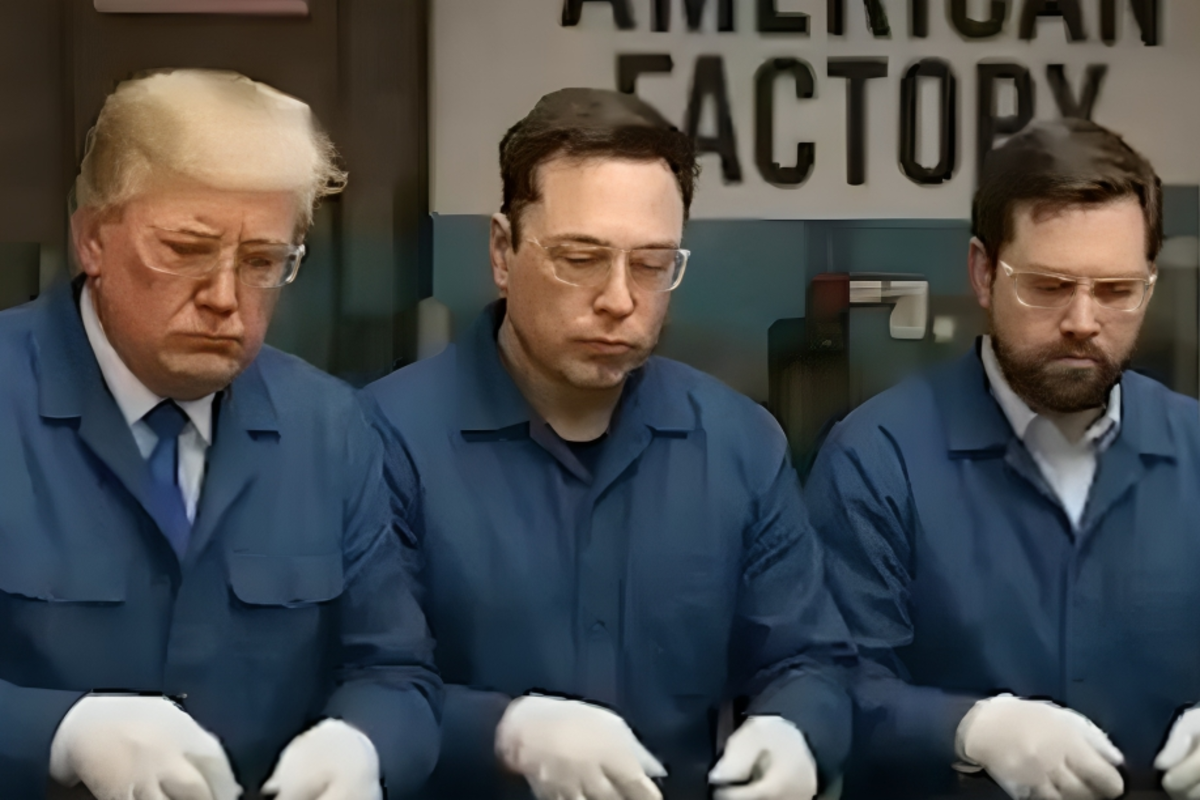
A new wave of satirical AI-generated videos from Chinese social media users has sparked widespread attention and debate online. These clips China Shares AI Video of Trump, Vice President JD Vance, and tech magnate Elon Musk portrayed as ordinary factory workers on assembly lines.
The AI-crafted visuals, meant to lampoon recent American manufacturing policies, have gone viral across platforms like X (formerly Twitter) and TikTok—spurring both laughter and criticism amid escalating trade tensions between China and the United States.
The video phenomenon comes just days after President Trump announced a controversial shift in tariff policy. The United States raised tariffs on Chinese imports to a steep 145%, while simultaneously offering a 90-day suspension of tariffs to several other countries—excluding China.
In response, China fired back with its own 84% retaliatory tariffs. This rapid back-and-forth has fueled not only political tensions but also economic anxieties worldwide, as markets react to the deepening rift between the world’s two largest economies.
Satirical AI Videos Paint a Mocking Picture of American Industry
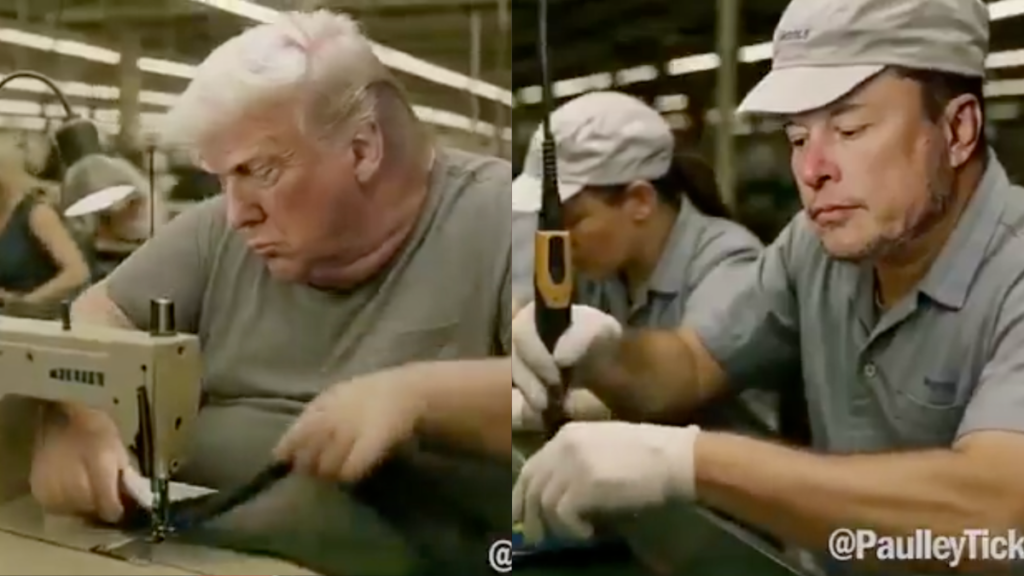
The core of this internet sensation lies in a series of AI-generated videos that present American leaders in settings reminiscent of Chinese manufacturing lines. One widely circulated clip shows a digitally recreated Donald Trump, JD Vance, and Elon Musk hunched over sewing machines, dressed in blue or grey factory uniforms, clumsily attempting to assemble products.
The exaggerated movements and robotic expressions are clearly intended to caricature the trio and by extension, the U.S. effort to revitalize its industrial base.
A TikTok user named Ben Lau was among the first to post the video, tagging it with hashtags such as “#tariff” and “#America,” along with the ironic caption “Make America great again.” Another TikTok user, Damon Chen, reposted it on X, adding a laughing emoji that resonated with millions—over six million views were recorded within just a few days.
Read : Donald Trump and Joe Biden Become BFFs: Watch
The use of AI to satirize international figures is not new, but what’s notable here is the direct targeting of political and business elites during a sensitive period of economic conflict. While some online users cheered the creativity and humor of the clips, others called out what they saw as demeaning representations—not just of U.S. leaders, but of factory workers in general.
AI-Generated videos depicting MAGA supporters – including Trump himself – working in warehouses sewing and manufacturing are going viral after the trade war between Beijing and Washington kicked off. pic.twitter.com/7L58XWnFGb
— Briefly (@Brieflybynewj) April 9, 2025
Critics questioned whether the videos crossed a line. “This isn’t satire—it’s classist,” one commenter posted. Another user pushed back against the mockery, noting that factory jobs were once the backbone of American prosperity: “My mom worked in a sewing factory for 15 years and kept us afloat. It’s a job deserving of respect, not ridicule.”
The Context: Escalating Trade Tensions Between China and the U.S.
The timing of these AI parodies is no coincidence. Trade tensions between China and the United States have once again reached a boiling point. After months of negotiations and temporary truces, both sides have resumed the tit-for-tat escalation of tariffs. President Trump’s decision to exclude China from a new round of tariff suspensions and instead dramatically increase import taxes has drawn a fierce reaction from Beijing.
China’s Ministry of Commerce spokesperson He Yongqian emphasized that China remains open to dialogue, but “any negotiations must be grounded in mutual respect.” The new tariffs have had immediate consequences on global stock markets, triggering fluctuations and raising concerns about future supply chain disruptions and inflationary pressures.
In this fraught climate, the AI videos appear not just as a cultural jab but as a symbolic retaliation. By placing prominent American figures in labor-intensive factory roles—especially in environments visually similar to Chinese industrial settings—the videos seem to argue that U.S. manufacturing dreams are both unrealistic and out of touch with current global economic dynamics.
Observers in both countries see this as part of a broader narrative war. While the U.S. emphasizes the need to bring manufacturing back to American soil, Chinese social media counters with a satirical message: you may try, but the global industrial stage is not so easily reshaped. And with AI tools now capable of producing increasingly convincing visual content, these messages can spread more rapidly and persuasively than ever.
Cultural Reactions and the Ethics of AI Satire
While the videos have largely played out as comedy on Chinese social media, the reactions elsewhere have been mixed. In the United States, the content touched a nerve with many who see factory work not as something to be mocked, but as a proud and often difficult livelihood.
One user wrote, “What exactly is your point? My mom worked in a sewing factory for 15 years, she raised us after dad left, stayed off welfare & kept food on the table & a roof over our heads.” This response captured the broader unease with the videos’ tone—using AI to mock blue-collar laborers runs the risk of perpetuating harmful stereotypes and disrespecting honest work.
— Damon Chen (@damengchen) April 7, 2025
Others pointed out the potential dangers of AI-driven satire when it comes to international relations. “This is soft propaganda,” one tech analyst commented. “What happens when world leaders are consistently shown in degrading or undignified roles via AI? This could erode diplomatic decorum and fuel mistrust.”
Indeed, while the current examples may seem humorous or low-stakes, the capabilities of AI to produce hyper-realistic or emotionally manipulative content raise serious ethical questions.
If political satire moves from the realm of editorial cartoons and sketch comedy into AI video simulations, where should the boundaries be drawn? Who decides when it is humorous critique and when it becomes misinformation or character assassination?
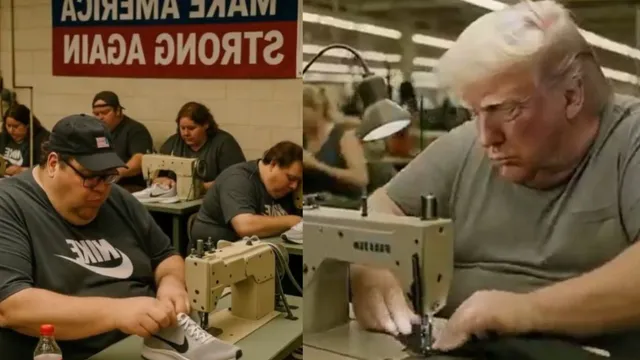
Despite the backlash from some quarters, many Chinese netizens appear to relish the videos as a clever response to Western economic policies perceived as unfair.
In this sense, the AI-generated factory worker satire becomes part of a broader movement: the use of technology not only for storytelling and entertainment but for political expression and nationalistic messaging.
The meme war is no longer just about jokes—it’s a high-tech cultural confrontation that mirrors the economic and geopolitical tensions simmering beneath the surface. Whether meant in jest or with sharp political intent, the impact of these videos is clear: they resonate, provoke, and leave a lasting impression.
As the trade conflict deepens, so too does the information war waged through AI, satire, and social media. What began as a light-hearted parody may well become a regular tactic in the modern arsenal of digital diplomacy—or digital confrontation. Either way, the image of Donald Trump hunched over a factory bench may stay with global audiences far longer than any policy memo or tariff chart.