
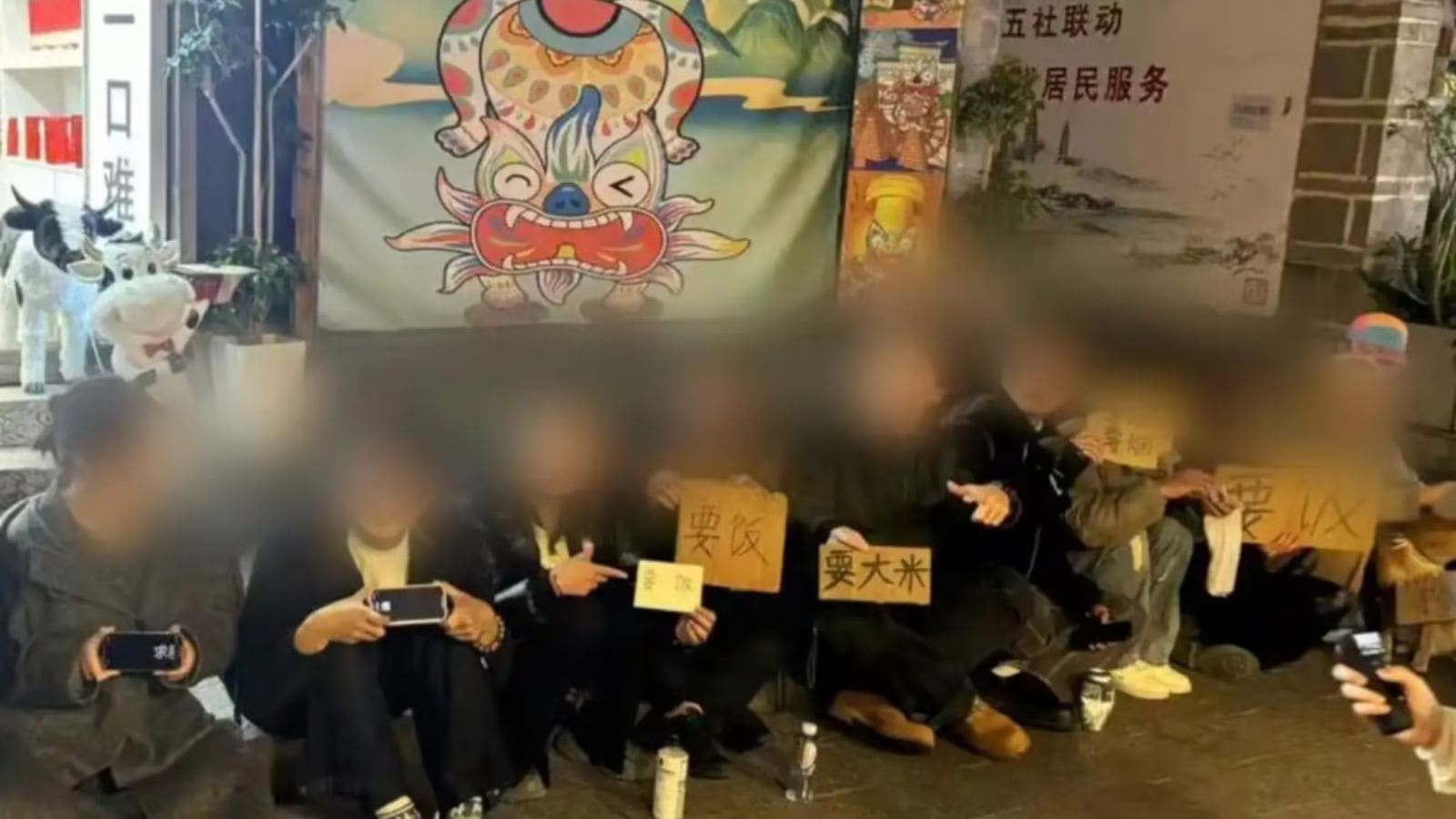
A unique social phenomenon “playful begging” emerged in the tourist city of Dali, Yunnan province, where groups of young individuals have redefined the concept of begging.
Unlike traditional beggars seeking financial aid, these so-called “playful beggars” gather on the streets, engaging in activities such as smoking, drinking, chatting, and taking photographs while displaying signs that read “begging.” However, their primary goal is not to collect money but rather to embrace a new form of social interaction and self-expression.
The trend, which has sparked widespread discussion on Chinese social media, reflects deeper societal themes, including the desire to break free from rigid norms and the pressures of China’s demanding work culture.
Many participants see their involvement as a way to challenge conventional definitions of success and survival while embracing a more laid-back, unconventional lifestyle. While authorities have begun taking steps to curb the movement, it continues to evolve as an emblem of youthful defiance and experimentation with alternative ways of living.
The Concept of Playful Begging and Its Growing Popularity
The rise of “playful begging” in Dali is rooted in a broader cultural shift among young Chinese adults who are increasingly rejecting traditional career paths and societal expectations.
Many of these individuals feel disillusioned with China’s intense work culture, particularly the notorious 996 system—working from 9 a.m. to 9 p.m., six days a week. As an alternative, they seek a more relaxed and fulfilling way of life, free from the constraints of corporate employment and societal pressures.
A man surnamed Yang, who has participated in this movement, explained that the “begging” is not meant to be taken literally. Instead, it serves as a form of social engagement and performance art.
“It’s not truly begging in the traditional sense; it’s more about having a good time,” he said. “Passers-by frequently offer us cigarettes, beer, drinks, and snacks, but we rarely accept money.”
The movement has gained traction, with more people joining in. Some individuals display QR codes for small donations, but even then, the amounts received are minimal. The act of playful begging is more about making a statement than acquiring financial assistance. It symbolizes an intentional rejection of conventional success and a pursuit of freedom and self-expression.
Read : Chinese Woman Cheated 36 Men to Buy Apartment in Shenzhen
The ease of participation has contributed to its growing appeal. According to Yang, anyone can join the movement by simply placing a sign that says “begging” on the ground and sitting down.
Read : Viral ‘Stop Banana green’ Trend that Chinese Employees are Using to Fight Work Stress
This informal and inclusive nature makes it accessible to a wide range of individuals, from local workers to travelers passing through Dali. The act challenges the idea that begging is solely associated with desperation or economic hardship; instead, it reframes it as a voluntary, almost rebellious act against societal expectations.
Societal Reactions and Government Response
The emergence of playful begging has sparked intense debate on Chinese social media, with opinions sharply divided. Some view it as an innovative form of self-expression, likening it to performance art or a modern protest against rigid social norms.
“To be honest, this makes sense,” one advocate said. “A 3,000-yuan salary barely covers food and rent, and you still have to endure a dreadful boss. At least by ‘begging,’ you get free meals during the day and can enjoy yourself at night.”
Others, however, criticize the movement as a sign of declining self-respect among young people. “Relying on charity? What about your dignity?” one commentator questioned.
Critics argue that the movement romanticizes idleness and irresponsibility, discouraging hard work and perseverance. They believe that young people should focus on building stable careers rather than engaging in what they perceive as a frivolous social experiment.
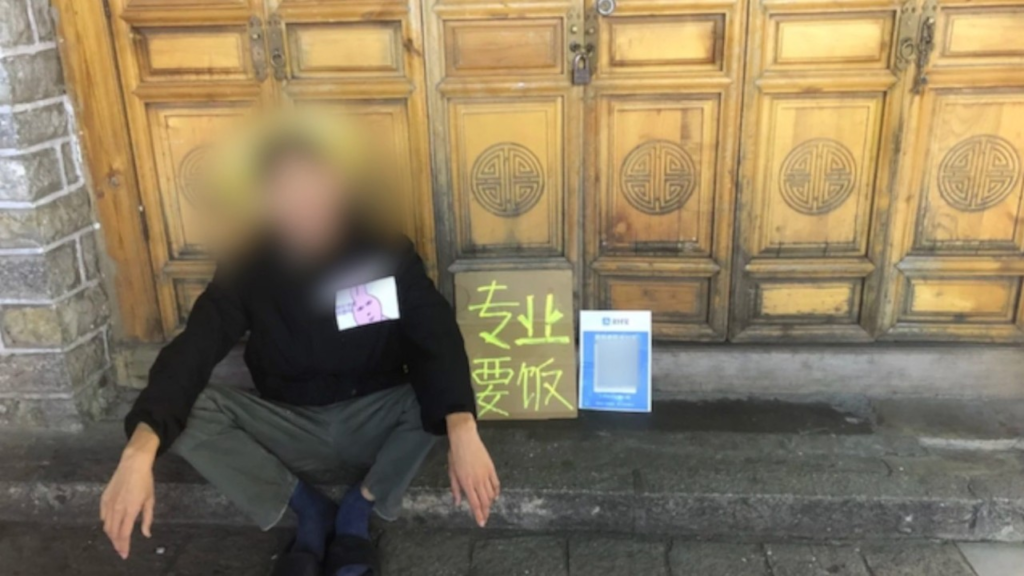
Despite the polarized opinions, the Chinese government has responded by attempting to regulate and discourage the activity. On March 4, the Dali Ancient City Protection and Management Bureau announced the formation of a special task force to intervene and reduce the presence of playful beggars.
Additionally, the Dali Municipal Bureau of Culture and Tourism has initiated a campaign promoting “civilized tourism” to maintain the city’s image as a top travel destination.
Authorities fear that the movement may tarnish Dali’s reputation and create an environment that discourages responsible tourism. However, their efforts to curb the trend face challenges, as many participants view their actions as harmless and within their personal rights.
Some argue that as long as they are not disrupting public order or engaging in criminal activity, they should be free to express themselves in this manner.
The Connection to Tangping Culture and the Search for Freedom
The rise of playful begging is closely linked to the broader “tangping” or “lying flat” movement, a popular trend among Chinese youths advocating for stepping away from the rat race and rejecting excessive societal pressures.
The tangping mindset encourages individuals to live minimally, reduce material ambitions, and focus on personal well-being rather than constantly striving for career advancement and financial success.
For many, playful begging is an extension of this philosophy, symbolizing a conscious decision to step outside the conventional workforce and redefine what it means to live meaningfully. Participants see it as an act of rebellion against the stress and dissatisfaction that often accompany traditional employment paths.
In a society that places significant emphasis on productivity and success, playful begging represents an alternative perspective—one that values leisure, connection, and personal fulfillment over relentless ambition.
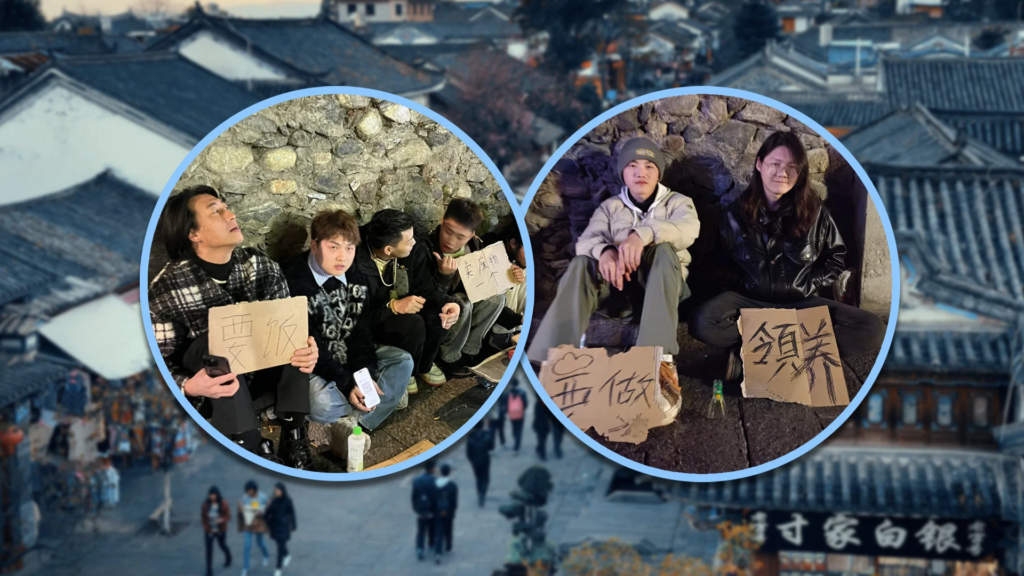
Yet, while some celebrate this newfound freedom, others worry about its long-term implications. If a growing number of young people choose to opt out of conventional employment, it could impact China’s workforce and economic stability. Critics fear that such attitudes may lead to a decline in national productivity and discourage innovation and hard work.
Despite these concerns, playful begging continues to resonate with a segment of Chinese youth who feel trapped by modern work expectations. The movement highlights a broader societal shift, where younger generations are increasingly questioning traditional notions of success and seeking alternative paths to happiness.
Whether it remains a niche social experiment or evolves into a larger cultural shift remains to be seen, but for now, it serves as a thought-provoking expression of generational discontent and the desire for personal freedom.
As the debate surrounding playful begging continues, the movement challenges China’s evolving cultural landscape and raises important questions about work-life balance, societal expectations, and the meaning of self-expression in a rapidly changing world.
Whether viewed as a rebellious statement, a form of performance art, or a symptom of economic frustration, one thing is clear: playful begging has captured the attention of many, pushing the boundaries of conventional societal norms in modern China.