
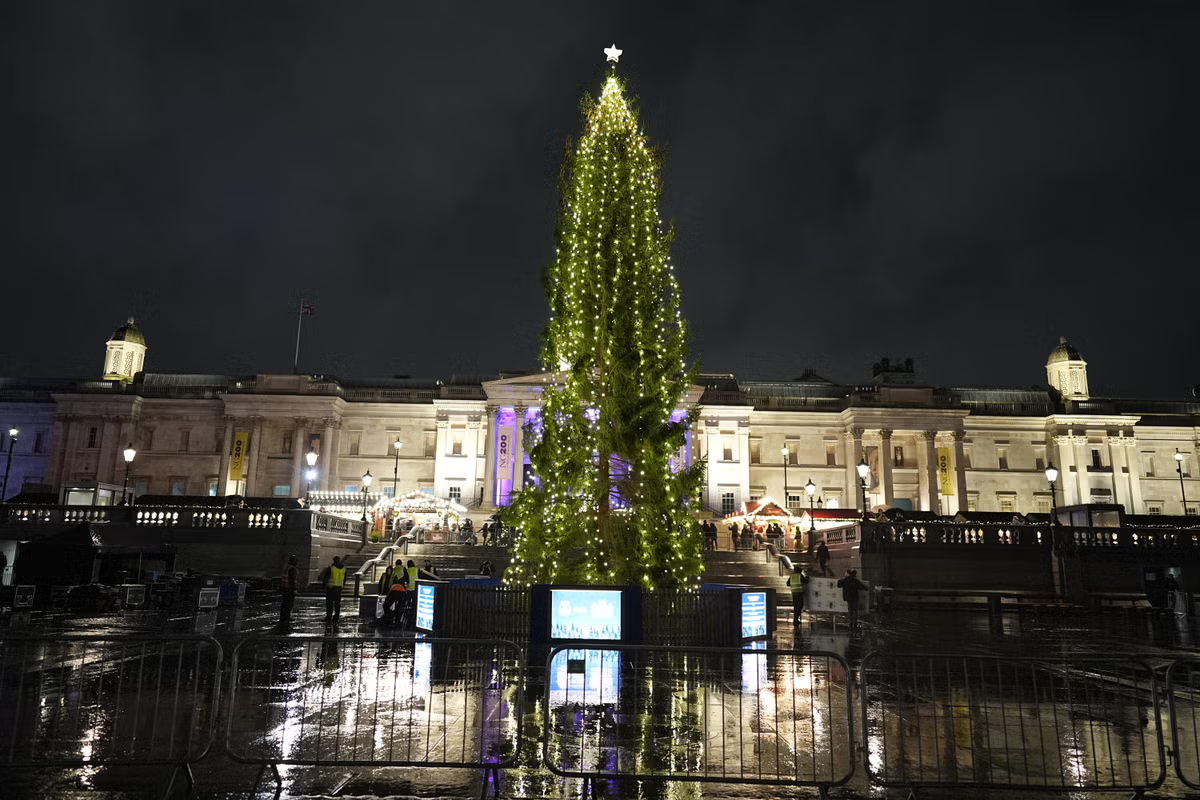
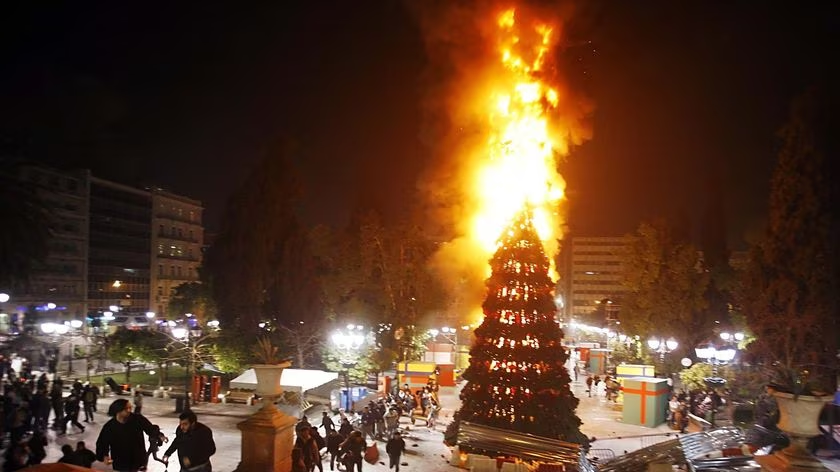
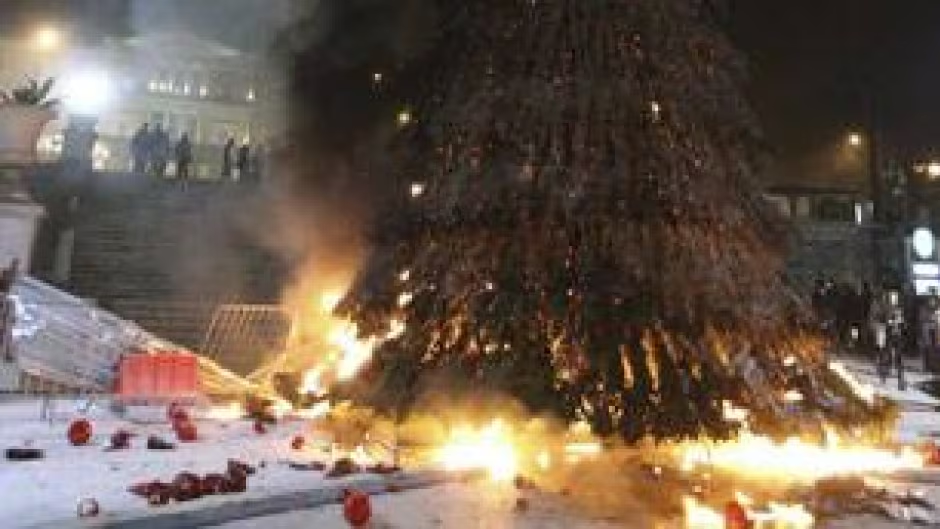
In a shocking display of hostility towards religious symbols, a Christmas tree was burned by Islamist fighters near the town of Suqaylabiyah, located in the central Syrian governorate of Hama.
The incident, which has sparked widespread outrage, particularly among Syria’s Christian community, has led to protests in several Christian-majority areas, including the capital Damascus.
These protests have ignited a broader discussion on the security and rights of minority communities in Syria, particularly Christians, who have long been part of the fabric of Syrian society.
The burning of the Christmas tree, which symbolizes the Christian faith and the Christmas season, became a flashpoint in the already tense political and religious atmosphere in Syria.
It occurred amid a backdrop of shifting power dynamics in the country, following recent victories by Islamist coalitions against the government of Bashar al-Assad.
Read : Christmas Market Opens in Syria’s Damascus Days After Assad’s Exit
While the Syrian government, under Assad, had long positioned itself as a protector of religious minorities, recent events suggest that Syria’s Christian community is increasingly vulnerable, and the fire that consumed the tree in Suqaylabiyah only fueled these concerns.
The Incident: What Happened in Suqaylabiyah?
The town of Suqaylabiyah, located in central Syria near Hama, has long been known for its Christian majority. The town had prepared for the holiday season, and the lighting of the Christmas tree was a symbolic event for the local community.
However, in a disturbing turn of events, a video surfaced on social media showing a group of hooded men burning the Christmas tree, sparking outrage across the country.
Radical Muslims lit a Christmas tree on fire in Al-Suqaylabiyah to send an unwelcoming message to the few remaining Christians in Syria. pic.twitter.com/3cgF8Gz2Oi
— Brigitte Gabriel (@ACTBrigitte) December 23, 2024
The perpetrators of this act were identified as foreign fighters from the Islamist group Ansar al-Tawhid, according to the Syrian Observatory for Human Rights. The act of burning a Christmas tree, a symbol of Christian identity, shocked many Syrians, particularly those in the Christian community, who have faced increasing marginalization in recent years.
The video, which quickly spread across social media platforms, led to immediate condemnation from religious leaders and Christian groups, who saw this as an attack on their faith and heritage.
The burning of the tree became not just an attack on a physical object but a direct challenge to the Christian identity in the region.
For many, the Christmas tree represents more than just a holiday decoration—it is a symbol of faith, unity, and resilience. The attack on this symbol, especially in a community already under pressure, further exacerbated the sense of insecurity among Christians in Syria.
Outrage and Protests: A Call for Christian Rights
In response to the burning of the Christmas tree, protests erupted in several Christian-majority areas, with demonstrators marching through the streets of Damascus, chanting slogans like “We demand the rights of Christians.”
The protests were not only a reaction to the burning of the tree but also a broader expression of frustration with the increasing vulnerability of Christians in Syria. The protesters gathered in front of the Orthodox Patriarchate in the Bab Sharqi neighborhood, demanding justice and protection for their community.
One protester, identified only as Georges, expressed his anger and frustration, saying, “If we’re not allowed to live our Christian faith in our country, as we used to, then we don’t belong here anymore.” His words resonate deeply within the context of Syria’s ongoing conflict, where religious minorities, especially Christians, have faced increasing threats from extremist groups.
While the Assad government had historically positioned itself as a protector of religious minorities, the shifting alliances and power structures in the region have left Christians in a precarious position.
The protests were a cry for recognition and safety, with many Christian Syrians fearing for their future in a country where they have lived for centuries. The fear is not just about the present but also about the future, especially with the rise of Islamist groups like Ansar al-Tawhid and Hayat Tahrir al-Sham (HTS), which have gained ground in recent months.
The Role of Islamist Groups in Syria’s Changing Landscape
The burning of the Christmas tree in Suqaylabiyah occurred amid significant shifts in Syria’s political and military landscape. Following the collapse of government control in some regions, Islamist groups have gained ground, particularly in the north and west of the country.
Ansar al-Tawhid, a group linked to al-Qaeda, and Hayat Tahrir al-Sham (HTS), which also has ties to extremist groups, have made significant inroads in regions once under government control.
HTS, in particular, has positioned itself as a protector of religious minorities, promising to uphold the rights of Christians in the areas they control. Despite this claim, the burning of the Christmas tree in Suqaylabiyah suggests that their assurances may not be enough to ensure the safety and security of religious minorities in Syria.
In a statement following the incident, a religious leader from HTS, which led the offensive against Assad’s forces in recent months, stated that those responsible for burning the tree were not Syrian and promised that they would be punished.
He also assured the residents that the tree would be replaced and lit up again the following morning. Despite these promises, the damage to the trust between Syria’s Christian community and the Islamist groups in the region is palpable.
HTS’s mixed record on religious tolerance raises questions about its future role in Syria. While they claim to protect minorities, their actions often speak louder than their words. The destruction of a Christmas tree, one of the most significant symbols of Christian faith, undermines their rhetoric and raises doubts about their commitment to safeguarding the rights of Christians.
A Broader Reflection on Religious Freedom in Syria
The incident in Suqaylabiyah and the subsequent protests reflect a broader issue that has been simmering in Syria for years: the struggle for religious freedom and the protection of minority rights.
Syria has long been home to a diverse range of religious communities, including Christians, Alawites, Druze, and various Sunni sects. However, the ongoing conflict, which has pitted the Assad regime against various opposition forces, has exacerbated religious and ethnic tensions.
Under the Assad regime, Christians were largely protected, but the war and the rise of extremist groups have complicated their position. While some Islamist groups, like HTS, claim to protect minorities, their actions, such as the burning of the Christmas tree, suggest otherwise.
The Christians of Syria are left in a difficult position, caught between the regime, which they see as a protector but also as part of the wider problem, and the growing influence of Islamist groups that do not share their values or respect their religious freedoms.
For many Christians, the recent events are a reminder that they are increasingly marginalized in a country they have called home for millennia. The destruction of the Christmas tree symbolizes more than just a single act of vandalism; it is a reflection of the ongoing religious and political struggles that threaten the very fabric of Syrian society.
A Call for Unity and Protection of Minority Rights
The burning of the Christmas tree in Suqaylabiyah has sparked a series of protests and renewed fears among Syria’s Christian population. It is a stark reminder of the challenges facing religious minorities in a country mired in conflict.
As Syria’s political landscape continues to shift, the international community must take notice of the plight of Christians and other minorities, who are at risk of being caught in the crossfire of competing political and religious forces.
The protests in Damascus and the broader calls for the protection of Christian rights reflect a deepening sense of insecurity among Syria’s Christian community. As the future of Syria remains uncertain, it is imperative that efforts be made to ensure the safety and rights of all religious groups, including Christians, who have long been an integral part of the nation’s identity.
Only through dialogue, cooperation, and a commitment to religious freedom can Syria move toward a future where all of its people can coexist peacefully, without fear of persecution based on their faith.