

A sense of normalcy prevailed on the 3600 block of North Campbell Road in Las Vegas until the afternoon of Thursday, May 29, when a fatal altercation inside a shared residence disrupted the community’s quiet routine. According to a statement released by the Las Vegas Metropolitan Police Department (LVMPD), officers responded swiftly to reports of gunfire, only to discover a chilling scene—an unresponsive man lying on the floor, suffering from multiple gunshot wounds.
Despite the efforts of first responders, he was declared dead at the scene. The suspect, 36-year-old Christopher Rainey, was still inside the home, armed and ultimately taken into custody. The preliminary investigation by the LVMPD revealed that the victim was more than just another resident—he was Rainey’s landlord and roommate.
This tragic event wasn’t a random act of violence, but the deadly culmination of a deteriorating landlord-tenant relationship. Shortly before the shooting, the landlord had served Rainey with an eviction notice. The notice, intended to begin a legal process of reclaiming the property, was instead met with fatal resistance. Police reported that an argument followed the notice, and moments later, Rainey allegedly opened fire on his landlord multiple times, ending his life in a matter of seconds.
This incident sent shockwaves through the neighborhood and deeply affected those who knew the victim personally. A fellow roommate, who had lived in the house with both the victim and the suspect, shared with reporters the deep sense of loss and disbelief. “He was my friend, and he didn’t deserve to die like this,” the roommate said.
Describing Rainey, they added, “He was a creepy, sneaky, son of a b—- up there in his room.” Their words reflected not just grief, but a lingering unease about Rainey’s presence and behavior prior to the tragedy.
The Eviction Notice That Turned Deadly
In most rental disputes, an eviction notice serves as a formal beginning to the process of asking a tenant to vacate a property. While it can be stressful and upsetting, it is typically handled through legal channels with eventual court intervention if necessary. However, in this instance, the notice seems to have been the final spark in a volatile situation that had likely been simmering for some time.
The details provided by the police indicate that the situation escalated quickly. After receiving the notice, Rainey and the landlord exchanged words. What might have remained a heated argument between two adults instead turned deadly. Authorities say Christopher Rainey retrieved a weapon and shot the landlord multiple times before remaining in the house, armed, as police responded to the scene.
This act of violence sheds light on the hidden emotional and psychological tensions that can develop in shared living arrangements—especially when power dynamics, such as landlord and tenant roles, come into play.
Read : Landlord in Ontario Faces Stress as Tenants Skip Rent, Raise Khalistan Flag
Rainey’s reaction to the eviction notice suggests that the act of being removed from his living space was not something he could accept passively. Whether the motive was driven by fear of homelessness, pride, resentment, or deeper psychological issues, the outcome was catastrophic.
Read : 7 Palestinians Killed in Jenin by an Israeli Military Operation in West Bank: Watch
The case is also a reminder of how dangerous disputes within homes can become. Shared spaces, when filled with unresolved grievances, strained relationships, or mental instability, can transform from places of shelter into zones of conflict. The roommate who survived described Rainey as “sneaky,” hinting at underlying behavioral issues or personality traits that may have gone unnoticed or unaddressed until it was too late.
Aftermath and Arrest
Following the shooting, law enforcement officers arrived at the residence and found Christopher Rainey armed. He did not flee the scene nor offer resistance, which allowed police to arrest him without further incident. He was then booked into the Clark County Detention Center on charges of murder with a deadly weapon and assault. His next court appearance is scheduled for June 3, according to Clark County public records.

News of the shooting quickly spread throughout the neighborhood and the local media. The story was picked up by several outlets, including Fox affiliate KLAS, which reported additional details about the living arrangement in the home. There were a total of four people living in the house at the time of the incident, and one of them was present during the shooting.
That roommate, who was interviewed afterward, expressed both sorrow and a sense of eerie inevitability. They described Christopher Rainey’s presence in the house as unsettling and isolated—someone who “kept to himself” and was largely unknown to the others despite living under the same roof.
These kinds of shared housing situations are not uncommon, especially in cities like Las Vegas where housing costs can force people into closer quarters than they might prefer. But they also bring risks, especially when conflict resolution is absent or when emotional stability is in question. This tragedy underscores how quickly things can spiral out of control when disputes are not de-escalated or when people carry unaddressed mental health challenges.
A Life Lost and a Community Shaken
At the heart of this tragedy is the life that was taken. The victim, though not yet named by authorities, was remembered fondly by his roommate of 15 years. Their friendship, built over more than a decade, ended in the most horrific way imaginable. “He didn’t deserve to die like this,” the roommate repeated, a haunting sentiment that now echoes in a home that has been permanently scarred by violence.
This story isn’t just about the crime itself—it’s about the broader social and emotional fallout that follows such an event. A home has been broken, a friendship has ended in grief, and a man’s life has been cut short over a dispute that should have been handled within the boundaries of law and dialogue. Instead, a gun was drawn, a trigger pulled, and a community left stunned.
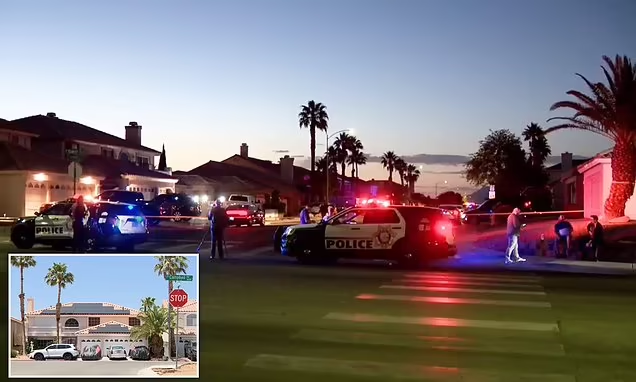
The LVMPD has not yet disclosed further details about the case, and it remains unclear what, if any, prior tensions existed between Christopher Rainey and his landlord beyond the eviction notice. The public and the courts will learn more in the coming weeks as Rainey’s case proceeds through the legal system. Meanwhile, neighbors and friends are left grappling with a senseless act that turned a home into a crime scene.
Court documents and jail records show Christopher Rainey is facing severe charges, and if convicted, he could spend the rest of his life in prison. But no conviction, no sentence, can undo what has already been done. A man is dead. A household is fractured. And a neighborhood in Las Vegas will forever remember May 29 as the day normal life was shattered by a gunshot.
Community Reflections and the Road Ahead
As Las Vegas residents continue to process this disturbing event, many are asking how such a tragedy could have been prevented. Mental health support, access to mediation for housing disputes, and greater awareness of red flags in shared living environments are all part of the conversation now emerging in the wake of the shooting. It’s easy to look back in hindsight and see warning signs, but the real challenge lies in addressing these issues before they escalate.

The tragic death of the landlord has ignited a broader discussion about the stresses associated with housing instability, especially in a post-pandemic world where many are still struggling to regain financial stability. Evictions, while sometimes necessary from a legal standpoint, can carry deep emotional consequences.
For some, the prospect of losing a home can feel like the end of the road. And without the proper channels to process that stress or seek support, it can manifest in dangerous and unpredictable ways.
In the coming weeks, more will be learned about Christopher Rainey’s background, his mental state, and the events leading up to the eviction notice. But what’s already clear is that a volatile mix of personal tension, legal pressure, and emotional instability proved to be a deadly combination. The challenge for communities, lawmakers, and mental health professionals is to build better systems of support so that such confrontations do not turn fatal.
The tragedy that unfolded on North Campbell Road is a somber reminder of how quickly life can change—and how essential it is for individuals and systems to recognize distress before it becomes disaster. As the city of Las Vegas mourns this loss, there is also a renewed urgency to prevent similar events from happening in the future.