

In a gripping tale of survival against the odds, American climate journalist Alec Luhn endured six harrowing days stranded in the remote wilderness of Norway’s Folgefonna National Park after a devastating fall during a solo hike. The 38-year-old Wisconsin native, known for his award-winning reporting on environmental issues, found himself immobilized with severe injuries, resorting to extreme measures to stay alive in one of Europe’s most unforgiving glacial landscapes.
This incident, which unfolded in early August 2025, highlights the perils of solo adventuring in glacial terrain and the resilience of the human spirit. Luhn’s story, pieced together from his own accounts in post-rescue interviews, serves as a stark reminder of nature’s unpredictability, even for experienced outdoorsmen. Alec Luhn, who has reported from remote locations like Siberia and the Arctic Ocean for outlets such as National Geographic,
The Guardian, and The New York Times, had extended a family vacation in Bergen, Norway, to embark on this personal expedition. His background in climate journalism, including a 2024 Kavli Science Journalism Award from the American Association for the Advancement of Science, often takes him to harsh environments to cover stories on global warming and ecological changes.
Folgefonna National Park, home to the third-largest glacier on mainland Norway, seemed a fitting backdrop for his hike, offering stunning views of ice fields and valleys. However, what began as an invigorating four-day backpacking trip quickly turned into a life-or-death struggle, testing his physical and mental limits in ways he never anticipated.
The Fateful Hike: From Adventure to Nightmare
Alec Luhn set out on his solo journey on July 31, 2025, eager to explore the Buarbreen glacier within Folgefonna National Park in southwestern Norway. As an experienced hiker accustomed to challenging terrains, he had prepared for the trek, packing essentials like a tent, sleeping bag, food supplies, and a cellphone. He informed his wife, Veronika Silchenko, a fellow journalist based in London, that cell service might be spotty and that he wouldn’t be in constant contact. The plan was to complete the hike and catch a flight back to England on August 4.
Trouble started early. On the first day, the sole of his left boot began to detach, a minor issue he attempted to fix with athletic tape. Undeterred, Alec Luhn pressed on, reaching a ridge near the glacier by late evening. The Norwegian summer sun provided extended daylight, allowing him to hike longer than usual. However, around 10 p.m., disaster struck. Luhn took a wrong step on the steep, icy slope, causing him to slip and tumble down the mountain.
He described the fall as “pinballing down the mountain,” sliding, spinning, and bouncing off rocks in a chaotic descent that left him battered and disoriented. When the tumbling finally stopped after slamming into a large rock, Alec Luhn assessed his injuries. His left femur had snapped in two places, his pelvis was fractured in three spots, and he had suffered about half a dozen broken vertebrae.
Severe pain radiated through his body, and his left foot dangled limply, “just flopping around with no direction.” The fall also ripped open his backpack, scattering vital items. He lost his cellphone, water canteen, and most of his food supplies, including energy bars and nuts that could have sustained him longer. Immobilized and alone on the rugged terrain, Alec Luhn realized he was stranded in a remote area where no other hikers were visible. The glacier’s isolation, combined with his inability to move, meant he had to endure until someone noticed his absence.
CNN's Anderson Cooper speaks with Alec Luhn, a hiker who was rescued after 6 days with little food and water on a remote mountaintop in Norway. pic.twitter.com/Bd6fX0ocy9
— Anderson Cooper 360° (@AC360) August 22, 2025
The initial hours were a blur of shock and pain. Alec Luhn managed to drag himself slightly to set up a makeshift shelter using his surviving tent poles and rain jacket. He rationed the few remaining snacks— a handful of peanuts and granola bars—but without water, eating them felt like swallowing “concrete” due to his parched throat.
As night fell, the reality of his situation sank in: he was trapped on a glacier with no immediate help, facing dehydration, exposure, and the psychological torment of uncertainty. Alec Luhn later reflected that he regretted not turning back when his boot failed, a small decision that snowballed into catastrophe. This phase of the ordeal underscored the fine line between adventure and peril in glacial environments, where a single misstep can lead to isolation amid vast, unforgiving ice fields.
Desperate Measures: Survival in the Wilderness
Stranded for what would become six agonizing days, Alec Luhn turned to extreme survival tactics to combat dehydration, hunger, and the elements. With no access to fresh water in the first two days under the intense sun, he faced the grim prospect of dying from thirst. Recalling survival knowledge that humans can perish after three days without water, Luhn made the difficult decision to drink his own urine. He urinated into an empty water pouch and consumed small amounts to stay hydrated enough to swallow his limited food rations.
This method, while unpalatable, has been used by other survivors in dire situations and provided crucial moisture to prevent organ failure. In another desperate act, Luhn popped a blister on his hand to drink the blood, gaining a tiny bit of liquid sustenance. He supplemented his diet by eating grass and moss found nearby, meager sources of nutrition that helped stave off starvation.
Read : 59-year-old Troy Casey Claims He Drinks His Own Urine to Remain Healthy
By the third day, the weather shifted dramatically, bringing heavy rain that Luhn described as “the best thing I ever tasted.” He collected rainwater by sucking it from the creases of his sleeping bag and licking every drop he could find, providing much-needed relief after days of severe dehydration. However, the rain introduced new challenges. Torrential downpours and gale-force winds soaked him through, turning his shelter into a cold, wet prison. Luhn endured near-freezing temperatures, which exacerbated his injuries and led to severe frostbite on his feet.
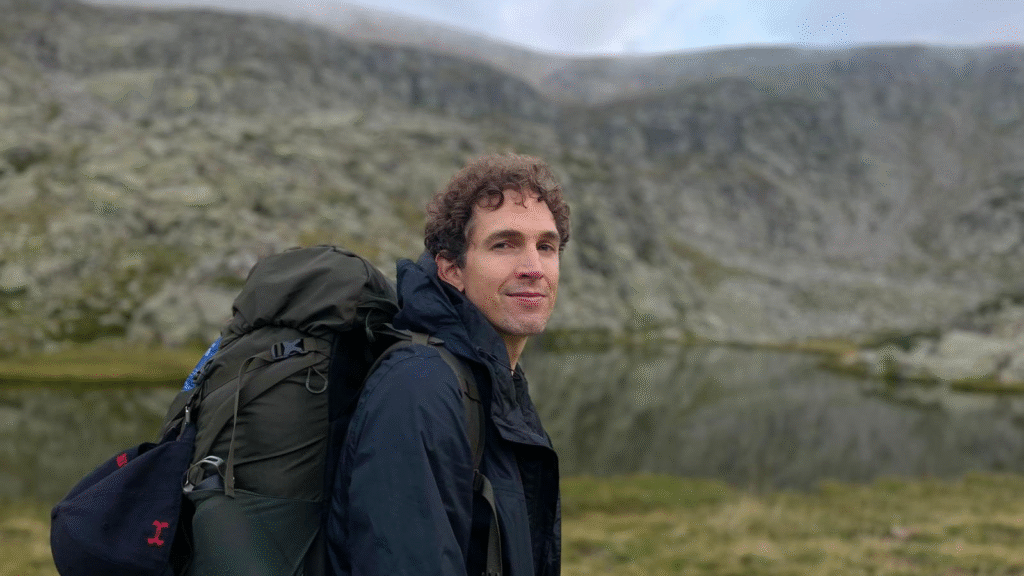
Hallucinations set in from the pain, exhaustion, and isolation; at one point, he feared the approaching storm clouds merging with the mountain peaks signaled his end. “This actually might be it. I might not make it through this,” he thought. Mentally, Luhn drew strength from thoughts of his family—his wife, parents, and siblings—praying and calling on the universe to reunite him with them. His brightly colored clothing and improvised flag from a tent pole and bandanna were deliberate choices to aid visibility, reflecting his foresight even in crisis.
Throughout this period, Luhn’s journalistic instincts persisted; he mentally noted details of his experience, later requesting pen and paper in the hospital to document his story. The glacier’s harsh conditions, amplified by climate factors like unpredictable weather patterns, mirrored the environmental themes he often covers in his work. This survival phase not only tested his physical endurance but also highlighted the psychological resilience required to face prolonged solitude and suffering in a glacial wilderness.
Rescue and Reflection: A New Lease on Life
The turning point came on August 6, 2025, after Luhn’s wife, Veronika Silchenko, reported him missing on August 4 when he failed to board his scheduled flight. Unable to eat or sleep from worry, she coordinated with Norwegian authorities, confident in his strength: “I knew that he would do everything he could to wait for us to rescue him.” Initial search efforts were hampered by persistent rain, wind, and low clouds, making aerial operations nearly impossible on August 5.
With improved weather on the sixth day, a massive rescue operation involving over 50 personnel from the Norwegian Red Cross, local police, alpine rescue groups, and drones swung into action. Alec Luhn spotted a helicopter approaching but watched in despair as it passed without noticing him.

Undeterred, he waved his improvised flag vigorously. When the chopper returned 45 minutes later, he yelled and signaled until a crew member waved back, confirming he had been seen. “That was the moment I knew it was finally, finally over,” Luhn recalled. He was airlifted to a hospital in Bergen, where doctors treated his fractures, frostbite, and performed surgery on his femur and pelvis.
The reunion with his family was emotional. Upon seeing Silchenko, Luhn said, “I love you,” to which she replied, “I’m gonna rip you a new one, but for now, I love you.” His parents also flew in, providing support during his recovery. Doctors anticipate a full recovery after extensive rehabilitation, though Luhn has been banned from solo hiking by his wife.
Reflecting on the experience, Luhn expressed profound gratitude for his survival, noting how the ordeal reshaped his priorities. “I spent a lot of time thinking about my wife and my family and how silly it was that here I was possibly going to die because I wanted to do a cool hike around this glacier,” he told interviewers.
The incident has given him a renewed appreciation for life and family, while also underscoring the risks of glacial hiking amid changing climates. As a climate journalist, Luhn’s personal brush with nature’s fury may inform future stories, emphasizing the human impact of environmental extremes. His story stands as a testament to human endurance and the critical role of timely rescue operations in remote areas.