
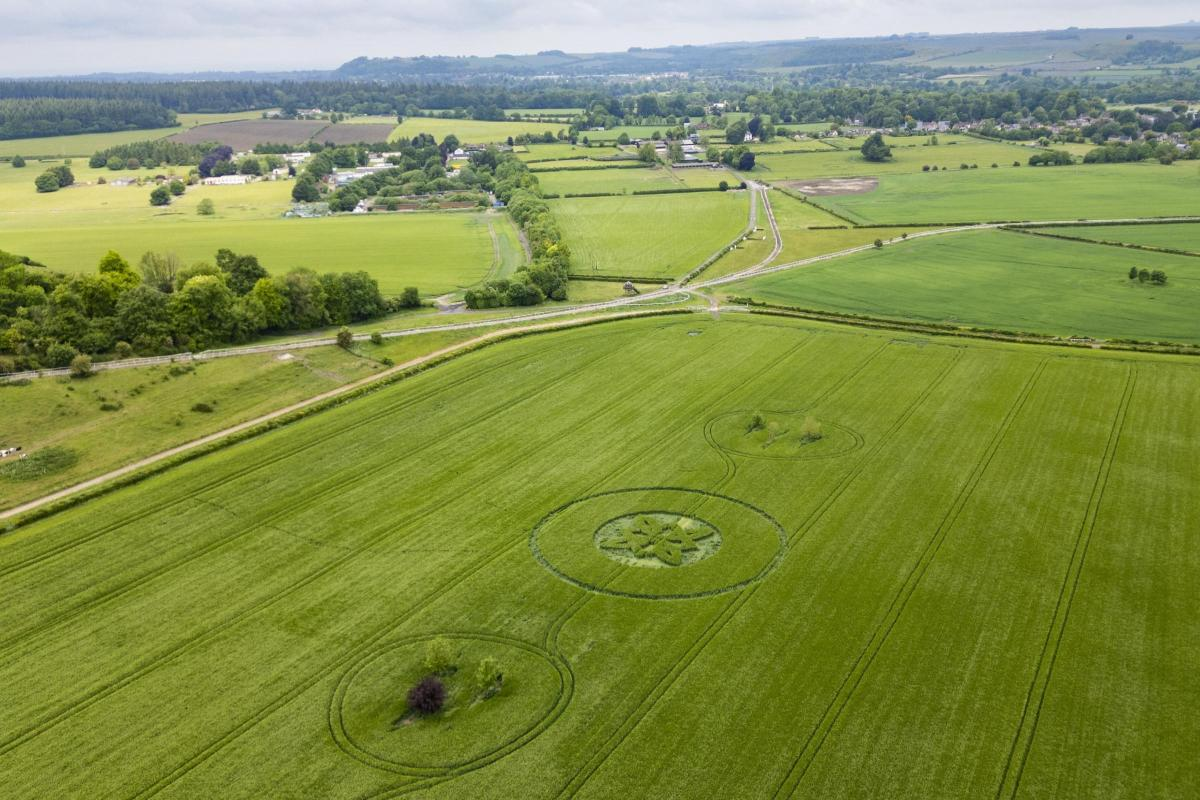
In the heart of England, among the rolling landscapes and ancient monuments, an enduring mystery continues to fascinate both skeptics and believers alike. The county of Wiltshire, famously home to the prehistoric site of Stonehenge, has also become synonymous with crop circles—large, elaborate geometric patterns that suddenly appear in fields of wheat, barley, and other crops, often overnight and without a clear explanation.
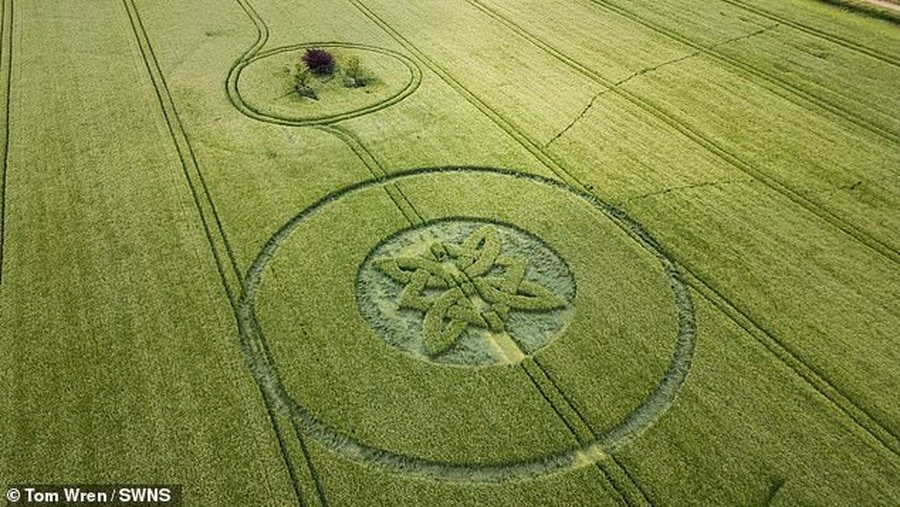
While some dismiss them as the work of pranksters, others insist these designs are messages from an otherworldly intelligence. The most recent sightings have thrust Wiltshire back into the global spotlight. On May 15, 2025, a crop circle featuring a pattern resembling a Celtic knot or a four-pointed star appeared in a farmer’s field in Sutton Veny.
Just days later, another elaborate formation, composed of interlocking circles and geometric shapes, was discovered 30 miles away in Dorset. These designs have sparked a surge of interest from enthusiasts and researchers around the world, raising new questions about their creation and meaning.
The Art and Allegations: Man or Machine?
The idea that crop circles are simply the work of human artists or pranksters is not without merit. Many formations have been conclusively linked to human activity. Tools such as wooden planks, ropes, and even GPS devices are often used to flatten crops into precise shapes.
In one of the most notable confessions, Doug Bower and Dave Chorley, two Englishmen from Southampton, admitted in 1991 that they had created more than 200 crop circles across southern England since the late 1970s. Their demonstration using basic equipment proved that it was possible to construct these elaborate designs without any supernatural help.
Further supporting the man-made theory, a group of MIT graduate students in aeronautics and astronautics were able to replicate a complex crop circle in 2002 for a television experiment. Their goal was to mimic the type of formation thought to be beyond human capability. With planning and teamwork, they succeeded—casting doubt on the claim that intricate crop circles could only be made by alien intelligence.
Despite these human confessions, not all crop circles are easily explained. Many patterns show remarkable symmetry and mathematical precision. Some formations span hundreds of feet and feature complex fractal patterns that would require significant planning and execution—supposedly accomplished in the dark of night and within minutes.
First crop circle of Crop Circle this season in Wiltshire, UK. https://t.co/KmfPRPFIbm
— Good Morning UFO (@goodmorningufo) May 20, 2025
Doug Bower and Dave Chorley, two Englishmen, famously admitted in 1991 that they created more than 200 crop circles in southern England using simple tools like planks and rope.
What do you… pic.twitter.com/fYV8lXpi4U
Skeptics argue that even with modern tools, such feats are unlikely without being noticed, especially given the scale and rural visibility of the fields involved.
Unexplained Elements: A Paranormal Puzzle
Proponents of the extraterrestrial hypothesis point to several anomalies surrounding certain crop circles. For instance, some stalks in these formations are bent at the nodes but not broken, as if they were softened by heat rather than mechanically forced down. Additionally, these patterns often appear without any sign of footprints or tire tracks, further fueling the mystery.
Eyewitness accounts add to the intrigue. Some people claim to have seen strange orbs of light hovering over fields shortly before crop circles appear. In other cases, witnesses have reported unusual sounds, electronic malfunctions, or even a sudden sense of calm or euphoria while near these sites. These experiences, though anecdotal, have convinced some researchers that the phenomenon may have a paranormal or extraterrestrial origin.
Read : People Panic After Mysterious UFO Caught Hovering Above Capitol Hill: Watch
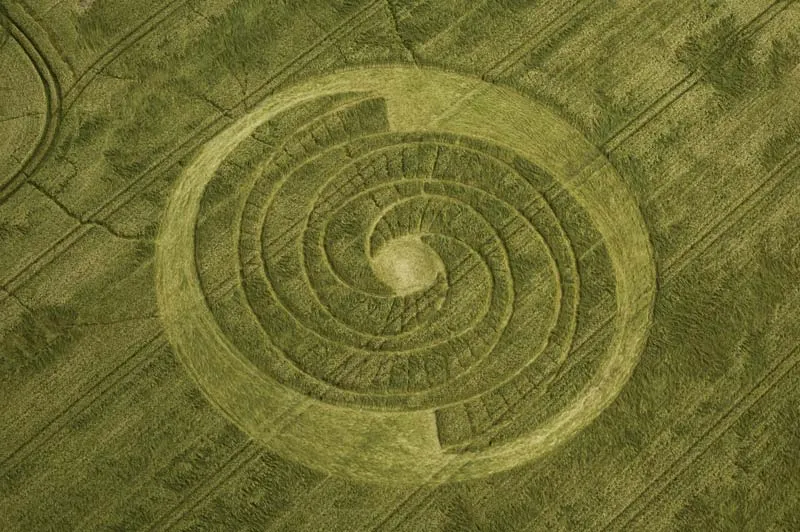
One of the most famous formations cited by believers is the 2001 Milk Hill crop circle. Comprising over 400 circles and spanning 787 feet, this formation appeared overnight in Wiltshire and was so intricate that many experts doubted it could have been made by human hands alone.
The design’s complexity and symmetry, especially given its size, remain a source of fascination and debate. Monique Klinkenbergh, founder of the crop circle exhibition in Wiltshire’s Pewsey Vale, acknowledges the existence of hoaxes but believes some patterns defy rational explanation.
According to Klinkenbergh, the speed at which many crop circles appear—often within minutes—along with the lack of witnesses, suggests a mystery that has yet to be fully understood. “There is definitely a mystery going on, but it’s very hard to label the source, whether it is extra-terrestrial, paranormal or just nature,” she told the BBC in 2023.
Culture, Commerce, and Continuing Curiosity
Beyond their mysterious origins, crop circles have had a significant cultural and economic impact on the regions in which they appear. In Wiltshire, landowners have capitalized on the phenomenon by opening up their fields to curious visitors in exchange for donations. The farmer whose field hosted the May 15 Celtic knot circle was reportedly upset about the damage but soon saw an opportunity to turn the unwanted attention into a modest income.
The designs have also inspired a vibrant subculture of researchers, artists, and spiritual seekers. Some believe the symbols contain encoded messages or serve as a kind of cosmic communication.
Others suggest they may have healing properties or trigger subconscious realizations in those who view them from above. Social media platforms and online forums are filled with debates, theories, and personal interpretations, keeping the mystery alive in the digital age.
The timing of crop circles also appears to follow a seasonal pattern. In the Northern Hemisphere, they typically appear between May and August, coinciding with the growth of crops like wheat and barley. This natural window allows for clearer visibility of the patterns and may explain why so many circles emerge during these months.
Still, the recurrence of formations in places like Wiltshire—accounting for more than 80% of UK crop circles—suggests that geography, history, and perhaps even local energies play a role.
As modern technology advances, so too does the ability to study crop circles in greater detail. Drones, satellite imagery, and computer modeling have enabled researchers to analyze patterns with unprecedented accuracy.
Despite this, no definitive answer has emerged. Are crop circles merely an elaborate art form, a clever hoax sustained by tradition, or something truly beyond our understanding?
For now, the truth behind crop circles remains elusive. Whether viewed as a cultural phenomenon, a clever prank, or a message from another world, these mysterious formations continue to spark imagination and wonder. As long as they appear, people will come—from across the globe—to see, to question, and to believe.