
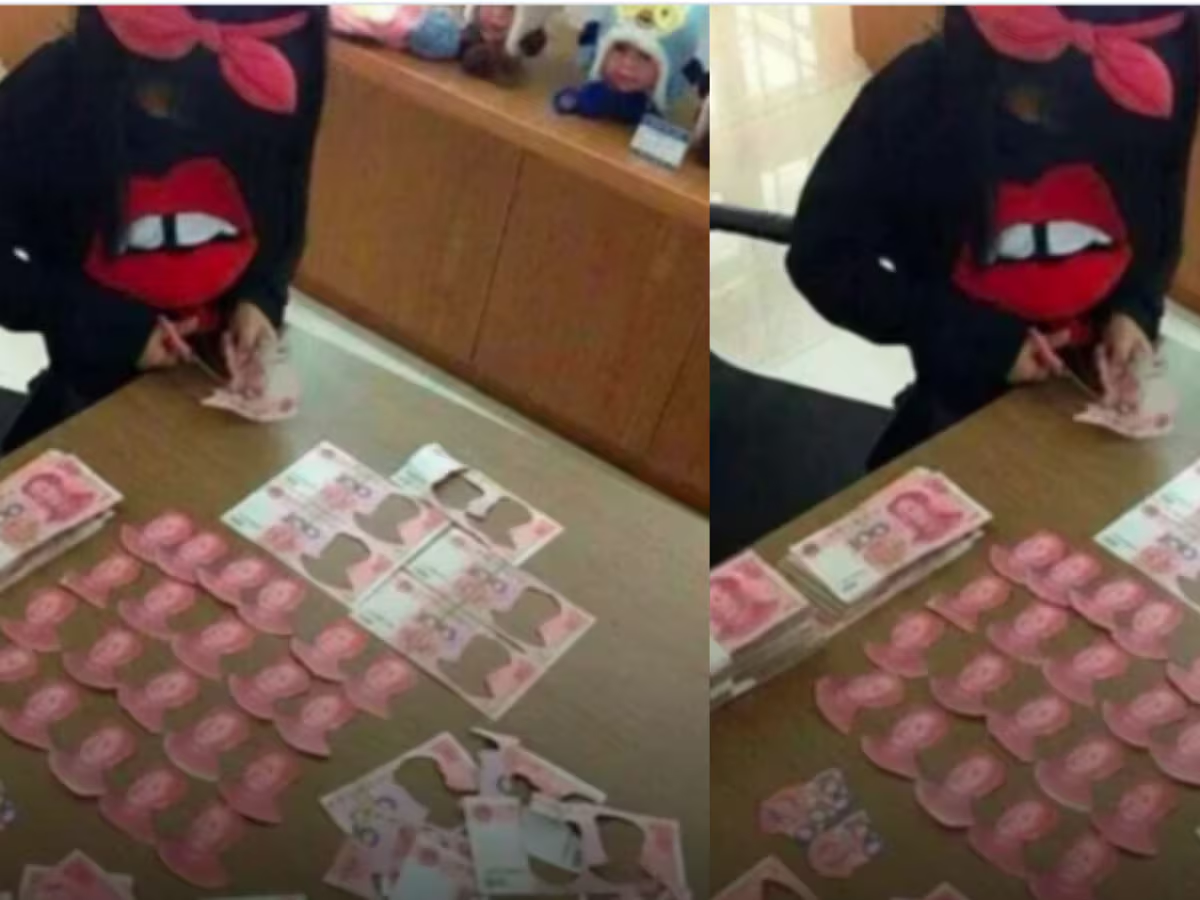
A seemingly unbelievable incident from eastern China captured widespread attention in mid-December 2025 after reports emerged that a five-year-old girl had accidentally destroyed her father’s life savings while playing with scissors. The child, from Qingdao in Shandong Province, reportedly seen Cutting Mao Zedong’s Portrait from 100-Yuan Notes after discovering a large stash of cash at home. What initially appeared to be a light-hearted social media story quickly evolved into a viral discussion touching on parenting, financial security, and the reliability of viral news itself.
Despite online skepticism, the episode is rooted in a genuine event, corroborated by multiple reports, and reflects a costly combination of childhood curiosity and adult oversight. The case gained prominence after an Instagram post shared by the account @china.travels described how the girl, left home alone briefly by her father, came across 500 crisp 100-yuan notes amounting to 50,000 yuan.
Mistaking the bills for ordinary craft paper, she began cutting out Mao Zedong’s portrait from each note with remarkable consistency. By the time her father returned, the currency had been rendered largely unusable, raising serious doubts about whether the money could be exchanged at a bank. The story resonated widely online, provoking reactions ranging from humor and admiration to criticism and disbelief.
How the Incident Unfolded in Qingdao
According to reports, the father had stepped out for a short period, leaving his five-year-old daughter alone at home. During his absence, the child discovered a hidden bundle of cash kept inside the house. The money consisted of 500 newly issued 100-yuan notes, each bearing the portrait of Mao Zedong on the front. For the child, the bills appeared no different from sheets of printed paper suitable for arts and crafts.
Armed with a pair of scissors, she began carefully cutting out Mao’s portrait from each note. Observers later noted that she also removed other decorative elements such as denomination markers, arranging the cutouts neatly while the remaining portions of the notes were left in small fragments. By the time the activity ended, the cash had been transformed into a pile of confetti-like shreds and dozens of identical portraits.
When the father returned home, he reportedly found the cutouts lined up separately, with the rest of the banknotes scattered across the floor. Realising the scale of the loss, he spent several hours attempting to tape the pieces back together. However, the damage proved too extensive. Many notes were missing large sections, and the precision with which the portraits had been removed meant that essential identifying features of the currency were no longer intact.
In China, damaged banknotes can sometimes be exchanged at financial institutions if a significant portion of the note remains recognizable. Generally, banks require at least two-thirds of the bill to be present and identifiable. In this case, the careful excision of the central portrait and other elements made it highly unlikely that the notes would meet the criteria for replacement. As a result, the family faced the possibility of losing the entire sum, estimated at around $6,800 or approximately ₹5.7 to ₹6.3 lakh.
Why the Money May Be Impossible to Recover
The destruction of the banknotes raised immediate questions about whether the father could recover any of the lost funds through official channels. Chinese banking regulations regarding damaged currency are relatively clear but strict. Notes that are torn, burned, or otherwise damaged may be exchanged if sufficient parts remain to verify authenticity and denomination. However, when critical features are missing, especially the central portrait and serial numbers, banks are far less likely to approve an exchange.
In this incident, the child’s actions went beyond accidental tearing. Each note had its portrait deliberately removed, leaving a uniform hole in the center. While the remaining fragments might still show parts of the note’s design, the absence of the portrait significantly reduces the chances of successful replacement. Even if some notes could theoretically qualify, the labor-intensive process of reconstructing hundreds of fragments would be daunting, and banks may still reject them due to the extent of the damage.
Read : Chongqing Businesswoman Denied Refund of 3M Yuan Paid for Lover’s Divorce
The story also sparked discussion about why such a large amount of cash was kept at home rather than deposited in a bank. In parts of China, as in many countries, it is not uncommon for individuals to store savings in cash for personal or cultural reasons. However, the incident has reignited debate about the risks associated with keeping large sums of money unsecured at home, especially in households with young children.
No reports suggest that authorities took legal action against the father. While some online commenters criticized him for leaving a child alone with scissors and valuables, there has been no indication of formal penalties. The episode appears to have been treated primarily as a personal misfortune rather than a case of negligence warranting legal consequences.
Viral Reactions, Skepticism, and Broader Lessons
Once the story appeared on social media, it quickly drew global attention. Many users expressed amazement at the child’s apparent skill and patience, noting that cutting out 500 identical portraits would require significant focus. Comments praised her fine motor skills, with some joking that she had an artistic future ahead of her. Others suggested that the cutouts themselves could be turned into an art installation and sold for more than the original value of the cash.
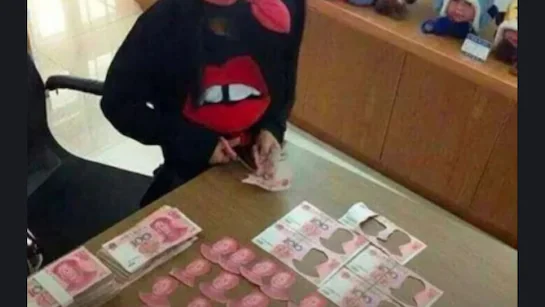
At the same time, skepticism emerged. Some users questioned whether a five-year-old could realistically complete such a task alone, suggesting that the story might be exaggerated or staged for online engagement. Despite these doubts, the incident has been corroborated by multiple outlets, and no evidence has surfaced to indicate fabrication. The family’s anonymity and the lack of sensational follow-up reporting have further supported the credibility of the account.
The reactions also highlighted broader social themes. Several commenters framed the incident as a cautionary tale about child supervision, emphasizing the dangers of leaving young children unattended with sharp objects. Others viewed it as an example of the unintended consequences of poor financial storage practices. A recurring sentiment described the loss as an expensive lesson rather than a malicious act, underscoring the innocence of the child involved.
Beyond humor and criticism, the story resonated because it blended relatability with shock. Many parents could imagine a child mistaking money for play material, even if the scale of the loss was unusually large. The incident also illustrated how quickly a private family mishap can become a global talking point in the age of social media, with strangers offering judgments, jokes, and advice within hours of a post going viral.
Ultimately, the Qingdao incident stands as a real-world reminder of how small decisions can have disproportionate consequences. A brief absence, unsecured cash, and a child’s natural curiosity combined to produce a loss that may never be recovered. While the story has been treated lightly in some corners of the internet, its underlying reality is far from humorous for the family involved. It underscores the importance of child safety, responsible storage of valuables, and caution in interpreting viral stories that straddle the line between incredulity and truth.