
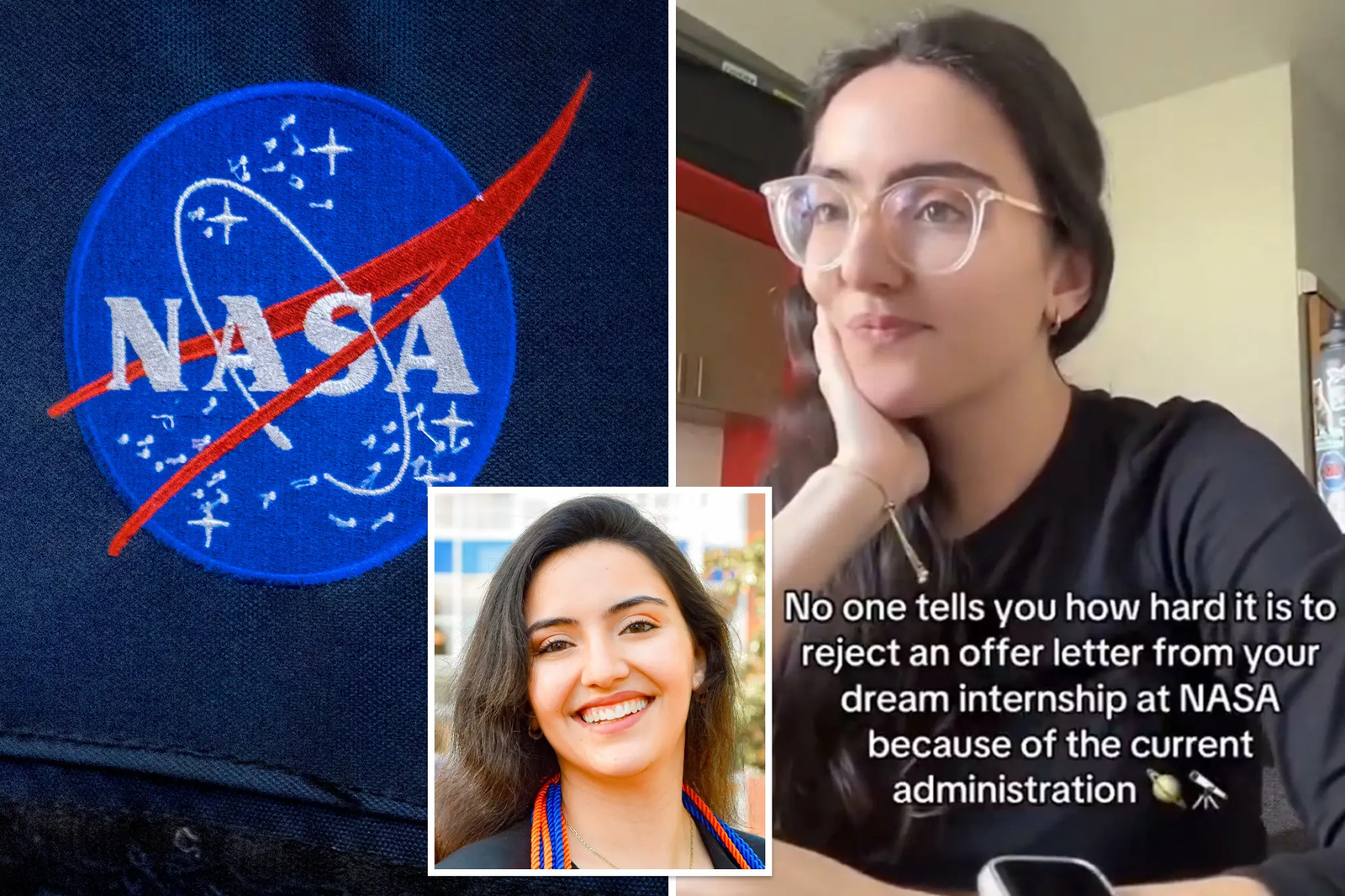
Daniela Lucas, a 26-year-old PhD student in bioengineering at the University of California, San Diego, has set social media ablaze after publicly turning down an internship at NASA — an opportunity she says she spent “years” pursuing.
The internship, offered by NASA’s Human Health and Performance program, is considered one of the most prestigious in the world, often seen as a golden ticket to a career in space science and innovation. Yet, despite the prestige and potential, Lucas declined the offer, citing the “current administration” as the reason behind her dramatic and deeply emotional decision.
In a now-viral TikTok video, Lucas can be seen hovering her cursor over the “Decline Offer” button, before finally clicking it as weepy piano music underscores her expression of disbelief and sadness. Over the video, she wrote, “No one tells you how hard it is to reject an offer from your dream internship at NASA because of the current administration.”
Her caption added more context: “I worked years to receive this letter, just to have to decline,” accompanied by a crying face and devil emoji. The video has since been reposted by numerous users across various platforms, becoming a lightning rod for debate, support, and skepticism.
Years of Effort Meets a Crisis of Conscience
Daniela Lucas’s journey toward the internship was not an easy one. Originally from Venezuela, she and her family immigrated to Florida in 2015. Her father, a doctor, helped anchor the family in a new country, while Daniela went on to earn a full scholarship at Miami Dade College, followed by admission into one of the most competitive PhD programs in the nation.
For someone with such a background, receiving an offer from NASA wasn’t just a career milestone — it was a personal triumph. But for Lucas, the decision to turn down the offer wasn’t about qualifications or readiness. It was a moral stance, a refusal to be associated with what she perceives as troubling shifts under the current U.S. administration.
Although she didn’t provide specific details about her objections, several media outlets and commenters speculated that her discontent could be tied to ongoing budget cuts to NASA, the removal of DEI (Diversity, Equity, and Inclusion) policies, or broader ideological shifts happening at the federal level.
NASA has, in recent years, been swept up in larger political narratives. While former President Trump boosted the agency’s budget early in his first term and emphasized a bold vision for space exploration, including a return to the moon and a future mission to Mars, a more recent report suggests that the same administration may now be planning a significant cut — up to 20% — in NASA’s budget by 2026.
A young liberal woman turns down a NASA internship "because of the current administration" pic.twitter.com/aSZzhzwk1S
— Ian Miles Cheong (@stillgray) April 23, 2025
If enacted, these cuts would severely impact research programs, including the very department that offered Lucas the internship. For a student deeply invested in scientific research and ethical standards, the thought of joining an institution that may face reduced funding and shifting priorities might have felt like compromising her ideals.
Social Media Reactions: Mockery and Support Collide
Unsurprisingly, Lucas’s decision triggered a firestorm online. Her TikTok was flooded with thousands of comments, many expressing disbelief, confusion, or sarcasm. “This has to be fake,” one person wrote on X. “No way someone applies for and is smart enough to be offered a NASA internship only to turn it down.”
Others framed her decision as an overreaction, with one commenter saying, “I feel like NASA dodged an asteroid there.” A few even took a mocking tone, suggesting that Lucas’s decision was performative or lacking in real-world logic.
However, not everyone viewed her choice through a critical lens. Many lauded her for standing by her beliefs, even in the face of such a difficult decision. “You can disagree with her reasons, but she’s sticking to it,” one person wrote.
“This is what sticking to the cause looks like.” Another praised her integrity compared to political leaders: “Good on her for sticking to her convictions. At least she’s committed unlike our politicians in the GOP.”

Lucas’s decision appears to have stirred a broader conversation about integrity, idealism, and what it means to work within — or reject — systems influenced by political agendas. In an era where political polarization has bled into nearly every institution, her video and the decision behind it have become a case study in how young professionals are grappling with the implications of their career choices in the wider political landscape.
NASA, Politics, and the Cost of Principles
The situation surrounding Lucas’s decision reflects a deeper cultural moment. For decades, NASA has been an emblem of American ingenuity and progress. It has carried the hopes of a nation during the Space Race, inspired generations of scientists and explorers, and even survived budget threats and administrative shifts. But in today’s climate, even NASA isn’t immune to the changing tides of politics.
President Trump’s relationship with NASA has been multifaceted. He increased the agency’s funding early on and promised to take America back to the moon and eventually to Mars. Yet, recent reports suggest he also plans to slash its funding in coming years — especially targeting research programs that have been integral to its scientific output.
These proposed cuts, according to Ars Technica, could reduce some departments’ budgets by half. Moreover, the administration’s broader move to eliminate DEI initiatives — many of which received expanded funding under President Biden — further suggests a shift in the culture and priorities within institutions like NASA.

Lucas’s rejection may be seen, in part, as a reaction to this new direction. Her concerns might not be with NASA itself, but with the federal oversight and funding conditions under which it now operates. For young scientists who value diversity, equity, and inclusive scientific progress, the current climate can present a stark ethical dilemma.
Adding to this, NASA’s internships are known to be the most prestigious in the world. In fact, Vault.com ranked NASA’s internship program above even Google, Apple, and the CIA. Interns have gone on to become astronauts, engineers, and leaders in global space research.
Declining such an opportunity is a decision that would understandably baffle many — especially those outside the world of academia or politics. But for Lucas, the act of refusal appears to be less about career sabotage and more about staying true to her principles.
As of now, neither Lucas nor NASA has issued a formal comment in response to the viral video or the media attention it has garnered. The silence from both sides only adds to the mystery and intrigue surrounding the story.
Whether Lucas will be offered a similar opportunity in the future, or whether NASA will alter its programs in response to ongoing political shifts, remains to be seen.
But one thing is clear: Daniela Lucas’s decision to decline NASA’s offer has sparked a necessary conversation — one that straddles the boundary between science and politics, between ambition and conscience, and between the future of space exploration and the values we carry into it.