
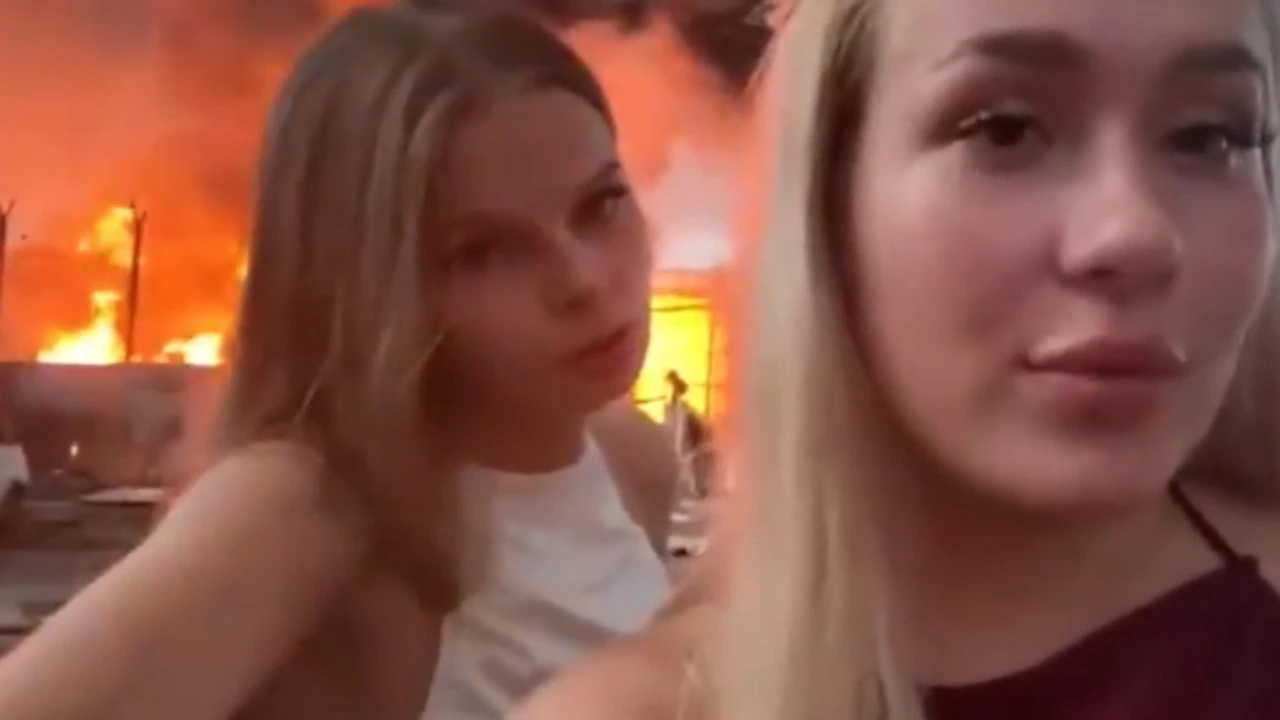
In a dramatic turn of events amid the ongoing Russia-Ukraine conflict, two young Russian influencers—21-year-old Dasha Vladimirova and 19-year-old Karina Evgenieva—were arrested for filming a TikTok video in front of a burning oil depot that had just been hit by a Ukrainian drone strike. The incident took place in Adler, a district of Sochi, located on the Black Sea coast, and has since sparked a wave of controversy and debate throughout Russia and on global social media platforms.
The arrest came swiftly after the video went viral, drawing unwanted attention to the drone strike and the subsequent destruction at the Rosneft-Kubannefteprodukt oil depot.
As Russian authorities continue to crack down on any media that could be seen as portraying Ukrainian military successes or undermining Russian control, the actions of the influencers were viewed not only as inappropriate but also politically damaging. The case reflects deeper tensions within Russian society, where social media culture collides with state-imposed censorship and nationalism in the midst of an ongoing war.
The Viral Video and Arrest of the Influencers
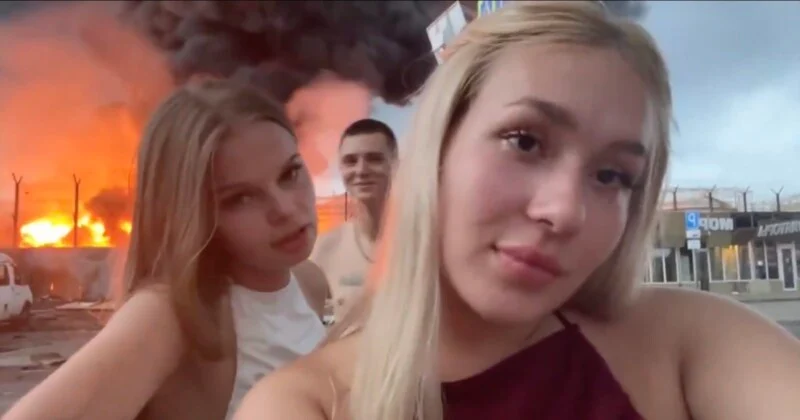
The video in question showed Dasha Vladimirova and Karina Evgenieva standing with an unidentified male companion, casually filming in front of the blazing oil depot while playing the track “Crimson Dawn” by Russian rapper Endshpil. The setting was eerily dramatic—black smoke towering into the sky, the flames illuminating the backdrop, and the influencers smiling or posing as if they were at a concert rather than a conflict zone.
The moment the video hit TikTok, it immediately gained traction. Many users were stunned not just by the content but by the audacity of posting such footage in a tightly-controlled media environment.
What could have been just another misguided attempt to go viral on TikTok quickly spiraled into a national scandal. Russian authorities, already on high alert due to increasing Ukrainian drone attacks on strategic infrastructure, reacted harshly. They launched an investigation to track down the individuals responsible. Within days, both Vladimirova and Evgenieva were arrested and taken into custody.
According to reports, they were charged under a lesser-known law: “Failure to comply with rules of conduct in an emergency or the threat of its occurrence.” This charge carries a maximum fine of 30,000 rubles—around $300. However, the punishment extended far beyond monetary penalties.
Two women, identified as 21-year-old Darya and 19-year-old Karina, alongside an unidentified male, have been arrested after filming a social media video earlier today in front of a burning oil depot in Adler, Southwestern Russia, which was targeted last night in a large-scale… pic.twitter.com/R8xr0xyqdu
— OSINTdefender (@sentdefender) August 3, 2025
The police made the two young women issue a public apology on video. They were recorded at a police station, visibly distressed, acknowledging their mistake and asking for forgiveness. The incident became a symbol of the Russian government’s broader effort to suppress narratives that challenge the state-sanctioned view of the war.
A Strategic Location and a Dangerous Message
The oil depot in question belonged to Rosneft-Kubannefteprodukt, a subsidiary of Russia’s state oil giant Rosneft. Located in Adler, a district known for being a hub of tourism near Sochi, the facility’s destruction from a Ukrainian drone strike was already significant. The fact that two influencers used the burning site as a backdrop for a social media post added a new dimension to the story—one that Russian authorities found deeply unsettling.
Sochi is a high-profile location. As Russia’s largest tourist resort and the host city of the 2014 Winter Olympics, the city symbolizes modern Russian prestige and development. For a Ukrainian drone to penetrate its airspace and strike a key oil facility sends a powerful and humiliating message to Moscow.
That message was amplified by the actions of the influencers, who unintentionally broadcasted the success of Ukraine’s military operations to a young and tech-savvy audience that often avoids state-run news.
Read :First Woman Chief Justice of Russia and Former Classmate of Vladimir Putin Dies At 71
This amplification, according to Russian media outlets aligned with the government, is the true reason for the harsh response. They accused the girls not just of being tasteless but of aiding the enemy by highlighting a Ukrainian victory. Some war-supporting media voices even called for harsher sentences or mandatory community service, arguing that the influencers had undermined national morale and dignity.
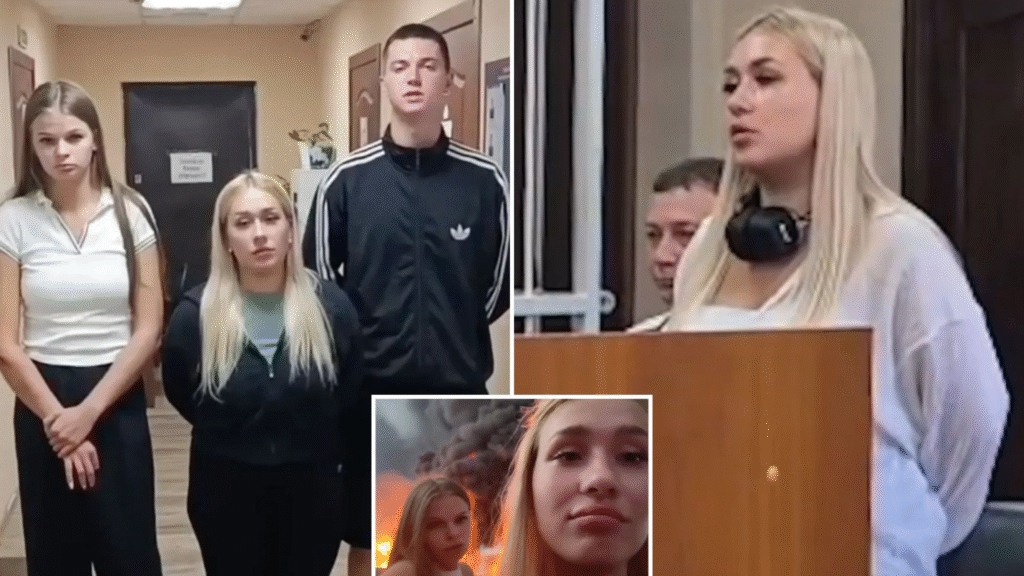
Meanwhile, observers outside of Russia have raised concerns about the freedom of expression and the increasing militarization of everyday life under Vladimir Putin’s government. Critics argue that the young women’s behavior—while immature and insensitive—does not warrant the kind of public shaming and legal consequences they’ve endured. Instead, the state’s response is viewed as a calculated attempt to discourage others from sharing content that contradicts the official wartime narrative.
The Role of Social Media in Russia’s War Narrative
This incident underscores a broader issue unfolding in Russia: the role of social media in shaping public discourse during wartime. While the Kremlin has exerted increasing control over traditional media, it struggles to fully police the sprawling ecosystem of online platforms like TikTok, Telegram, and Instagram, especially among the country’s youth.
Influencers like Vladimirova and Evgenieva are part of a generation that has grown up in the digital age, where visibility and virality often trump caution and consequence. Their arrest sends a clear signal to others in the influencer community: the government will not tolerate any content that casts the Russian military in a weak or vulnerable light.
This is particularly important as Ukrainian drone attacks on Russian territory become more frequent and more sophisticated. Videos like the one filmed in Adler threaten to break through the government’s carefully managed narrative that portrays Russia as being firmly in control of the conflict.
Moreover, the backlash against the influencers has revealed fractures within Russian society. On one side are conservative, pro-war voices who see the influencers as traitors or misguided fools. On the other side are younger, more liberal Russians who are increasingly skeptical of the war and the government’s handling of information. For the latter group, the arrests represent yet another example of authoritarian overreach and an attempt to silence dissent, even when it takes the form of a foolish social media post.
The apology video—filmed at the police station and disseminated by state-friendly media—also highlights how public shaming has become a tool for controlling online behavior. These confessions are meant to humiliate and deter, turning young people into cautionary tales. Whether or not this strategy is effective remains to be seen. What’s clear, however, is that the Russian state is becoming more aggressive in its attempts to control the narrative, both offline and online.
The case of Dasha Vladimirova and Karina Evgenieva is about much more than just a poorly timed TikTok video. It is a microcosm of the broader tensions between a digitally connected youth and a government that is increasingly obsessed with controlling the narrative around its war in Ukraine. The backdrop—a burning oil depot struck by Ukrainian drones—only heightens the stakes, reminding everyone that this is not just a cultural dispute, but one set against the violent backdrop of a real, ongoing war.
Their arrest may have been justified under Russian law, but the public nature of their apology and the political framing of the incident reveal the state’s deeper concerns. Russia is not just fighting a war on the battlefield—it is waging a psychological and information war within its own borders. And in that war, even a 15-second TikTok video can become a battleground.
As the conflict continues, and as Ukrainian drone strikes test the limits of Russian defense systems, stories like this will likely become more common. The fate of these two young influencers serves as both a warning and a reflection of a nation grappling with internal and external pressures in an age where everyone is a potential broadcaster—and every post a potential threat.
Today, I went to the beach with my children. I found a sea shell and gave it to my 4 year old daughter and said “You can hear the ocean if you put this to your ear.” She placed the shell to her ear and screamed. There was a hermit crab inside and it pinched her ear. She never wants to go back! LoL I know this is completely off topic but I had to tell someone!
I consider something really special in this site.
I believe that is one of the such a lot vital information for me. And i am happy studying your article. But should commentary on some common things, The web site taste is perfect, the articles is truly nice : D. Just right process, cheers
Good info. Lucky me I reach on your website by accident, I bookmarked it.