
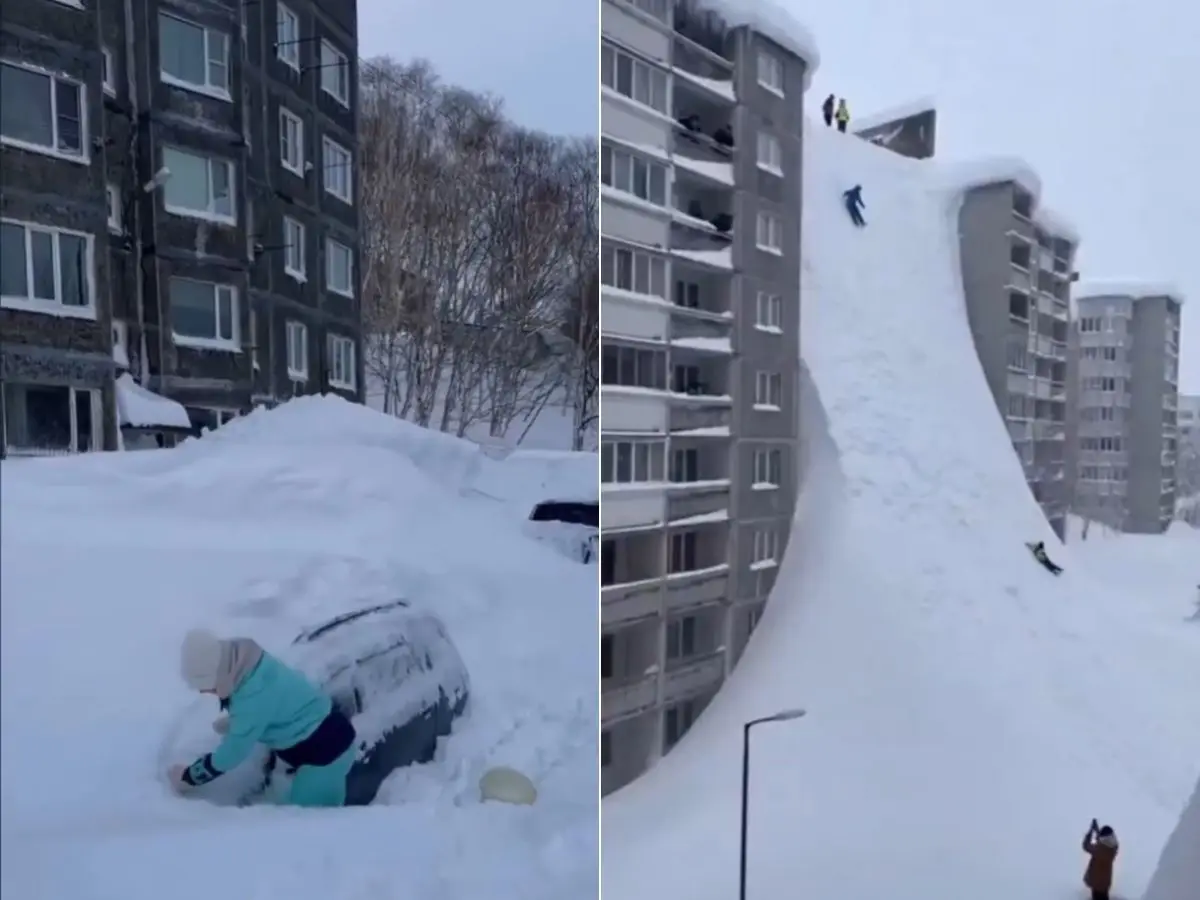
Russia’s Far Eastern Kamchatka Peninsula has become the unlikely focus of global attention after extraordinary scenes emerged from one of the most severe winter events in the region’s recorded history. In January 2026, relentless Pacific cyclones delivered snowfall on a scale not seen for 146 years, burying cities, paralysing infrastructure, and forcing residents to adapt in ways few modern urban communities ever have.
As snow accumulated to window height and beyond, everyday movement became impossible in some neighbourhoods. In response, residents improvised, climbing out of windows and leaping into deep snowdrifts that had transformed streets into soft, elevated landscapes. Videos of these moments, equal parts surreal and startling, quickly spread online, offering a rare visual record of life inside an extreme weather event.
While the images have often been described as playful or humorous, they emerged from a serious and disruptive crisis. Roads disappeared under metres of snow, flights were cancelled, emergency services were stretched thin, and authorities declared states of emergency in multiple areas. Kamchatka’s experience has highlighted both the vulnerability of communities to extreme weather and the resilience that can emerge when ordinary routines collapse under extraordinary conditions.
A Historic Snowfall Paralyzes Kamchatka
The Kamchatka Peninsula is no stranger to harsh winters, but the scale of the snowfall recorded in January 2026 exceeded even local expectations. Meteorological authorities reported that some areas received close to five metres of snow over a short period, the heaviest accumulation documented in the region in nearly a century and a half. Successive Pacific cyclones pushed moisture-laden air across the peninsula, where it met freezing temperatures and mountainous terrain, producing relentless snowfall with little respite.
Cities such as Petropavlovsk-Kamchatsky were among the hardest hit. Residential districts vanished beneath towering drifts, leaving only the upper floors of buildings clearly visible. Streets, pavements, and parked vehicles were swallowed entirely, turning familiar urban layouts into unrecognisable white expanses. Public transport systems were suspended as buses and trams became unusable, and road clearance crews struggled to keep pace with the constant accumulation. In many places, snowploughs could not reach residential entrances, leaving people effectively sealed inside their homes.
Air travel was also heavily disrupted. Flights in and out of the region were cancelled or delayed for days at a time, isolating Kamchatka further from the rest of Russia. Supply chains were strained as deliveries of food, fuel, and medical supplies faced delays. Emergency services declared a state of emergency to mobilise additional resources, but even with extra personnel and equipment, progress was slow. In some neighbourhoods, residents resorted to digging narrow tunnels through the snow simply to reach the outside world.
Kamchatka's Snow Apocalypse: Nature's Brutal Fuck-You to Humanity
— LᥱᥣᥲᥒᏧ Chᥲɾᥣᥱs Pιᥴᥴoᥣᥲ (Actual) (@lelandcpiccola) January 19, 2026
Mother Nature just dropped a white middle finger on Petropavlovsk-Kamchatsky, burying apartment blocks under drifts so deep they swallow second floors like cheap vodka shots.
✠ Record cyclone barrage dumped… pic.twitter.com/DbWd4jLd5j
The weight of the snow posed additional risks. Authorities warned of potential roof collapses, particularly on older buildings not designed to support such heavy loads. Utility services worked to prevent power outages and heating failures, critical concerns in a region where winter temperatures can be life-threatening. Against this backdrop of disruption and danger, the scenes that later went viral were not acts of novelty, but practical responses to a city temporarily reshaped by nature.
Improvised Escapes and Viral Moments
As snowbanks rose to block doors and stairwells, residents began to seek alternative ways to leave their homes. In some apartment buildings, the ground floors were entirely inaccessible, with snow pressed tightly against entrances. Windows, especially those on lower levels, offered the only exit. With metres of compacted but still soft snow below, people began climbing out and dropping down into the drifts, treating the snow as a natural cushion.
Videos capturing these moments show adults and children alike stepping out of windows, hesitating briefly, and then disappearing into the white below before re-emerging, laughing and brushing off snow. Balconies also became launch points, with residents lowering themselves or jumping carefully into the accumulated drifts. What might ordinarily appear reckless was, in context, a calculated adaptation to conditions where walking out the front door was impossible.
Read : Skiers Romain Tronchi and Gabriel Mahe Stuck in Waist-Deep Snow on Mount Moosilauke, Rescued
These clips quickly spread across social media platforms, drawing millions of views and comments from around the world. For many viewers, the sheer depth of the snow was astonishing, challenging assumptions about what urban snowfall can look like. Others were struck by the calmness and even humour displayed by residents navigating such an extreme environment. The images offered a stark contrast to the anxiety often associated with natural disasters, presenting instead moments of levity amid hardship.
Local reports indicated that, remarkably, many of those captured in the videos escaped without injuries. The depth and softness of the snow played a crucial role, absorbing the impact of jumps that would otherwise be dangerous. Nevertheless, authorities cautioned against attempting such exits without care, warning that hidden obstacles, compacted ice layers, or uneven surfaces could pose serious risks. Emergency services urged residents to coordinate with local officials whenever possible and to avoid unnecessary movement during peak storm conditions.
Despite these warnings, the viral footage became a symbol of adaptability. Children treated the snow as a vast playground, sliding and diving through drifts that dwarfed them. Adults, while aware of the seriousness of the situation, found brief moments of relief in shared laughter and collective experience. The videos did not diminish the severity of the blizzard, but they humanised it, showing how communities respond when standard systems fail.
Resilience, Risk, and a Changing Climate
Beyond their viral appeal, the events in Kamchatka have prompted broader discussions about resilience, preparedness, and the increasing frequency of extreme weather. While the peninsula’s geography and climate make it prone to severe winters, the scale of the 2026 snowfall has raised questions among scientists and policymakers about whether such events are becoming more intense due to shifting global climate patterns. Warmer oceans can contribute to stronger storms, and when combined with freezing regional temperatures, the result can be unprecedented snowfall.
❄️ In Kamchatka (Russia), rescuers urged residents not to jump into snowdrifts from windows:
— Zlatti71 (@Zlatti_71) January 16, 2026
“Under the layer of snow, there may be fences, cars, sharp metal structures that can injure a person. There's also a high chance of getting stuck in a snowdrift without being able to get… pic.twitter.com/Jg2IxZlNH4
For local authorities, the blizzard exposed both strengths and limitations in emergency response systems. The rapid declaration of a state of emergency enabled additional resources to be deployed, but the sheer volume of snow overwhelmed even well-prepared services. Urban planning in cold regions traditionally accounts for heavy snowfall, yet events of this magnitude challenge existing infrastructure standards. Roof load capacities, snow removal equipment, and evacuation protocols may all require reassessment in light of changing weather extremes.
At the community level, the response highlighted the importance of social cohesion. Neighbours assisted one another in clearing paths, sharing supplies, and checking on vulnerable residents. The act of jumping from windows into snowdrifts, while striking visually, was part of a wider pattern of mutual adaptation. People adjusted routines, coordinated with building managers, and used local knowledge to navigate conditions safely.
The global reaction to the videos also revealed how digital platforms shape the perception of disasters. Short clips stripped of context can appear light-hearted, even entertaining, yet they represent lived experiences within a broader crisis. In Kamchatka’s case, the images served as an entry point for international audiences to learn about the severity of the blizzard, the challenges faced by residents, and the realities of life in one of the world’s most remote and climatically demanding regions.
As recovery efforts continued, authorities focused on clearing roads, restoring transport links, and assessing structural damage. While daily life gradually resumed, the memory of the storm and its extraordinary moments remained. The sight of residents calmly leaping into snow from apartment windows has become an enduring image of the winter of 2026, encapsulating both the risks posed by extreme weather and the ingenuity people display when confronted with it.
Kamchatka’s record snowfall stands as a reminder that even in an era of advanced forecasting and infrastructure, nature retains the capacity to overwhelm. Yet it also demonstrates that within such moments, communities find ways to adapt, endure, and, occasionally, to laugh, even as they navigate one of the harshest winters in generations.