
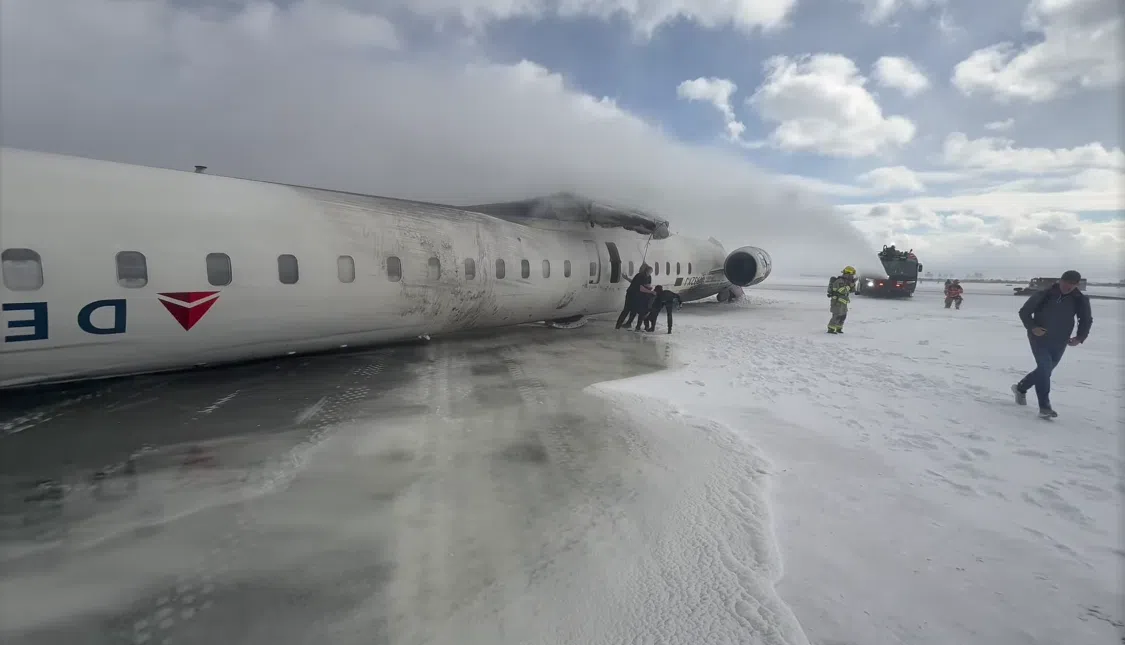
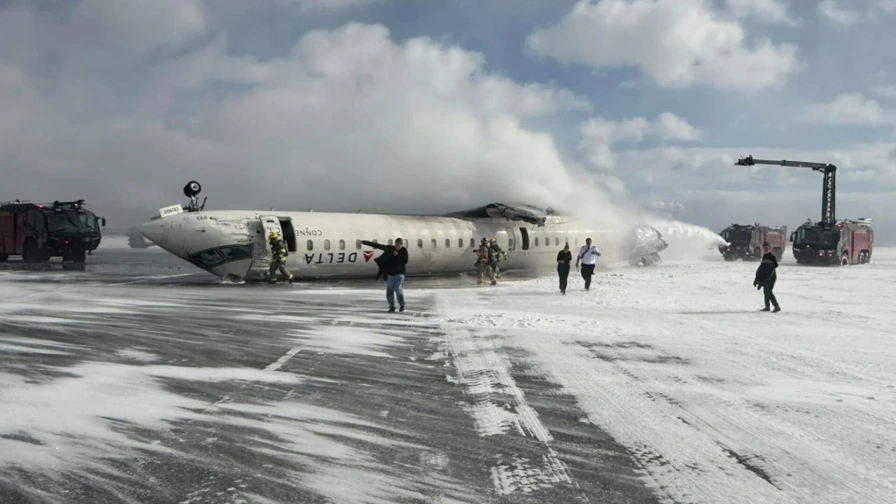
A Delta Air Lines regional jet flipped upside down upon landing at Canada’s Toronto Pearson Airport on Monday amid strong winds following a snowstorm.
The plane flipped upside down after touching the runway, causing panic among passengers and crew aboard the aircraft. The crash resulted in injuries to at least 18 people, including three who suffered critical injuries, among them a child. Despite the severity of the incident, no fatalities have been reported so far.
The Crash and Its Aftermath
The Delta Air Lines flight originated from Minneapolis-St. Paul International Airport and was carrying 80 people, including crew members. As the CRJ900 aircraft, operated by Delta’s subsidiary Endeavor Air, made its final approach to Toronto, the icy and windy conditions made for a challenging landing.
Upon touchdown at 2:13 p.m. local time, the aircraft skidded and flipped upside down, finally coming to a stop near the intersection of Runway 23 and Runway 15 at Pearson Airport.
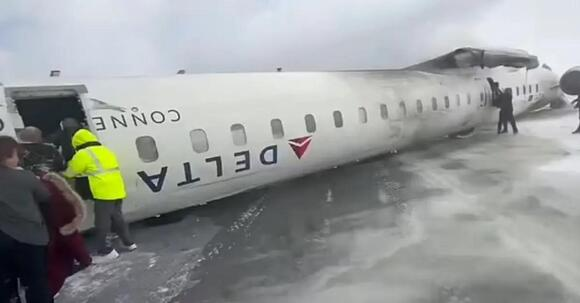
Emergency responders were quick to react, reaching the aircraft as passengers scrambled to evacuate. Some passengers were able to unbuckle their seat belts and exit the plane, while others had to be assisted by first responders.
Videos shared by survivors show a chaotic scene inside the aircraft, with some people suspended upside down in their seats while others tried to navigate their way out.
Read : 67 Bodies of DC Plane Crash Have Been Recovered from Potomac River
Passenger John Nelson, who was aboard the flight, described the terrifying moments after the crash. “We hit the ground, and we were sideways, and then we were upside down.
Terrifying footage from John Nelson, a passenger on Delta Flight #DL4819. The plane flipped upside down upon landing in Toronto after a 1.5 hour trip from Minneapolis, MN.
— Jordan Rhone (@JordanRhone) February 17, 2025
Miraculously, only 8 of 60 passengers are reported injured. The rest have walked off unharmed. pic.twitter.com/P7qbMBj0IQ
I was able to just unbuckle and push myself to the ground,” he told CNN. He noted that some passengers needed help being lowered from their seats as they were still strapped in when the plane overturned.
Another passenger, Pete Koukov, posted a video on Instagram showing the aftermath of the crash. The footage captures the evacuation process, with fire engines spraying water on the aircraft as passengers made their way to safety. Another viral video taken by a female passenger shows her hanging upside down in her seat, exclaiming, “My plane crashed, I’m upside down.”
Investigation and Possible Causes
Canadian authorities have launched an investigation to determine the cause of the crash. The Transportation Safety Board of Canada (TSB) is leading the probe, with assistance from the U.S. National Transportation Safety Board (NTSB).
The aircraft manufacturer, Japan’s Mitsubishi Heavy Industries, which acquired the CRJ program from Bombardier in 2020, has pledged full cooperation with the investigation.
While the exact cause of the crash is still unknown, preliminary reports suggest that poor weather conditions played a significant role.
Toronto Pearson Airport had been experiencing high winds and freezing temperatures following a snowstorm that dumped over 22 cm (8.6 inches) of snow over the weekend. The hazardous conditions led to delays and cancellations at the airport as airlines struggled to manage flights.
Flight tracking data from FlightRadar24 indicates that the aircraft was in the air for 86 minutes before making its descent into Toronto. Audio recordings between air traffic controllers and emergency personnel captured the immediate response following the crash.
One emergency worker can be heard reporting, “The aircraft is upside down and burning,” while another controller notes that passengers were already walking away from the scene.
Aviation experts have pointed out that while such incidents are rare, strong crosswinds and icy runways can lead to destabilized landings.
Michael J. McCormick, an associate professor of air traffic management at Embry-Riddle Aeronautical University, remarked that the upside-down position of the plane made this crash particularly unusual. However, he also highlighted that the survival of all 80 people aboard was a testament to modern aircraft engineering and safety regulations.
Operational Impact and Airport Delays
The crash caused significant disruptions at Toronto Pearson Airport, one of Canada’s busiest air travel hubs. Following the accident, the airport temporarily suspended all departures and arrivals for over two hours, leading to flight diversions and delays. Montreal-Trudeau International Airport reported receiving several diverted flights as airlines scrambled to manage their schedules.
The impact of the crash extended beyond the immediate hours after the incident. Deborah Flint, president of Toronto Pearson Airport, confirmed that operational delays would persist in the coming days as two runways remained closed for the investigation. “We are very grateful that there is no loss of life and relatively minor injuries,” she stated in a press conference.
Delta Air Lines issued a statement acknowledging the incident, confirming that all injured passengers had been transported to area hospitals for treatment. Supervisor Lawrence Saindon of Peel Regional Paramedic Services reported that two passengers had been airlifted to trauma centers, while a critically injured child was taken to a children’s hospital.
This crash follows a series of recent aviation incidents in North America. Just weeks prior, an Army helicopter collided with a CRJ-700 passenger jet in Washington, resulting in 67 fatalities.
Additionally, a medical transport plane crash in Philadelphia claimed seven lives, while another plane crash in Alaska led to the deaths of ten passengers. These incidents have raised concerns about aviation safety, particularly in adverse weather conditions.
Despite the frightening nature of the Delta crash, experts emphasize that air travel remains one of the safest modes of transportation. Investigations into the accident will provide valuable insights to improve safety protocols and prevent similar incidents in the future.
As authorities work to uncover the cause of the crash, passengers and airline officials alike are reflecting on the harrowing experience. The resilience of the passengers, coupled with the swift response of emergency personnel, helped ensure that all 80 individuals aboard survived an incident that could have had a far worse outcome.
The Delta Air Lines crash at Toronto Pearson Airport serves as a stark reminder of the unpredictable nature of aviation and the critical importance of safety measures in mitigating the risks associated with extreme weather conditions.
While passengers may still be shaken by their ordeal, the successful evacuation and lack of fatalities highlight the effectiveness of modern aircraft design and emergency response procedures.
As the investigation unfolds, more details are expected to emerge regarding the factors that led to the crash. For now, the focus remains on aiding the injured, restoring airport operations, and understanding how such incidents can be prevented in the future.