

Diane Crawford, a 66-year-old school bus driver from Juniata County, Pennsylvania, became the focus of national attention after her contract was terminated following the posting of a sign on her bus instructing students not to speak Spanish. What began as a localized employment dispute quickly evolved into a broader public controversy involving questions of school safety, cultural sensitivity, employment standards, and political polarization.
Diane Crawford, who had driven school buses in the county for more than a decade under a subcontracting arrangement, has said she did not intend to offend or target students based on race or ethnicity. Her termination, the explanations given by her employer and the school district, and the subsequent reactions from political figures and online groups have placed her at the center of a debate that extends well beyond the school bus aisle.
The incident has drawn coverage from local and national media outlets, prompted social media campaigns both supporting and criticizing Diane Crawford, and led to a reported investigation by the U.S. Department of Justice’s Civil Rights Division. As the situation continues to unfold, Crawford’s background, her stated reasoning for the sign, and the actions taken by her employer provide essential context for understanding how the controversy developed and why it has resonated so widely.
Diane Crawford’s Career and the Sign That Led to Her Termination
Diane Crawford had worked as a school bus driver serving the Juniata County School District for over ten years through Rohrer Bus, a transportation company contracted by the district. According to Diane Crawford, she viewed her role as more than a job and described her work as a long-term commitment to student safety and well-being. In interviews, she said she built relationships with students and families over the years and took pride in maintaining order and discipline on her bus.
Earlier this year, Diane Crawford placed a printed sign in the window of her bus that read: “Out of respect to English-only students, there will be no speaking Spanish on this bus.” The wording of the sign quickly drew attention after it was reported by parents and students. Within days, Crawford was informed that her contract with Rohrer Bus had ended. The company initially stated publicly that she had been suspended as a precautionary measure pending an investigation into the matter.
Diane Crawford later disputed that account, telling local television station CBS 21 that she was never formally suspended and that no investigation took place before her termination. She said she was instead asked to provide a written statement acknowledging that she had placed the sign on the bus. In a joint statement issued by Rohrer Bus and the Juniata County School District, officials said the investigation concluded once Crawford provided written confirmation that she had installed the sign, after which leadership from both organizations reviewed the facts and made a final decision.
Legal Report: Termination and Potential Civil Action Involving Juniata County School District Bus Driver
— Go Kick Rocks ( ಠ ͜ʖಠ) (@KickRocks2025) December 22, 2025
Case Summary
Diane Crawford, a 66-year-old school bus driver with over 30 years of experience transporting students for the Juniata County School District (JCSD) in… pic.twitter.com/eRZ7sGeMse
The joint statement emphasized that the conduct did not align with the standards expected of student transportation providers and reaffirmed the district’s commitment to providing what it described as a safe and inclusive environment for all students. The district and the company said they stood by the decision to end Diane Crawford’s contract.
Crawford’s Explanation and the Dispute Over Intent
Diane Crawford has repeatedly stated that her intent in posting the sign was not to be racially insensitive or discriminatory. She told CBS 21 that the sign was directed at a specific situation involving a bilingual student whom she claimed had a history of using Spanish to target or bully other students on the bus. According to Crawford, her concern was that other students did not understand what was being said and that this created tension and potential safety issues during transport.
In reflecting on the wording of the sign, Diane Crawford acknowledged that it could have been phrased differently. She suggested that a more appropriate message might have been “No bullying in any language,” adding that her goal was to stop behavior she perceived as disruptive rather than to single out Spanish-speaking students. She maintained that she did not intend to prohibit students from expressing their cultural identity or speaking their native language in general.
Read : Former NASCAR Driver Greg Biffle and Family Killed in Plane Crash at Statesville Regional Airport
Despite these explanations, critics argued that the sign itself amounted to language-based discrimination and could make Spanish-speaking students feel unwelcome or singled out. Supporters of Diane Crawford, however, framed her actions as an attempt to maintain discipline and ensure that all students felt respected and safe.
The disagreement over intent versus impact became a central element of the controversy. While Diane Crawford focused on her stated motivation and long record as a bus driver, her employer and the school district emphasized policy standards and the broader implications of allowing such signage in a public school setting. The dispute highlighted the challenges school systems face when addressing behavior management issues in increasingly diverse environments.
Aftermath, Public Reaction, and Ongoing Developments
Following her termination, Diane Crawford said she experienced significant financial and emotional hardship. In interviews, she stated that she had gone on Medicare, Medicaid, and SNAP benefits and had begun taking antidepressants as a result of the stress surrounding the incident. She said she had purchased a bus and route the previous year and was now seeking $30,000 to help cover those costs. Crawford expressed hope that Rohrer Bus and the school district would acknowledge that terminating her contract was a mistake.
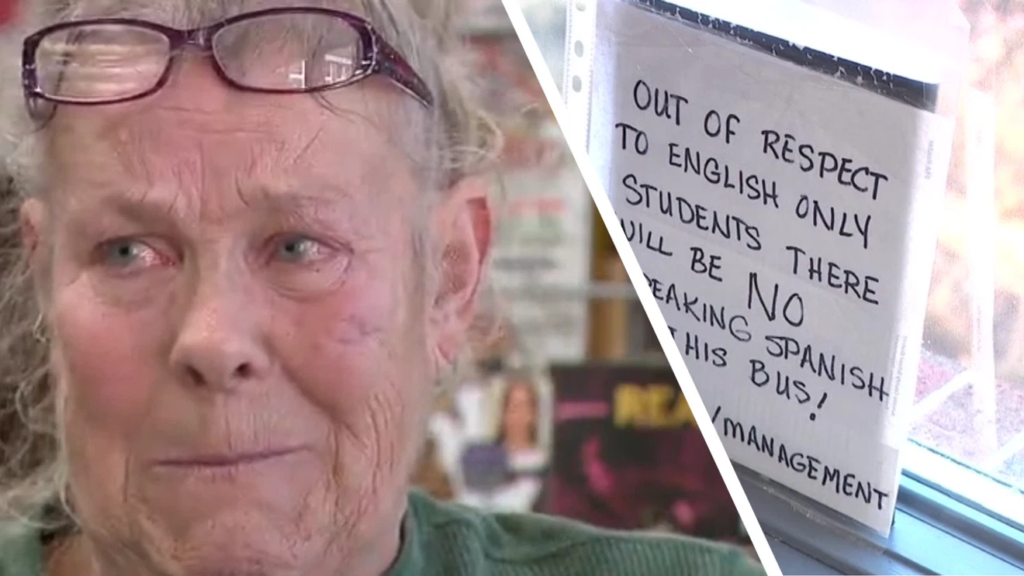
Her interview prompted a strong reaction on social media, particularly among right-wing commentators and accounts who portrayed her as a victim of excessive political correctness. Clips of her statements were widely shared, often accompanied by messages criticizing diversity, equity, and inclusion policies. An online fundraiser was launched on the platform GiveSendGo, raising more than $2,000 in donations within days. The fundraiser described Crawford in highly charged terms and included language that itself drew criticism for its portrayal of immigrants and non-English speakers.
The situation also attracted attention from political figures. Harmeet Dhillon, who leads the Department of Justice’s Civil Rights Division, wrote on social media that the case was “deeply concerning” and said she had directed the division to open an investigation into the matter. While details of any such investigation have not been publicly released, the announcement further elevated the profile of the case.
At the same time, Rohrer Bus and the Juniata County School District reiterated their position in public statements, stressing that their decision was based on established procedures and standards for student transportation providers. They said the matter progressed quickly once Crawford confirmed the presence of the sign and that leadership concluded her actions were inconsistent with expectations for maintaining an inclusive environment.
As of now, Crawford has not been reinstated, and there has been no public indication that the district or the transportation company plans to reverse its decision. The case continues to be cited in broader discussions about language use in schools, employee conduct, and the boundaries between personal judgment and institutional policy.
Mejor Casino en Linea, now that’s a bold claim! Best online casino eh? Gotta see if it lives up to the hype. Ready to test the waters! mejorcasinoenlinea