
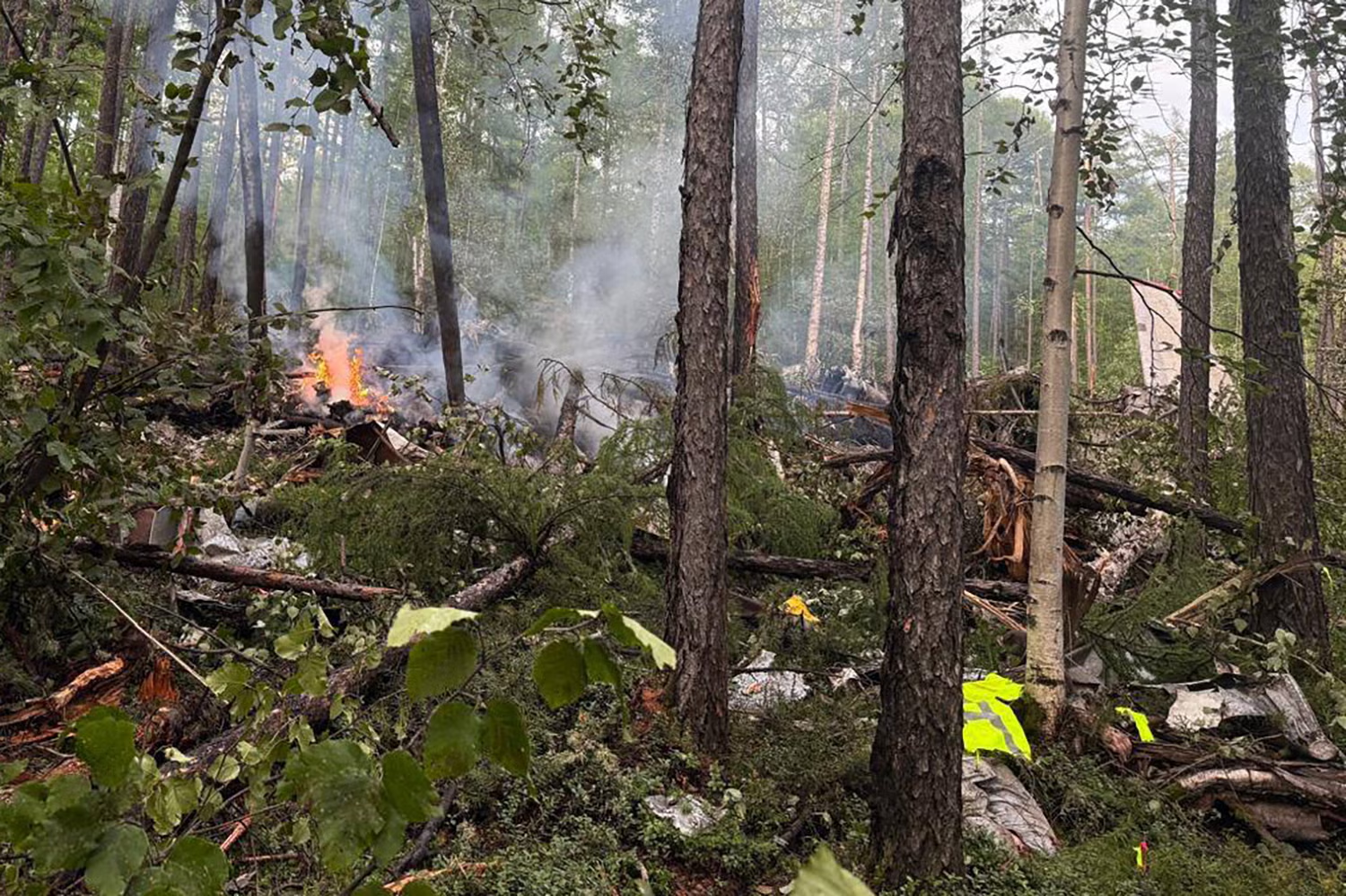
A routine flight across Russia’s vast eastern expanse turned into a national tragedy when a Soviet-era Antonov An-24 aircraft crashed near the remote town of Tynda, killing all 48 people on board. The story, however, has a chilling twist: a last-minute decision by one woman to leave the plane moments before departure spared her life in what her family has described as a “miracle.” This is the story of Marina Avalyan, a grandmother whose instinctive action saved her from a catastrophic end.
The Miracle Exit: A Grandmother’s Timely Decision
Marina Avalyan, 55, had no idea that a sudden phone call from her daughter would become the difference between life and death. Having boarded the Angara Airlines flight scheduled to travel from Blagoveshchensk to Tynda, she was settling in for a short but routine journey home after a family visit. The weather was grim—persistent rain in Tynda had delayed takeoff—and the passengers waited on the tarmac inside the aircraft.
During this delay, Marina received a call from her daughter, who told her that her granddaughter had suddenly fallen ill. The child was experiencing nausea and stomach pain, and with the infant’s father away accompanying her older sibling to a hospital, Marina was urgently needed at home to look after the baby.
Trusting her maternal instinct, Marina requested to be allowed off the plane. Airline staff obliged, and she disembarked with her luggage, unknowingly removing herself from what would soon become the final moments of every other passenger’s life. By the time she returned home, her granddaughter’s symptoms had subsided. Then came the devastating news: the flight she was meant to be on had crashed.
Today, this video shared as Angara Airlines An-24 crash Near Tynda, Russia. Claiming All 48 Lives On Board
— aircraftmaintenancengineer (@airmainengineer) July 25, 2025
But the real story of this video is below:
An Ilyushin Il-112V military transport aircraft prototype crashed in a forested area near Kubinka Air Base, Russia, killing all… pic.twitter.com/CLsYDz3QP5
Her brother-in-law Samvel confirmed to Russian news outlet Pravda.ru that Marina had indeed left the aircraft moments before takeoff, calling the decision nothing short of a divine intervention. “She really did leave the plane, collected her luggage, and went home,” he said, echoing what many now consider an act of providence.
A Tragic Crash in the Far East
The aircraft involved was an Antonov An-24, a model first introduced in the late 1950s and still in limited service today in some parts of the world, especially remote regions. The An-24 departed Blagoveshchensk, a city close to Russia’s border with China, en route to Tynda—a key railway junction in the Amur region and part of the strategic Baikal-Amur Mainline.
Contact with the plane was lost at around 1 p.m. local time. A short while later, search and rescue teams discovered the charred remains of the aircraft approximately 15 kilometers from Tynda, scattered across a forested slope. Aerial footage released by Russian media showed plumes of smoke rising from the crash site. Rescue teams had to cut through dense woods using heavy machinery to reach the wreckage.
Read : First Woman Chief Justice of Russia and Former Classmate of Vladimir Putin Dies At 71
The plane was making its second approach to the Tynda runway after a failed initial landing, according to early reports. Experts suggest the adverse weather conditions and the aborted first attempt will be central to the crash investigation. Despite having passed a recent technical inspection, the aircraft was built in 1976—almost five decades old.
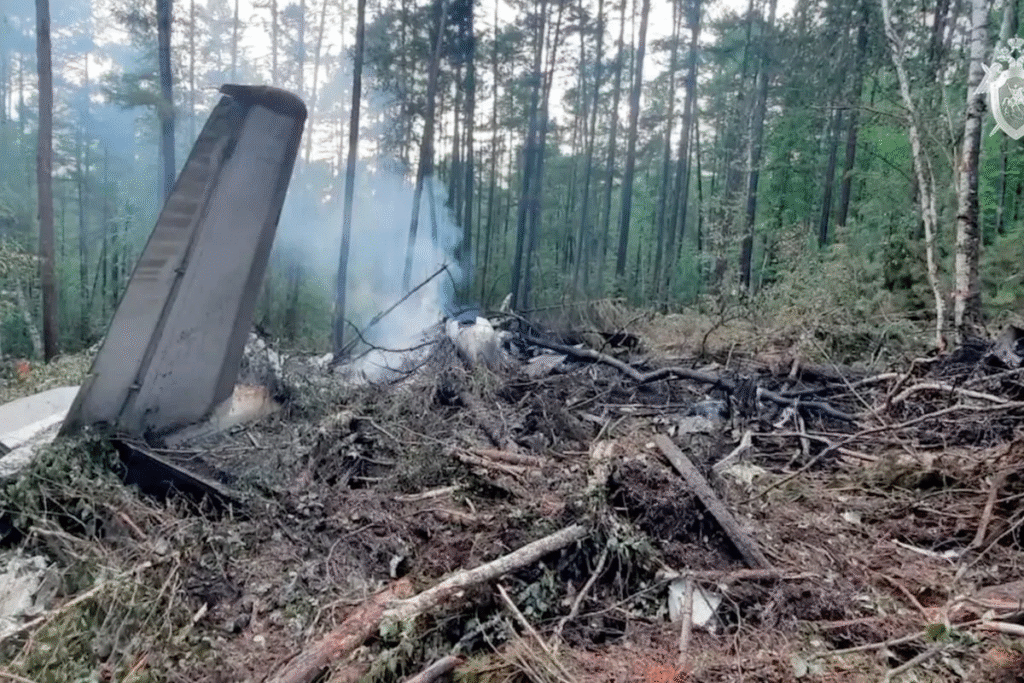
Authorities confirmed that all 48 individuals onboard—42 passengers, including five children, and six crew members—had perished. Among the deceased were entire families, couples celebrating milestones, and young children returning home after hospital stays.
Flight attendant Anastasia Bessmertnaya, a seasoned aviation professional since 2007, was also among the victims. Her husband, a flight engineer, had survived a similar crash in 2011, making the news even more heartbreaking for their two daughters left behind. The pilot, Vyacheslav Logvinov, had long been associated with Angara Airlines, which continues to operate older aircraft models in difficult terrain.
One of the most heart-wrenching stories was that of Sergei Shiyan, a fitness coach from Khabarovsk, who died alongside his wife Natalia and their 18-month-old daughter Eva. They had been visiting Tynda, Natalia’s hometown, for a family vacation. Another couple, Alexander and Elena Mamedov, were on their way to celebrate their 10th wedding anniversary.
Irina Alexandrikova, 25, and her six-year-old son Sergei Ochkin, also died. They had taken photos together the night before by the Amur River, commemorating what would unknowingly be their final evening together. Meanwhile, Elena Velikanova, another 55-year-old grandmother, texted her family from her seat on the plane, telling them to “meet her” upon arrival—words that now haunt her grieving relatives.
The Broader Implications and Questions Raised
The crash has reignited long-standing concerns over Russia’s ageing fleet of regional aircraft, particularly the An-24. Known colloquially as “flying tractors” for their robust performance in rugged and remote conditions, these aircraft are symbols of the Soviet aviation era. However, with technological advancements and changing safety standards, their continued operation has increasingly come under scrutiny.
In fact, former Russian President Dmitry Medvedev had called for grounding all An-24 aircraft in 2011 after a similar crash resulted in the loss of lives. The Russian government has since pledged to replace the ageing models with newer aircraft, notably the TVRS-44 Ladoga, but production is only expected to commence by 2027.
According to the RussianPlanes database, over 1,300 An-24s were produced during their manufacturing years. Of these, 88 have crashed, and another 65 have been involved in serious incidents. Only around 75 remain in service today, primarily in countries like North Korea, Cuba, Laos, Ethiopia, and parts of Central Asia. Despite passing technical inspections, these aircraft often operate in less-regulated environments and harsh weather, increasing the risks associated with their usage.
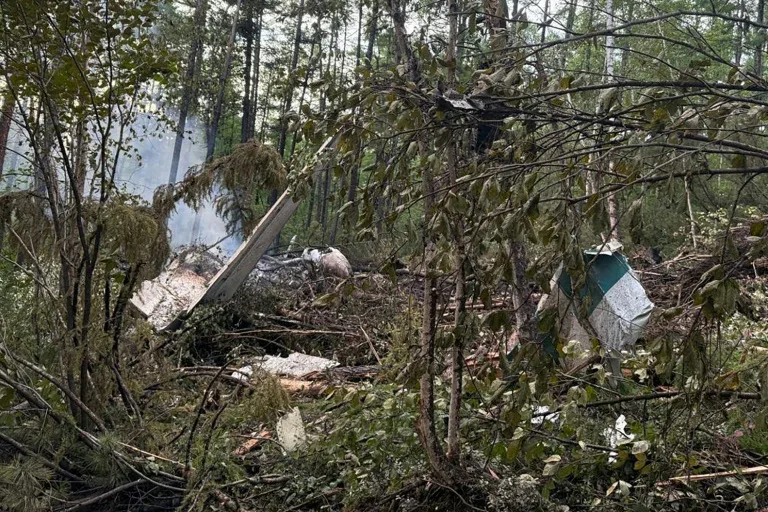
The Russian government has launched multiple investigations into the crash—criminal, administrative, and technical. A government commission has also been appointed to oversee the aftermath. President Vladimir Putin led a minute’s silence at a government meeting in honor of the victims and expressed condolences to the bereaved. Chinese President Xi Jinping also sent his sympathies, as reports suggest a Chinese national may have been among the victims.
With the tragedy still unfolding, questions linger: Why was an aircraft this old still in regular passenger service? Were there systemic oversights in safety protocols? Could more modern equipment have averted this disaster? While the answers will come with time, the grief left behind is immediate and immeasurable.
In the midst of national mourning and complex investigations, the story of Marina Avalyan shines like a narrow beam of light cutting through an otherwise dark narrative. Her survival is not just a matter of coincidence but a symbol of how life can turn on the most unexpected decisions.
As families prepare funerals and investigators analyze data, the haunting reality of what might have been will remain with Marina and her loved ones for a lifetime. Her story, both miraculous and heartbreaking, will be remembered not just for what was avoided, but for what was lost.