

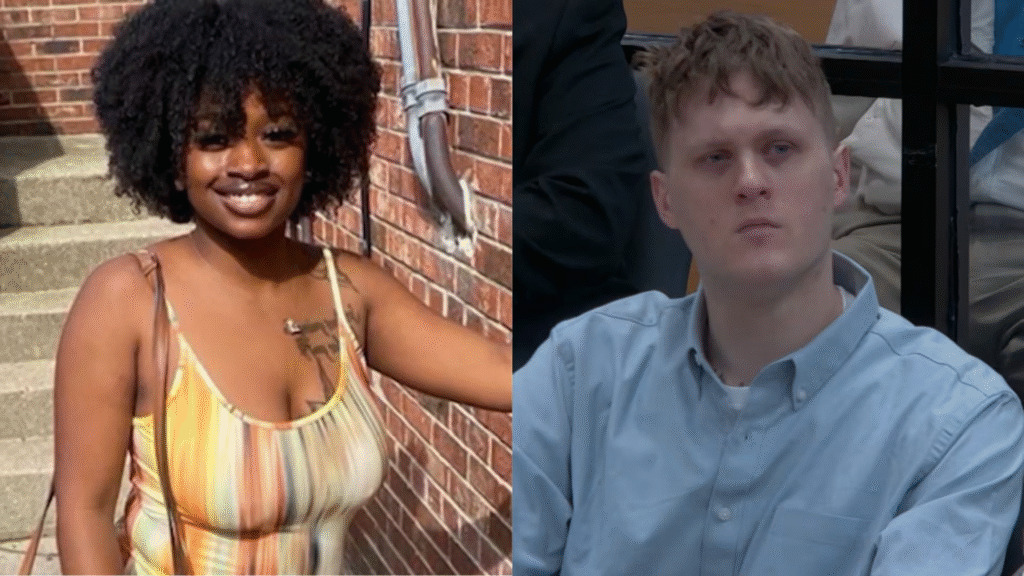
Sade Robinson was a bright, ambitious 19-year-old woman studying criminal justice at Milwaukee Area Technical College. With dreams of one day joining the military, she worked hard and carried a radiant spirit that left a lasting impression on those who knew her. But her life was cut tragically short in April 2024, when what was supposed to be a fun and hopeful first date turned into a horrifying and brutal murder.
Her killer, 34-year-old Maxwell Anderson, has since been found guilty, but the wounds of the case continue to echo across Milwaukee and the nation. This tragedy not only stunned the community but also reignited a critical conversation around how missing persons cases — particularly those involving Black women — are handled in America.
The Disappearance and the Gruesome Discovery
On April 1, 2024, Sade Robinson went out on a first date with Maxwell Anderson. The two met for dinner at the Twisted Fisherman restaurant in Milwaukee’s Menomonee Valley and later went to Dukes on Water for drinks. That night, Sade’s movements were captured on surveillance footage, including images of her car traveling across the city into the early hours of April 2. But by the next day, she didn’t show up for her shift at Pizza Shuttle, the job she dutifully held while balancing college.
Her co-workers, alarmed by her absence, promptly contacted law enforcement to report her missing. Yet, disturbingly, her mother, Sheena Scarbrough, wasn’t notified for another two days. The delay in reaching out to her family remains a haunting and frustrating point in the timeline — especially in a country where missing Black women are often met with systemic delays and inattention.
That same day — April 2 — a severed leg was discovered along the shores of Lake Michigan in Cudahy’s Warnimont Park. The leg, toes still coated in pink nail polish, was later confirmed to belong to Sade. Her car, meanwhile, was found torched, its interior scorched beyond recognition. Anderson was captured on surveillance footage at a nearby bus station shortly after the car fire, a telling moment in the digital trail that prosecutors would later present in court.
Read : Overdue Book Returned After 84 Years to Helsinki Library
As more body parts were found across Milwaukee County — including Robinson’s torso, breast, and eventually her arm, which washed ashore in Illinois — the horrifying truth came to light. Robinson had been brutally murdered and dismembered. Her head has still not been recovered.
The Trial of Maxwell Anderson and the Chilling Evidence
On June 7, 2024, after a two-week trial in Milwaukee County Circuit Court, Maxwell Anderson was convicted of first-degree intentional homicide, mutilating a corpse, hiding a corpse, and arson. The trial revealed a chilling narrative, painted by prosecutors through a combination of digital evidence, surveillance video, and damning witness testimony.
Prosecutors, led by Assistant District Attorney Ian Vance-Curzan, laid out a meticulous timeline. Video footage showed Sade Robinson and Anderson together at dinner and then heading to his home on Milwaukee’s south side. Neighbors’ security cameras recorded movement in and around Anderson’s house until nearly 1 a.m. on April 2. Cell phone records revealed Sade’s phone was later moving around the city — finally stopping at Warnimont Park, where her leg was discovered.
Read : 20-Year-Old Mazyar Azarbonyad Jailed After Failing to Stop for Police While on First Date
One of the most disturbing revelations came from a confidential informant, who told police that weeks before Robinson’s death, Anderson had expressed plans to kill her. The informant described seeing saws and a basement covered in plastic tarps and sanitation materials during a visit to Anderson’s home. According to the informant, Anderson explicitly stated he intended to use a gun to force Sade Robinson into the basement, kill her, dismember her body, and dispose of the parts throughout the city.

Inside Anderson’s home, police found no blood or overt signs of violence, but they did uncover photos on his phone — one of Robinson lying face down on his couch, and another in which her pants and underwear were being pulled down. Those very garments were later recovered in the trunk of her burned car. The prosecution argued that this deliberate and calculated behavior made it clear the murder was premeditated and that Anderson had followed through on a gruesome plan.
Anderson’s defense attorney, Anthony Cotton, did not dispute the timeline or deny that the dismembered remains belonged to Sade Robinson. But he argued that there was no direct evidence proving Anderson killed her. Anderson did not testify, nor did his defense call any witnesses. It was a stark contrast to the prosecution’s robust case, and in the end, the jury agreed with the state’s version of events.
Justice and a Call for Change
Sade Robinson’s murder was not only a horrific personal loss for her family and community — it also spotlighted broader issues in the U.S. related to how missing persons cases involving women of color are treated. Data from Columbia University in 2024 revealed that Black women in Wisconsin are 20 times more likely to be murdered than white women. That sobering statistic underscores the urgency behind the advocacy that has followed Sade’s death.
Her mother, Sheena Scarbrough, has emerged as a powerful voice in that advocacy. Grieving yet determined, she founded “Sade’s Voice Foundation,” a nonprofit organization focused on supporting families of missing or murdered young people and pushing for policy reform. Scarbrough stood with her younger daughter as she accepted Sade’s posthumous criminal justice degree from Milwaukee Area Technical College — a moment of profound sorrow and pride.
Since then, Scarbrough has partnered with Wisconsin lawmakers like State Representative Shelia Stubbs, who plans to reintroduce legislation that would mandate faster police responses to reports of missing Black women and girls. The push reflects similar efforts across the country. States like Massachusetts, Minnesota, California, New York, and Illinois have all moved in recent years to form task forces or introduce legislation targeting disparities in how missing persons cases are investigated based on race.
National organizations such as the Black and Missing Foundation and Our Black Girls have also played a critical role in bringing attention to cases like Sade’s — and countless others that receive far less media coverage than cases involving white victims.
A makeshift memorial in the Pizza Shuttle parking lot — pink and adorned with flowers and messages — stands as a tribute to Sade. But her mother wants something more enduring: systemic change. She wants her daughter’s light, so cruelly extinguished, to continue guiding change.
“It is her voice, her legacy to honor and carry what she was about,” Scarbrough said. “She has saved so many young women and individuals. My baby is a hero.”
The tragedy of Sade Robinson is, heartbreakingly, not unique. But her story — and the conviction of her killer — has become a clarion call to reimagine how America treats missing persons, especially those from marginalized communities. It is a call for empathy, urgency, and above all, justice.
As we remember Sade, we are also reminded that true justice doesn’t end with a conviction. It continues with action. With every piece of legislation passed in her name, every young girl protected by faster intervention, every family that doesn’t have to wait 48 hours for a phone call — Sade Robinson’s voice is heard. And her light, as her mother says, keeps working.