
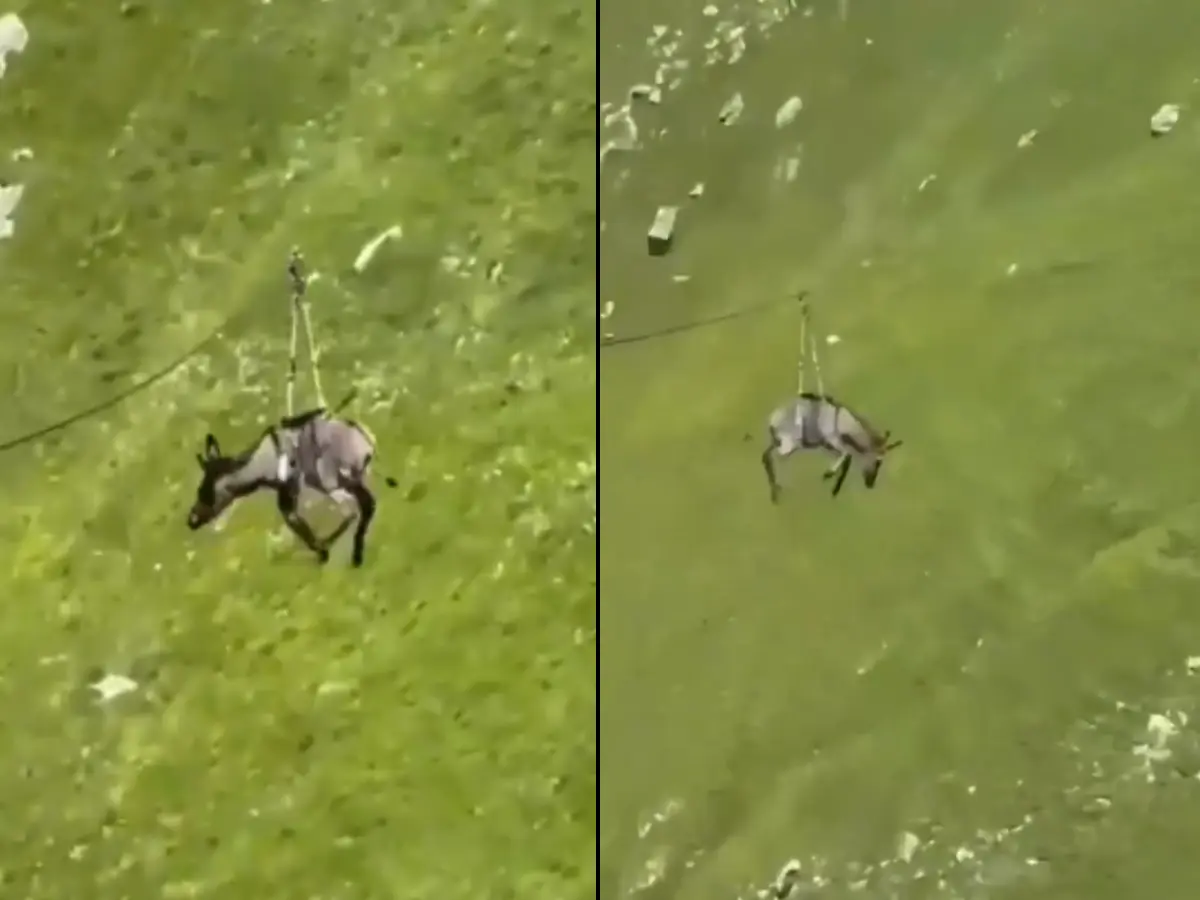
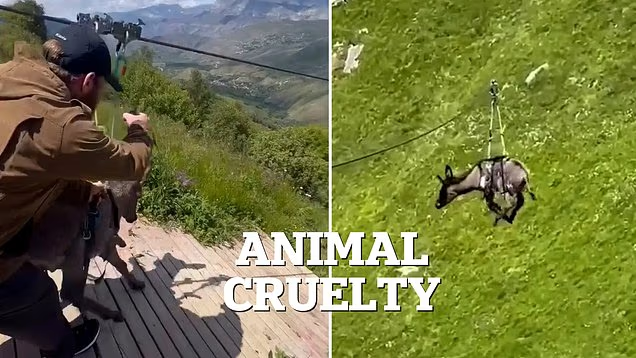
In the rugged terrain of Dagestan, a southern republic of Russia, a scene unfolded that has stirred widespread condemnation and sparked ethical debates across the internet. A Donkey Harnessed and Sent Down Zipline, visibly distressed through the air along a cable in what appeared to be a stunt designed to attract tourists. The animal’s flailing legs and the strained tension in its body painted a clear picture of discomfort—one that left viewers shocked and outraged.
As the video of the incident circulated rapidly on social media, it was met with near-universal disapproval. Many observers immediately labeled the act as a form of cruelty, an attempt to force entertainment value out of a terrified and defenseless creature.
The authorities in Dagestan did eventually take note of the matter, but their response, or lack thereof, only fueled further criticism. According to news outlet RT, the police acknowledged the event but stated that no legal action could be pursued since the animal was not physically injured and there was no measurable way to determine if it had been traumatized.
Donkey Harnessed and Sent Down Zipline
One of the most repeated arguments online was the clear absence of consent. Social media users, activists, and animal welfare advocates pointed out that just because the animal wasn’t injured doesn’t mean the act wasn’t cruel. In fact, many argued that the very idea of trying to determine whether a donkey “had a good time” was absurd and infantilizing.
On X (formerly Twitter), a user named Susie wrote, “Not cool. I can tell donkey is not happy.” Another user, Livia, echoed this sentiment, stating, “The animal did not have a choice. Would they say the same thing if it was a 1-year-old baby?”
This comparison underscored the fundamental issue of agency—or the complete lack thereof—that marks this event as morally troubling. The animal had no understanding of what was happening to it, nor any way to consent or resist. It was forcibly strapped into gear, hoisted into the air, and zipped across a terrifying gap for the amusement or curiosity of onlookers.
Donkey sent down a zipline in Russia's Dagestan
— RT (@RT_com) August 6, 2025
After public outrage, police say they can’t press charges: the animal wasn’t injured, and there’s no way to tell if it was traumatized or had a great time pic.twitter.com/Ou7My4bXam
The conversation online took many forms, with users dissecting everything from the psychological impact on the animal to the larger implications of using animals for entertainment under the guise of culture or tradition. One user sharply noted, “No injuries, sure — but guessing if it ‘had fun’ isn’t exactly science. Bit over the line.” This statement emphasized the flawed rationale behind the decision not to press charges. The absence of physical wounds does not automatically equate to the absence of harm.
Cultural Justification or Inexcusable Practice?
Amid the wave of criticism, a small but vocal group defended the act. Some framed the incident not as a stunt but as a practical method of animal transport in mountainous areas, claiming it was neither new nor inherently cruel. One post remarked, “Looks like a safe way to transport an animal a great distance in mountainous terrain.”
Another chimed in, “That’s how it’s done in those parts of the world. Did you notice how far apart the distance between the two locations and height are? That’s how it is and will be.”
But these justifications failed to address a crucial aspect: the purpose behind the action. Was the donkey being transported for survival or necessity? Or was it purely for spectacle? Based on reports and video evidence, the latter seems more likely. And if the goal was to impress or amuse tourists, then it becomes difficult to defend the act as a cultural or logistical norm.
Cultural practices do indeed vary across regions, but not all traditions are above scrutiny—especially those that involve suffering. In modern times, many formerly accepted traditions involving animals have been rightfully reevaluated and replaced with more humane alternatives. From bullfighting to dancing bears, societies around the world have recognized that entertainment should not come at the cost of cruelty. The same logic should apply to the donkey in Dagestan.
A Haunting Echo of the Past
This is not the first time Russia has seen controversy over animals being used in dangerous stunts. Back in 2010, a similarly bizarre and disturbing incident made headlines when a donkey was forced to parasail as part of a promotional event on a beach. Unlike the ziplining donkey, that one was left visibly traumatized, a fact confirmed by eyewitnesses and even police officials.
Regional police spokeswoman Larisa Tuchkova told AFP at the time, “The donkey screamed, and children cried.” The horrifying image of an animal screaming mid-air while terrified children watched should have been enough to prevent any such acts from happening again. But clearly, the lessons of the past were not learned.
That earlier incident drew widespread condemnation and served as a warning of how reckless and damaging such stunts can be—not only to the animals but to public perception. It showed that the price of momentary spectacle can be long-lasting trauma and public outrage. The fact that something similar has now happened again raises uncomfortable questions about accountability, cultural memory, and the effectiveness of animal protection laws.
The debate surrounding the Dagestan donkey underscores a crucial issue in how societies perceive and treat animals. It’s not enough to say an animal wasn’t injured. Psychological distress, fear, and lack of choice are all valid aspects of suffering, and they deserve attention and empathy. The idea that animals are mere props for human amusement is outdated and harmful.
What the video clearly shows is not innovation or tourism development—it’s a frightened animal trying to make sense of a terrifying experience. That the donkey landed safely is perhaps the only saving grace, but it does not redeem the act itself. The widespread backlash demonstrates that more and more people are unwilling to accept animal suffering as a side-effect of entertainment.
In the age of social media, where every action can be recorded, scrutinized, and judged in real time, stunts like these are not just poor choices—they are reputational disasters. More importantly, they expose deeper flaws in how animals are treated under the guise of tradition or fun. It’s high time that authorities, communities, and individuals come together to ensure that no animal is subjected to terror for the sake of a viral video.
In the end, the measure of a society is often how it treats its most vulnerable members—not just its people, but its animals too. And by that measure, the ziplining donkey in Dagestan is a stark reminder that there is still much progress to be made.