
In an era where tales of heroism from the greatest conflict in modern history often fade into the pages of textbooks, stories like that of Dougie Shelley remind us of the enduring spirit of those who served. At 100 years old, this Second World War veteran from Essex has captured hearts worldwide, first with an avalanche of birthday greetings and now with news of an impending national accolade from a grateful ally.
On September 23, 2025, Dougie Shelley marked a century of life not just with cake and candles, but with the promise of France’s highest civilian honor—the Légion d’Honneur—for his pivotal role in liberating Europe. This recognition, long overdue in the eyes of many, comes at a poignant moment, underscoring the timeless gratitude owed to the dwindling band of D-Day survivors. As the world reflects on the 81st anniversary of that fateful invasion, Shelley’s journey from a teenage seaman to a centenarian icon embodies the quiet valor that shaped our freedoms.
Born in 1925 in the coastal town of Southend-on-Sea, Dougie Shelley grew up in an England bracing for the storm clouds of war. The son of a humble family, he left school at 14 to work in a local factory, but the call to arms came swiftly. In 1942, at the tender age of 17, Shelley enlisted in the Royal Navy, trading the familiar shores of Essex for the unforgiving decks of warships patrolling the North Atlantic. His early service thrust him into the harrowing Arctic Convoys, those perilous supply runs to the Soviet Union that tested the limits of human endurance.
Temperatures plummeted to 40 degrees below zero, and German U-boats lurked like shadows beneath the ice-choked waves. Shelley, then a young able seaman, manned the guns on merchant vessels and escorts, braving storms that could swallow ships whole and enemy fire that claimed thousands of lives. “It was hell on water,” he would later recall in rare interviews, his voice steady despite the memories. Over 80 convoys sailed in total, but fewer than half returned unscathed, with losses exceeding 100 vessels and 3,000 Allied sailors. Shelley’s survival was no small feat; it forged in him a resilience that would carry him through the war’s defining battles.
By 1944, as the tide turned against the Axis powers, Shelley found himself aboard the destroyer HMS Milne, a sleek V-class vessel armed with 4.7-inch guns and depth charges. Commissioned in 1942, the Milne had already seen action in the Mediterranean and Atlantic, but her most glorious hour—and Shelley’s—came on June 6, D-Day. As part of Force S, the Milne escorted the vital convoy carrying British troops to Sword Beach, one of the five Normandy landing sites.
Read : Parents Sues Funeral Homes After Late Marine Veteran Son’s Brain Returned in Unmarked Box
Shelley’s role as a seaman gunner placed him at the heart of the chaos: scanning the horizon for Luftwaffe bombers, firing anti-aircraft rounds into the dawn sky, and providing suppressing fire to shield the landing craft as they churned toward the shore. The sea frothed with explosions, oil slicks, and the cries of the wounded. Allied naval forces unleashed over 7,000 tons of shells in the initial bombardment, but it was the gunners like Shelley who kept the German defenses pinned down.
Read : Biden Pardons Approximately 2,000 Veterans Convicted Under Military Ban on Gay Sex
Sword Beach saw fierce resistance from the 21st Panzer Division, yet the Royal Navy’s barrage helped secure a foothold, paving the way for the liberation of France and, ultimately, Western Europe. For Shelley, the day blurred into a symphony of smoke and thunder; he later described emerging from the gun turret to witness the first waves of soldiers storming the sand, a sight that etched itself into his soul. Demobilized in 1946, Shelley returned to civilian life as a painter and decorator, raising a family in Southend while quietly cherishing the bonds of comradeship that war had welded.
A Century Celebrated: The Birthday That Went Viral
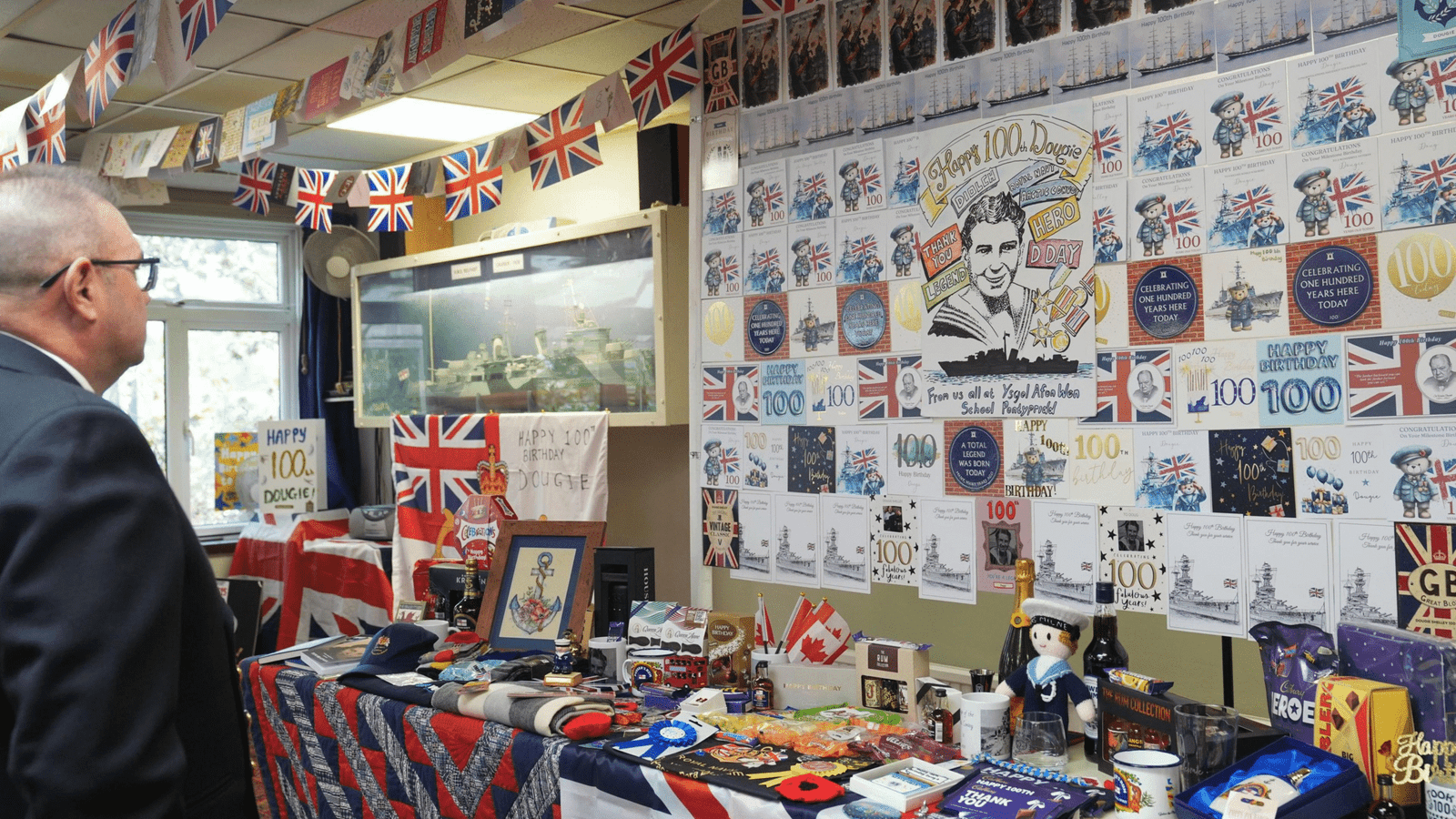
Fast-forward eight decades, and Dougie Shelley’s story took an unexpected turn into the digital age, proving that heroism transcends generations. In the lead-up to his 100th birthday on September 23, 2025, a simple social media campaign launched by the Royal Naval Association (RNA) Southend Branch snowballed into a global phenomenon. What began as a modest plea on Facebook—”Let’s send Dougie some cards to make his milestone special”—tapped into a wellspring of public affection for the Greatest Generation.
Within days, posts garnered thousands of shares, amplified by veterans’ groups, news outlets, and everyday admirers from as far as Australia and Canada. The result? Over 16,000 birthday cards flooded the RNA branch in Southend-on-Sea, transforming a modest community hall into a postal avalanche. Shelley, ever the modest soul, was reportedly stunned by the outpouring. “I never thought I’d get one card, let alone this many,” he quipped during a tea party on his actual birthday, surrounded by stacks of envelopes from schoolchildren, fellow veterans, and even serving sailors.

The cards ranged from heartfelt handwritten notes—”Thank you for giving me a free world, Grandpa Dougie”—to artistic masterpieces by primary school classes, complete with drawings of warships and Union Jacks. One particularly touching missive came from a French family, whose grandfather had been liberated by Allied forces; it read, “From one hero to another, vive la gratitude.” The event, attended by local dignitaries and RNA members, featured a flypast by vintage aircraft and a rendition of “Rule, Britannia!” Shelley cut a three-tiered cake emblazoned with naval insignia, his eyes twinkling amid the Union Jack bunting.
This viral birthday not only highlighted Shelley’s personal legacy but also spotlighted the plight of aging veterans. With fewer than 100 British D-Day survivors remaining in 2025, initiatives like the RNA’s card drive serve as lifelines, combating isolation in an increasingly disconnected world. Psychologists note that such communal gestures boost morale, with studies showing a 20% reduction in loneliness symptoms among elderly recipients of public recognition.
For Shelley, it was a reminder that his sacrifices— the frostbitten fingers from Arctic watches, the adrenaline-fueled nights off Normandy—still resonate. As one card poignantly stated, “Your service didn’t end in 1945; it echoes every day we live free.” The milestone wasn’t just a party; it was a testament to how ordinary people can honor extraordinary lives, bridging the chasm between past valor and present appreciation.
Echoes of D-Day: Earning France’s Eternal Gratitude
The Légion d’Honneur, established by Napoleon Bonaparte in 1802, stands as France’s preeminent order of merit, bestowed upon those whose deeds have profoundly benefited the nation. For foreign recipients, it symbolizes profound alliance, having adorned the chests of figures from Winston Churchill to modern peacekeepers. Dougie Shelley’s nomination fits squarely within this tradition, recognizing his contributions to the liberation of France during Operation Overlord.
As a gunner on HMS Milne, he directly aided the assault on Sword Beach, where over 28,000 British troops landed amid withering fire. French commandos under Lord Lovat’s brigade, supported by naval gunfire, scaled the cliffs at nearby Ouistreham, but it was the destroyers like Milne that silenced bunkers and routed panzers. Without such precision support, the Normandy breakout might have faltered, prolonging the war and costing untold lives.
The push for Shelley’s award began in earnest last year, spearheaded by his longtime friend and fellow veteran, 77-year-old Brian Bennett. Noticing that many of Shelley’s shipmates had received the Legion years earlier, Bennett took action. “A lot of his mates got it for their service to France in WWII,” Bennett explained, his voice laced with determination. In 2024, he meticulously completed a Ministry of Defence application form, detailing Shelley’s naval record from Arctic runs to D-Day.

The process, however, proved labyrinthine—bureaucratic hurdles, verification delays, and the need for official French correspondence stretched months into a year. “They kept saying, ‘Wait for the letter from the French,'” Bennett recounted. “I applied on his behalf because Dougie wouldn’t dream of it himself.” Persistence paid off; by summer 2025, approval came through the diplomatic channels, with the French Embassy in London confirming the honor.
This accolade arrives amid renewed global commemorations of D-Day’s 81st anniversary. In June, world leaders gathered at Normandy’s shores, but events like Shelley’s recognition personalize the history. The Legion for WWII veterans often cites specific acts: for Shelley, it’s the Milne’s role in escorting HMS Warspite, the grand old battleship that pounded German positions.
France has awarded the medal to over 1,000 British veterans since 2014, yet each ceremony evokes fresh emotion. Bennett broke the news to Shelley on his birthday, watching the centenarian’s face light up. “He was over the moon,” Bennett said. Official confirmation of the presentation date and venue is pending, but speculation points to a low-key affair at Southend’s RNA club or perhaps a trip to France—echoing the beaches he once defended.
A Legacy That Sails On: Lessons from a Sailor’s Century
As Dougie Shelley prepares to pin the Légion d’Honneur’s red ribbon to his lapel, his story transcends personal triumph, offering profound lessons for a fractured world. In an age of fleeting social media trends, the 16,000 cards illustrate the power of collective kindness—a digital-age equivalent of wartime camaraderie, where strangers become allies in honoring the past.
Shelley’s humility shines through; earlier this year, he lamented, “There’s not many of us left,” a sobering nod to the 16 million who served in WWII, now reduced to whispers. His Arctic and D-Day exploits remind us of the human cost: the convoys lost 18% of their tonnage to torpedoes, while Normandy claimed 10,000 Allied lives on Day One alone. Yet, from those depths rose resilience, much like Shelley’s own.
Looking ahead, this honor could inspire a surge in veteran recognitions. Organizations like the RNA urge public nominations, emphasizing that bureaucracy should never eclipse gratitude. For younger generations, Shelley’s tale is a clarion call: history isn’t dusty archives but living narratives demanding our attention. As climate crises and conflicts rage, his message of duty—serving without fanfare—resonates. Bennett, ever the steadfast friend, plans to attend the ceremony, ensuring Shelley isn’t alone. “He’s earned every bit of this,” he affirms.
In Southend’s salty air, where the Thames Estuary meets the North Sea, Dougie Shelley’s century unfolds as a beacon. From boy to gunner, veteran to viral hero, his life charts a course of quiet heroism. As France salutes him, so too does the world—proof that some waves never truly recede.