
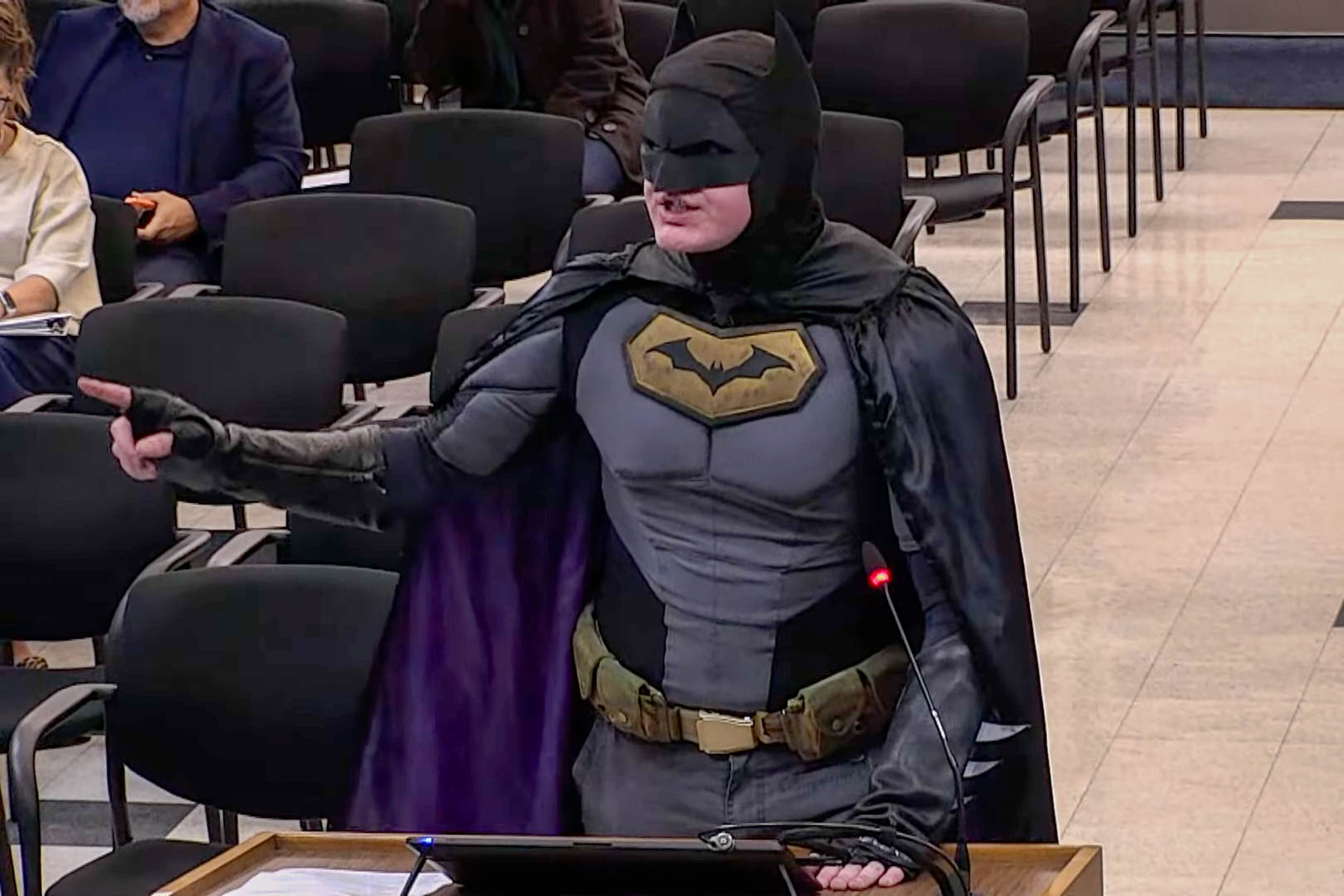
A public meeting of the Santa Clara City Council rarely attracts national attention, let alone global scrutiny. Yet a joint session of the council and the Santa Clara Stadium Authority in late January became an unexpected flashpoint in the ongoing debate over immigration enforcement, federal authority, and local government responsibility. The catalyst was not a policy paper or a protest march, but a single speaker who chose to address elected officials dressed as Batman.
The striking visual, paired with a sharply worded speech condemning the presence of US Immigration and Customs Enforcement (ICE) at the upcoming Super Bowl, propelled the moment far beyond the council chamber and into viral circulation across social media platforms. Super Bowl 60, scheduled for February 8 at Levi’s Stadium in Santa Clara, is one of the most high-profile sporting events in the United States.
It brings with it heightened security, federal coordination, and a visible presence of law enforcement agencies. For some residents and activists, that reality has raised serious concerns about immigration enforcement practices, particularly in light of recent deaths attributed to ICE operations elsewhere in the country. Against this backdrop, the man in the Batman costume used the public comment period to deliver a confrontational appeal, demanding that no city resources be provided to ICE in connection with the event.
While the costume drew immediate attention, the substance of the remarks reflected deeper anxieties about civil liberties, local autonomy, and the human consequences of federal immigration policy. The episode illustrates how unconventional acts of protest can amplify longstanding policy disputes, forcing local governments to respond not only to their constituents but also to a broader national audience watching in real time.
A Viral Moment Inside a Municipal Chamber
The speaker, whose identity has not been publicly disclosed, addressed the council with language that was raw, emotional, and explicitly critical. He accused city officials of failing to act despite having months to prepare for the Super Bowl and questioned their willingness to stand up to federal authorities. His central demand was clear: Santa Clara should not provide city resources to ICE for Super Bowl security operations. In his view, allowing ICE to operate in connection with the event risked endangering vulnerable communities and undermined the city’s responsibility to protect its residents.
The speech quickly escalated beyond procedural criticism into moral indictment. The speaker referenced recent killings in Minnesota involving ICE agents, citing them as evidence of what he described as the dangers posed by aggressive immigration enforcement. He warned of “hundreds of masked men” descending on the city and accused council members of cowardice and betrayal for permitting such a scenario. His remarks culminated in a pointed question about whether officials could honestly tell their children and grandchildren that they had done everything possible to keep them safe.
Video footage of the exchange spread rapidly online. The juxtaposition of a comic book vigilante costume with a heated critique of federal policy proved irresistible to social media audiences. Clips were shared with commentary ranging from admiration to mockery, and the moment was dissected across political, cultural, and entertainment-oriented platforms. In an era where attention is fragmented and outrage competes with novelty, the visual symbolism of Batman confronting city officials served as a powerful accelerant.
Liberal dressed up as Batman showed up to the Santa Clara City Hall meeting and is OUTRAGED that ICE agents are allowed at the Super Bowl..
— American AF 🇺🇸 (@iAnonPatriot) January 29, 2026
The mental illness is off the charts. pic.twitter.com/OUuYutaTiL
Reactions among viewers were sharply divided. Some praised the speaker’s creativity, arguing that the costume was a calculated and effective way to draw attention to an issue that might otherwise have been ignored. Others focused on the irony of a vigilante character known for operating outside the law appearing before a formal governing body. Regardless of perspective, few disputed that the tactic succeeded in making the council meeting part of a much larger conversation.
ICE, Super Bowl Security, and Local Government Authority
Behind the viral spectacle lies a complex and contentious policy landscape. Major events like the Super Bowl typically involve coordination among local police departments, state agencies, and federal entities. ICE, as part of the Department of Homeland Security, has historically participated in security planning for large-scale gatherings, particularly where there are concerns about terrorism or transnational crime. Federal officials often frame such involvement as routine and preventative.
However, in recent years, ICE has become one of the most polarizing agencies in the United States. Critics argue that its enforcement practices have fostered fear within immigrant communities, discouraged cooperation with local authorities, and led to serious human rights violations. Several cities and states have responded by adopting so-called sanctuary policies, limiting cooperation with federal immigration enforcement and restricting the use of local resources for immigration-related purposes.
Santa Clara, located in California, operates within a state that has enacted laws curbing local collaboration with ICE. Yet these restrictions are not absolute, particularly when it comes to federally designated security events. The Super Bowl’s status as a high-risk, high-profile occasion complicates the legal and operational boundaries between local and federal authorities. City officials must balance compliance with state law, cooperation with federal agencies, and the logistical demands of hosting an event watched by hundreds of millions worldwide.
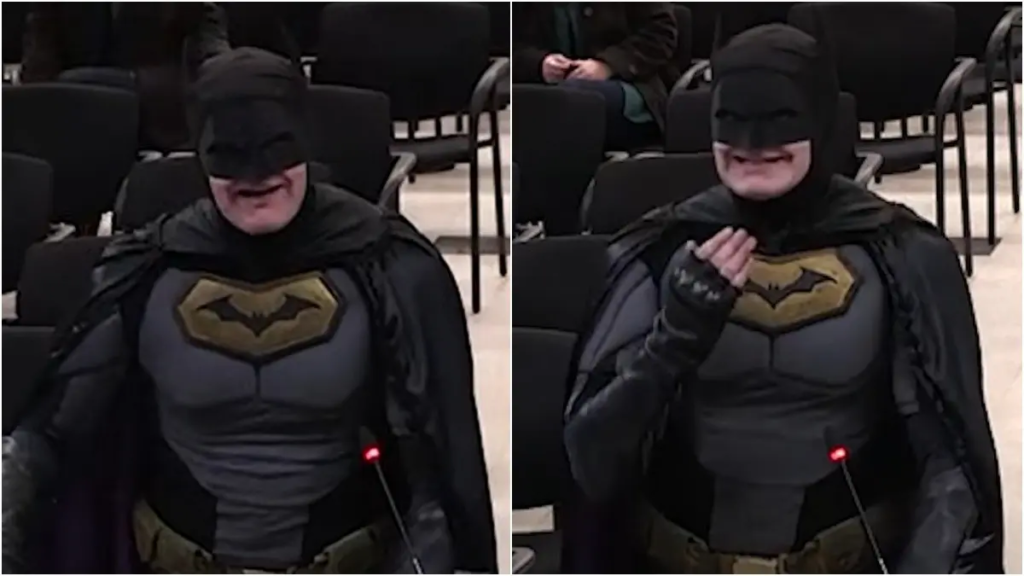
The Batman-clad speaker’s intervention highlighted the tension inherent in that balance. By framing ICE’s presence as a direct threat to community safety rather than a protective measure, he challenged the conventional narrative surrounding event security. His remarks suggested that the mere visibility of immigration enforcement could have chilling effects, particularly for undocumented residents who might avoid public spaces out of fear.
For city officials, responding to such concerns is not straightforward. Public safety planning often occurs behind closed doors, guided by threat assessments that are not fully disclosed to the public. At the same time, elected leaders are accountable to residents who demand transparency and assurance that local values are being upheld. The viral nature of the confrontation intensified that accountability, placing Santa Clara’s decisions under a national microscope.
Symbolism, Protest, and the Politics of Attention
The choice to appear as Batman was not incidental. The character occupies a unique place in popular culture as a symbol of justice, vigilance, and resistance to corruption. By adopting that persona, the speaker aligned himself with an archetype that resonates across political and generational lines. The costume transformed a routine public comment into a piece of political theater, one that communicated defiance and urgency before a word was spoken.
Read : Who Is Nasra Ahmed, Viral ‘Bananas and Rice’ Woman Arrested in Minneapolis?
Such symbolic protest is hardly new. Throughout history, activists have used costumes, satire, and performance to critique power structures and capture public attention. What distinguishes this episode is the speed and scale at which it circulated. In the digital age, the success of a protest is often measured not only by its immediate impact on decision-makers but also by its ability to travel, to be shared, remixed, and debated online. In that respect, the Batman appearance achieved what many carefully planned campaigns struggle to accomplish.
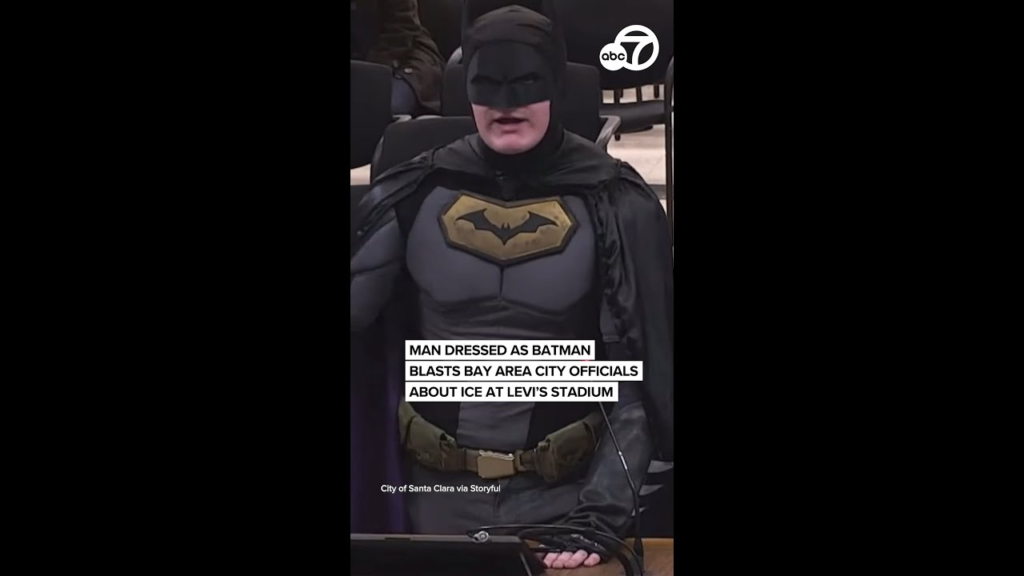
Social media responses underscored this dynamic. Supporters argued that the costume demonstrated strategic intelligence, recognizing that visual spectacle can amplify substantive critique. Detractors questioned whether theatrics undermined the seriousness of the issue. Yet even critical comments contributed to the spread of the video, ensuring that the underlying message reached audiences far beyond Santa Clara.
The episode also raises questions about how democratic institutions engage with dissent. Public comment periods are designed to give citizens a voice, but they are typically constrained by time limits and decorum. When a speaker disrupts those expectations, intentionally or otherwise, it tests the tolerance of governing bodies and the norms of civic engagement. The Santa Clara council allowed the speaker to finish his remarks, a decision that itself became part of the narrative surrounding the event.
Ultimately, the confrontation reflects a broader moment in American politics, where trust in institutions is strained and unconventional forms of expression are increasingly used to challenge authority. Whether or not the speaker’s demands lead to changes in Super Bowl security planning, his appearance has already influenced the conversation. It has forced questions about ICE’s role, local government complicity, and the ways in which public dissent is heard and remembered.
As Super Bowl 60 approaches, Santa Clara will remain a focal point for debates that extend far beyond football. The image of Batman standing before city officials may fade from headlines, but the issues it spotlighted are likely to persist. In a political climate shaped as much by symbolism as by policy, the episode serves as a reminder that attention itself is a form of power, and that even the most unexpected voices can reshape the terms of public debate.