

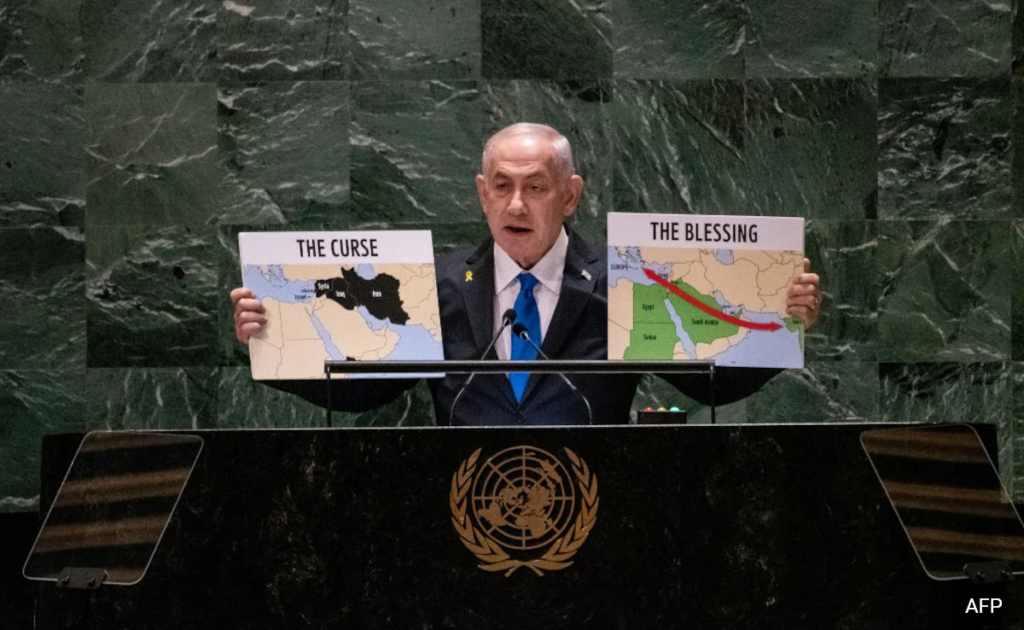
In his recent address at the United Nations General Assembly, Israeli Prime Minister Benjamin Netanyahu captured attention with a striking visual display, holding two contrasting maps to illustrate his view of the Middle East.
A key aspect of his presentation was his categorization of certain nations, including India blessing country, while others were labeled a “curse” for their destabilizing influence.
Netanyahu’s two maps conveyed a powerful message. Countries marked in green, such as Egypt, Sudan, Saudi Arabia, and India, were described as “blessing” nations, whereas those painted black—specifically Iran, Iraq, Syria, and Yemen—were termed as “cursed.” His speech, and these maps, have sparked much debate for the countries included and omitted, particularly Palestine, which was absent from both maps.
The Blessing and the Curse
Netanyahu’s speech focused on the growing divide between two distinct groups of countries. He labeled Iran and its allies as a “curse” for perpetuating violence and unrest in Lebanon, Syria, and Yemen.
Read : Dozens of Diplomats Walk Out Before Netanyahu Began Speech at UN: Watch
Iran’s influence, Netanyahu argued, was the root cause of the prolonged instability in the region, with Tehran providing financial and military support to groups like Hezbollah, Hamas, and the Houthis.
In contrast, the countries featured on the green map represented allies or potential partners that have either normalized relations with Israel or are moving toward closer cooperation.
These “blessing” nations, including Egypt, Sudan, Saudi Arabia, and India, were portrayed as integral to a more peaceful and prosperous future. The inclusion of India blessing country in this group signified the growing importance of India-Israel relations, particularly in defense and technology.
⚡During his speech at UN the Prime Minister of Israel #Netanyahu shown the maps of "The Curse" & "The Blessing"
— Pooja Sangwan 🇮🇳 (@ThePerilousGirl) September 27, 2024
Iran, Iraq, Lebanon, Syria & Yemen are described as “The Curse”.
The India-Middle East-Europe Corridor (IMEC) is described as “The Blessing”pic.twitter.com/qjO5Te2Ibp
However, the most notable aspect of Netanyahu’s maps was the erasure of Palestine. The absence of Palestine on both the blessing and curse maps led to widespread criticism, raising concerns over the future of the Israeli-Palestinian conflict.
Netanyahu’s Focus on Iranian Influence
Throughout his UN address, Netanyahu placed blame squarely on Iran for the violence in Lebanon, Syria, and Yemen. He pointed to Iran’s military and financial backing of groups like Hezbollah in Lebanon, Hamas in Gaza, and the Houthis in Yemen as evidence of Tehran’s destabilizing role. In stark contrast, countries like India blessing country symbolized hope for regional cooperation.
“If you strike us, we will strike you,” Netanyahu warned, sending a clear message to Iran. He stressed that Israel’s military reach extends throughout the Middle East, and that his country is ready to defend itself against any threats from Iran or its proxy militias.
Netanyahu also reiterated Israel’s position of acting in self-defense in the face of Iranian aggression, which has taken the form of direct attacks and proxy wars.
While Netanyahu’s tough stance on Iran was well-known, the visual aid of maps depicting a clear distinction between the curse of Iranian influence and the blessing of friendly nations reinforced his message.
The Role of the “Blessing” Countries
The green “blessing” map showed the nations that have either normalized ties with Israel or are in the process of doing so. Each country in the green zone plays a crucial role in Netanyahu’s vision of a stable and peaceful Middle East.
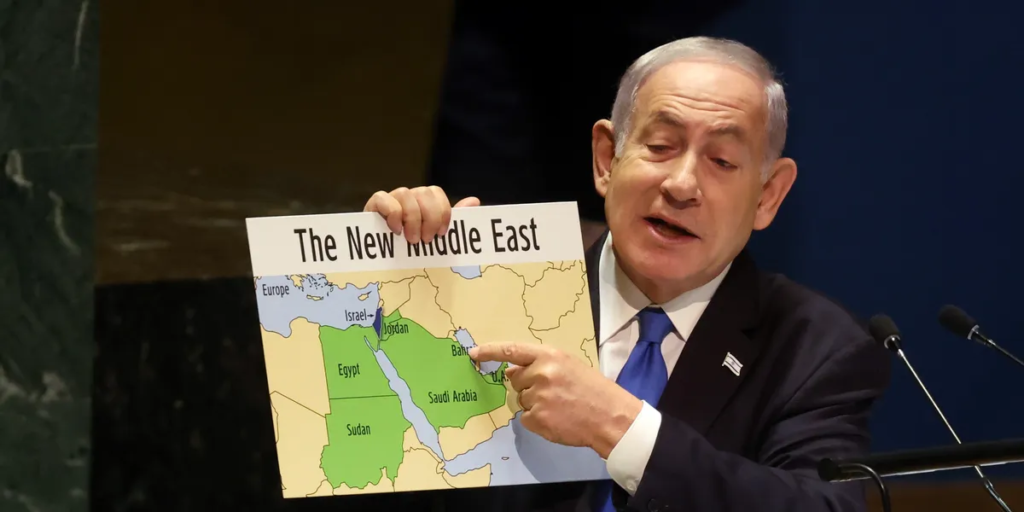
India blessing country highlights the strengthening bond between the two nations. In recent years, India and Israel have deepened their cooperation in several key areas, including defense, cybersecurity, and technological innovation.
Under Prime Minister Narendra Modi’s leadership, India has moved closer to Israel, shifting its historical stance that strongly supported Palestinian self-determination. India now balances its support for the Palestinian cause with a pragmatic approach to expanding ties with Israel, especially in areas of strategic importance.
For Netanyahu, the inclusion of India blessing country in the green map reflects this growing alliance. India has become one of Israel’s key partners in areas like defense technology and agriculture. This strategic collaboration has elevated India’s importance in Netanyahu’s vision for a more cooperative Middle East.
Saudi Arabia also featured prominently in Netanyahu’s green “blessing” map. Although the relationship between Israel and Saudi Arabia remains complex, especially with the ongoing conflict between Israel and Hamas, Netanyahu expressed optimism about the potential normalization of relations.
The Biden administration had been working toward such a deal before hostilities broke out between Israel and Hamas in October 2023. Saudi Arabia has maintained that normalization with Israel would not be possible without the creation of a Palestinian state, but Netanyahu’s map suggests hope for future cooperation.
Egypt was another country that appeared on the “blessing” map, reflecting its longstanding peace treaty with Israel. While relations between the two countries have been described as a “cold peace,” Egypt has played a significant role in maintaining regional stability, particularly regarding Gaza. Netanyahu’s depiction of Egypt as a “blessing” underscores the importance of Cairo in the broader Middle East peace process.
Sudan, a more recent addition to the group of nations normalizing ties with Israel through the Abraham Accords, also appeared on Netanyahu’s green map. Sudan’s decision to move toward closer relations with Israel marked a dramatic shift in its foreign policy and a departure from decades of hostility.
The Impact of Netanyahu’s Speech
Netanyahu’s maps and his speech at the United Nations emphasized Israel’s evolving alliances and its ongoing conflict with Iran and its proxies.
India blessing country and other nations marked in green were highlighted as examples of the growing cooperation between Israel and countries seeking peace and stability. Meanwhile, Netanyahu’s warnings about Iran’s influence in Lebanon, Syria, and Yemen served as a reminder of the challenges Israel continues to face from Iranian-backed groups.
Netanyahu’s portrayal of Israel’s allies and adversaries drew a mixed response from the international community. Jordan’s Foreign Minister Ayman Safadi criticized Netanyahu’s approach, accusing him of pushing the region toward open conflict.
Safadi reiterated Jordan’s willingness to guarantee Israel’s security, but only if Israel agrees to the creation of an independent Palestinian state.
Netanyahu’s speech and the maps presented his vision of Israel’s place in the region, with India blessing country and others playing a pivotal role in building alliances. However, the absence of Palestine from the maps and the ongoing tensions between Israel and its neighbors mean that peace in the Middle East remains an elusive goal.
Netanyahu’s optimism about future ties with nations like India blessing country reflects his hope for a cooperative future, but the complexities of the Middle East, especially the unresolved Israeli-Palestinian conflict, cast a long shadow over his vision.
Your article helped me a lot, is there any more related content? Thanks!
Your point of view caught my eye and was very interesting. Thanks. I have a question for you.
Can you be more specific about the content of your article? After reading it, I still have some doubts. Hope you can help me.
Thanks for sharing. I read many of your blog posts, cool, your blog is very good.
Your point of view caught my eye and was very interesting. Thanks. I have a question for you.
I don’t think the title of your article matches the content lol. Just kidding, mainly because I had some doubts after reading the article.
Your point of view caught my eye and was very interesting. Thanks. I have a question for you.
Thanks for sharing. I read many of your blog posts, cool, your blog is very good.
Thanks for sharing. I read many of your blog posts, cool, your blog is very good.
Can you be more specific about the content of your article? After reading it, I still have some doubts. Hope you can help me.
Can you be more specific about the content of your article? After reading it, I still have some doubts. Hope you can help me.
I don’t think the title of your article matches the content lol. Just kidding, mainly because I had some doubts after reading the article.
I don’t think the title of your article matches the content lol. Just kidding, mainly because I had some doubts after reading the article.
Your article helped me a lot, is there any more related content? Thanks!
Can you be more specific about the content of your article? After reading it, I still have some doubts. Hope you can help me.
Thanks for sharing. I read many of your blog posts, cool, your blog is very good.
Thank you for your sharing. I am worried that I lack creative ideas. It is your article that makes me full of hope. Thank you. But, I have a question, can you help me?
Thanks for sharing. I read many of your blog posts, cool, your blog is very good.
Thanks for sharing. I read many of your blog posts, cool, your blog is very good. https://accounts.binance.com/pt-PT/register?ref=DB40ITMB
Thanks for sharing. I read many of your blog posts, cool, your blog is very good.
Your article helped me a lot, is there any more related content? Thanks!
Your article helped me a lot, is there any more related content? Thanks! https://accounts.binance.com/uk-UA/register-person?ref=W0BCQMF1
Your point of view caught my eye and was very interesting. Thanks. I have a question for you.
I don’t think the title of your article matches the content lol. Just kidding, mainly because I had some doubts after reading the article.
Your article helped me a lot, is there any more related content? Thanks!
Can you be more specific about the content of your article? After reading it, I still have some doubts. Hope you can help me.
I don’t think the title of your article matches the content lol. Just kidding, mainly because I had some doubts after reading the article.
Can you be more specific about the content of your article? After reading it, I still have some doubts. Hope you can help me. https://www.binance.com/sk/register?ref=OMM3XK51
Thank you for your sharing. I am worried that I lack creative ideas. It is your article that makes me full of hope. Thank you. But, I have a question, can you help me? https://www.binance.info/en-IN/register-person?ref=UM6SMJM3
Your article helped me a lot, is there any more related content? Thanks! https://www.binance.info/sk/register?ref=OMM3XK51
Can you be more specific about the content of your enticle? After reading it, I still have some doubts. Hope you can help me.
I don’t think the title of your article matches the content lol. Just kidding, mainly because I had some doubts after reading the article.
Thanks for sharing. I read many of your blog posts, cool, your blog is very good. https://www.binance.info/bn/register?ref=UM6SMJM3
I don’t think the title of your article matches the content lol. Just kidding, mainly because I had some doubts after reading the article.
Thanks for sharing. I read many of your blog posts, cool, your blog is very good.
I don’t think the title of your article matches the content lol. Just kidding, mainly because I had some doubts after reading the article. Créer un compte gratuit
Thanks for sharing. I read many of your blog posts, cool, your blog is very good.
Thank you for your sharing. I am worried that I lack creative ideas. It is your article that makes me full of hope. Thank you. But, I have a question, can you help me? https://accounts.binance.info/en-IN/register-person?ref=UM6SMJM3
Your article helped me a lot, is there any more related content? Thanks!
Your article helped me a lot, is there any more related content? Thanks!
Can you be more specific about the content of your article? After reading it, I still have some doubts. Hope you can help me.
Can you be more specific about the content of your article? After reading it, I still have some doubts. Hope you can help me.
Thanks for sharing. I read many of your blog posts, cool, your blog is very good.
Can you be more specific about the content of your article? After reading it, I still have some doubts. Hope you can help me. https://www.binance.info/zh-TC/register?ref=DCKLL1YD
Can you be more specific about the content of your article? After reading it, I still have some doubts. Hope you can help me.
Thank you for your sharing. I am worried that I lack creative ideas. It is your article that makes me full of hope. Thank you. But, I have a question, can you help me?
Thank you for your sharing. I am worried that I lack creative ideas. It is your article that makes me full of hope. Thank you. But, I have a question, can you help me?
Thanks for sharing. I read many of your blog posts, cool, your blog is very good.
Thank you for your sharing. I am worried that I lack creative ideas. It is your article that makes me full of hope. Thank you. But, I have a question, can you help me? https://accounts.binance.info/es-AR/register-person?ref=UT2YTZSU
Thanks for sharing. I read many of your blog posts, cool, your blog is very good.
Thank you for your sharing. I am worried that I lack creative ideas. It is your article that makes me full of hope. Thank you. But, I have a question, can you help me?
Your article helped me a lot, is there any more related content? Thanks!
Thank you for your sharing. I am worried that I lack creative ideas. It is your article that makes me full of hope. Thank you. But, I have a question, can you help me?
Thanks for sharing. I read many of your blog posts, cool, your blog is very good.
Thanks for sharing. I read many of your blog posts, cool, your blog is very good.
Your point of view caught my eye and was very interesting. Thanks. I have a question for you. https://www.binance.info/register?ref=IXBIAFVY
I don’t think the title of your article matches the content lol. Just kidding, mainly because I had some doubts after reading the article.
Can you be more specific about the content of your article? After reading it, I still have some doubts. Hope you can help me.
Your article helped me a lot, is there any more related content? Thanks! https://accounts.binance.info/ES_la/register?ref=VDVEQ78S
I don’t think the title of your article matches the content lol. Just kidding, mainly because I had some doubts after reading the article. https://www.binance.info/register?ref=IXBIAFVY
Thanks for sharing. I read many of your blog posts, cool, your blog is very good.
Your point of view caught my eye and was very interesting. Thanks. I have a question for you. https://accounts.binance.com/lv/register-person?ref=SMUBFN5I
Your article helped me a lot, is there any more related content? Thanks! https://accounts.binance.com/cs/register-person?ref=OMM3XK51
Thank you for your sharing. I am worried that I lack creative ideas. It is your article that makes me full of hope. Thank you. But, I have a question, can you help me? https://accounts.binance.com/id/register-person?ref=UM6SMJM3
Your point of view caught my eye and was very interesting. Thanks. I have a question for you. https://www.binance.com/register?ref=JW3W4Y3A
Thanks for sharing. I read many of your blog posts, cool, your blog is very good. https://www.binance.com/register?ref=JW3W4Y3A
Your point of view caught my eye and was very interesting. Thanks. I have a question for you.