

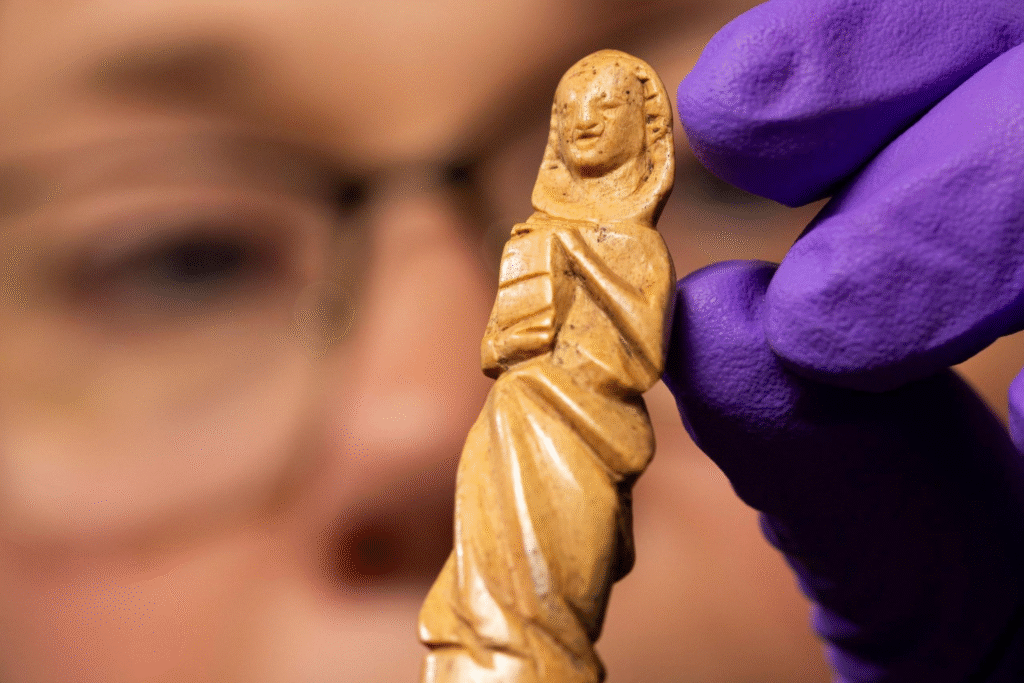
In the misty embrace of the Scottish Highlands, where ancient stones whisper tales of clans and conquests, a remarkable discovery has emerged from the depths of history. Archaeologists working at the iconic Eilean Donan Castle have unearthed a rare 13th-century hair-styling tool known as a gravoir, marking the first such find ever recorded in Scotland. This delicate artifact, now acquired by National Museums Scotland, offers a tantalizing glimpse into the daily lives of medieval elites, revealing how continental fashions trickled into the rugged fortresses of the north.
As excavations continue to peel back the layers of this storied site, the gravoir stands as a testament to the blend of practicality and elegance that defined life in the Middle Ages. Eilean Donan Castle, perched dramatically on a tidal island at the confluence of Loch Duich, Loch Long, and Loch Alsh, has long captivated imaginations. Its silhouette, often shrouded in Highland fog, has been immortalized in films and folklore alike. But beneath its romantic facade lies a rich archaeological tapestry waiting to be explored.
The recent dig, commissioned by the castle’s owners, The Conchra Charitable Trust, aimed to illuminate the castle’s zenith in the 13th and 14th centuries—a period when it served as a bastion for the Mackenzies and MacRaes, pivotal clans in Scotland’s turbulent history. The discovery of the gravoir wasn’t a solitary event; it emerged amid a trove of artifacts that paint a vivid picture of medieval existence. Alongside the hair tool, excavators uncovered brooches, dress pins, animal bones, and crucibles—small ceramic vessels used for melting copper alloy, silver, and gold.
These items suggest a bustling household where craftsmanship and daily routines intertwined. The gravoir itself, a slender, rudimentary hairpin crafted from metal, would have been used to secure and style elaborate coiffures, a far cry from the simple braids one might associate with Highland life. Its presence here, in the remote Scottish northwest, underscores the interconnected world of the medieval era, where trade routes and cultural exchanges bridged distant lands.
This find arrives at a time when public fascination with medieval Scotland is at an all-time high, fueled by everything from historical dramas to renewed interest in heritage tourism. As climate change threatens coastal sites like Eilean Donan—vulnerable to rising sea levels—such excavations become ever more urgent, preserving fragile histories before they succumb to the elements. The gravoir’s journey from the castle’s soil to a museum showcase not only enriches our understanding but also invites us to reimagine the people who once walked these halls, their aspirations as finely wrought as the tool in their hands.
The Gravoir: A Window into Medieval Grooming
At first glance, the gravoir might seem unassuming—a thin metal rod, perhaps no longer than a modern bobby pin, with a pointed end for weaving through hair. Yet, this 13th-century artifact is anything but ordinary. Derived from the French word “graver,” meaning to engrave or style, the gravoir was a multifunctional tool employed by both men and women to part, curl, or pin hair into fashionable arrangements. In an age without electric dryers or styling gels, it represented ingenuity, allowing users to achieve the voluminous, textured looks popularized in European courts.
Experts at National Museums Scotland describe the Eilean Donan gravoir as exceptionally well-preserved, its surface bearing faint traces of wear that hint at frequent use. Dating to around 1250-1300 AD, it aligns with a surge in personal grooming artifacts across Europe, reflecting a growing emphasis on appearance among the nobility. In France and England, where two similar examples have been found, gravoirs were often made of bone or ivory for the elite, but metal variants like this one suggest portability and durability suited to a castle’s demanding environment.
What makes this discovery particularly thrilling is its rarity. As the third gravoir ever unearthed in the United Kingdom and the first in Scotland, it challenges preconceptions about Highland isolation. Dr. Alice Blackwell, senior curator of medieval archaeology and history at National Museums Scotland, emphasizes its significance: “This remarkable gravoir shows us how elite inhabitants of Eilean Donan were engaging with fashions on the continent.”
Read : Rare “Pink Meanie” Jellyfish with 70-Foot Tentacles Spotted on Texas Coast
Indeed, during the 13th century, Scotland’s ties to France—forged through the Auld Alliance—facilitated the flow of ideas and goods. Scottish nobles, ever eager to emulate their southern counterparts, likely imported such tools via merchants sailing the North Sea.
Read : Should You Be Worried If You Took Two Doses of Covishield?
Imagine a lady of the castle, perhaps a Mackenzie consort, using this gravoir to tease her hair into intricate plaits adorned with ribbons or jewels, preparing for a feast or alliance negotiation. Or a knight, styling his locks before battle to project an air of refined valor. These scenarios, once speculative, now gain tangible form through the artifact. Grooming in medieval times wasn’t mere vanity; it was a social signal, denoting status and alliances. The gravoir’s design, with its hooked tip, allowed for precise manipulation, enabling styles like the “barbette” veil supports or curled fringes that framed the face elegantly.
Beyond aesthetics, the tool speaks to broader themes of gender and labor in medieval society. While often associated with women, historical texts suggest men too invested in their appearance, especially in martial contexts where a well-groomed warrior commanded respect. The artifact’s acquisition by National Museums Scotland ensures it will be studied further, perhaps through metallurgical analysis to trace its origins—French-forged, or locally wrought? Such questions propel ongoing research, reminding us that history is not static but a living dialogue with the past.
Eilean Donan Castle Unearthed: The Broader Excavation Story
The gravoir’s unearthing is just one thread in the larger fabric of the Eilean Donan excavation, a project spearheaded by The Conchra Charitable Trust to demystify the castle’s medieval heyday. Miranda van Lynden, head trustee of the trust, articulates the motivation eloquently: “Eilean Donan represents the very essence of a Scottish castle and its image is recognised around the world. However, we knew surprisingly little about life in the castle at the height of its power and influence in the 13th and 14th centuries. We commissioned these excavations to reveal some of these stories.”
Led by a team of archaeologists from across Scotland, the dig targeted areas around the castle’s original stone structures, buried under centuries of sediment and later reconstructions. The site, first fortified in the 13th century by Alexander II to defend against Viking incursions, evolved into a clan stronghold amid the Wars of Scottish Independence. By the 14th century, it had become a hub for political maneuvering, its inhabitants navigating feuds, marriages, and royal decrees.
The haul from the excavation is eclectic and enlightening. Brooches and dress pins, crafted from bronze and silver, indicate a wardrobe of fine woolen garments fastened with clan insignia. Animal bones—predominantly from cattle, sheep, and deer—reveal a diet rich in local game and dairy, supplemented by imported spices perhaps. The crucibles, scorched from repeated firings, point to on-site metalworking, where jewelers might have repaired the very brooches now in museum vaults. These items collectively evoke a self-sufficient yet cosmopolitan community, where Highland resilience met Lowland sophistication.
Challenges abounded during the dig. The castle’s island location meant working against tides and weather, with excavators donning waders to access submerged zones. Preservation was paramount; artifacts like the gravoir were carefully lifted in situ, stabilized with conservation fluids to prevent corrosion from the salty air. Digital mapping using LiDAR technology aided in reconstructing the site’s layout, uncovering hearths and latrines that humanize the stone edifice.
This excavation builds on prior work at Eilean Donan, including 20th-century restorations after its dramatic destruction by government forces in 1719 during the Jacobite risings. Yet, the medieval layer remains the most evocative, bridging Scotland’s Norse past with its feudal future. As van Lynden notes, these finds humanize the icon: “From the grand halls to the hidden corners, we’re piecing together the rhythms of life—feasts, crafts, and quiet moments of vanity.”
Continental Chic in the Highlands: Cultural Ripples
The gravoir’s arrival in the Scottish Highlands exemplifies the medieval world’s surprising interconnectedness, where a simple hairpin could traverse seas and symbolize status. In the 13th century, Europe’s courts buzzed with evolving beauty standards, influenced by Crusader encounters in the East and royal intermarriages. French styles, with their emphasis on elaborate headdresses and oiled curls, radiated outward, reaching even remote outposts like Eilean Donan through pilgrim routes, merchant fairs, and diplomatic envoys.
This cultural diffusion wasn’t unidirectional. Scottish wool and hides flowed south, exchanged for luxuries like the gravoir’s metal alloy. The Auld Alliance, formalized in 1295 between Scotland and France, amplified these ties, with Scottish warriors fighting alongside French knights and returning with tales—and tools—of continental flair. At Eilean Donan, such exchanges likely occurred in the great hall, where lairds hosted French traders amid tankards of ale.
The implications extend to social history. Women’s roles, often marginalized in chronicles, emerge through grooming artifacts. The gravoir suggests female agency in fashion, perhaps wielded by castle ladies who influenced alliances through their poise. For men, it hints at a performative masculinity, where appearance bolstered authority in clan disputes.
Today, as National Museums Scotland integrates the gravoir into its collections, it joins exhibits on medieval daily life, fostering educational programs on gender and trade. This find reignites debates on Highland identity—fiercely independent yet subtly European—challenging stereotypes of kilted isolation.
In the end, the gravoir is more than metal; it’s a bridge across time, inviting us to comb through history’s tangles with fresh eyes. As Eilean Donan’s mists swirl, its stories endure, styled with the elegance of a forgotten age.