
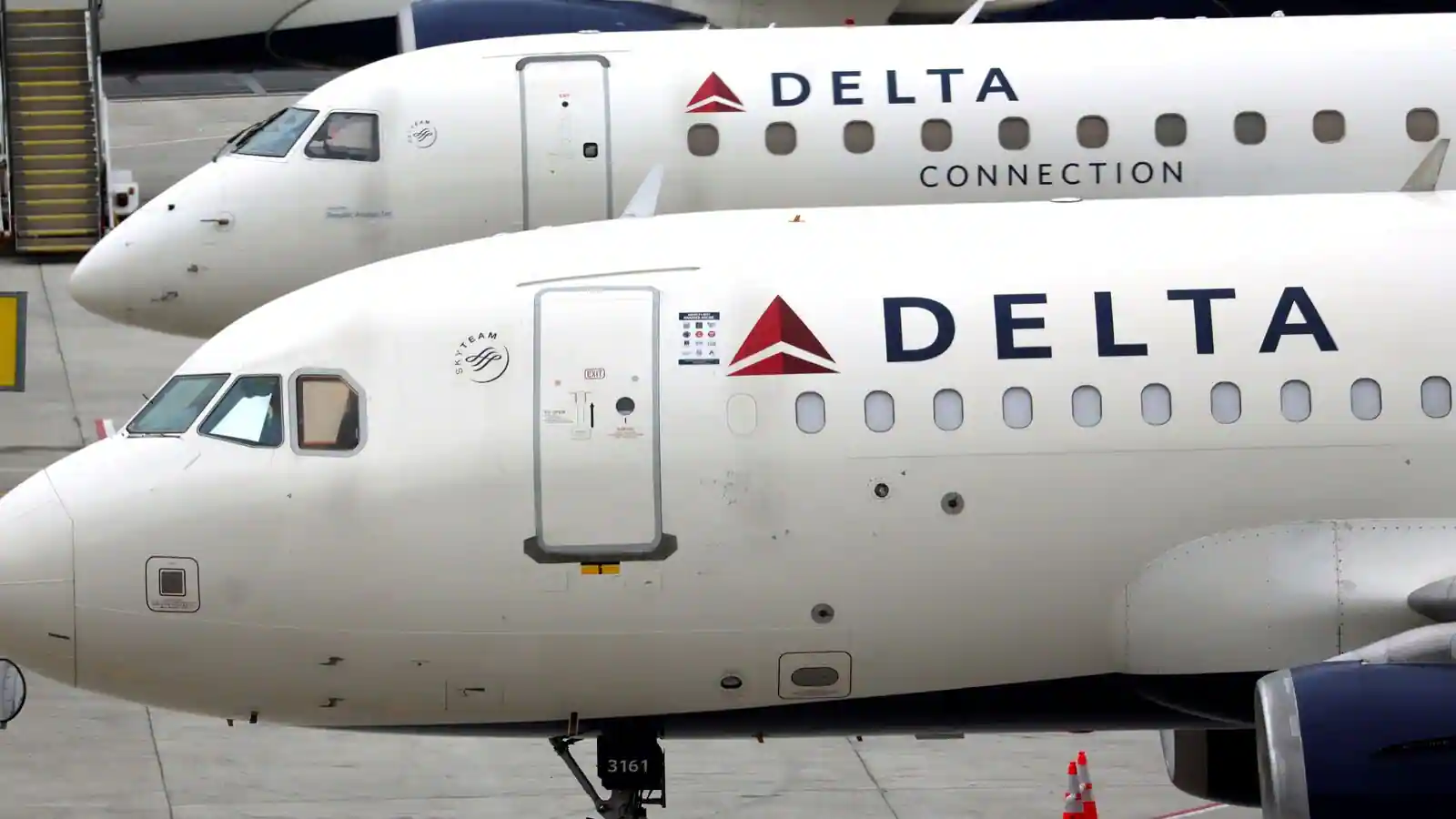
In an era where social media can amplify a single clip into a national controversy, a seven-minute video circulating online has ignited fierce debate over free speech, airline authority, and political expression. Shared widely on platforms like Instagram and Facebook, the footage appears to show an Elderly Man Removed From Delta Airlines Flight after a confrontation involving his headwear. Conservative commentators and MAGA supporters quickly labeled it as evidence of anti-Trump bias by the airline, with posts garnering millions of views and calls for boycotts.
But a closer examination reveals a more nuanced—and far less partisan—story. This incident, which unfolded on a recent Delta flight from Atlanta to an unspecified destination, stems not from a “Make America Great Again” hat, but from a profane slogan and a refusal to follow crew instructions. As fact-checks emerge, the narrative shifts from outright political persecution to a standard enforcement of aviation safety protocols.
The video’s rapid spread highlights the perils of misinformation in the digital age, where context is often sacrificed for clicks. Delta has not issued an official statement on the matter, but details from the footage and passenger accounts paint a clear picture of compliance issues rather than ideological targeting.
The Onboard Confrontation: A Step-by-Step Account
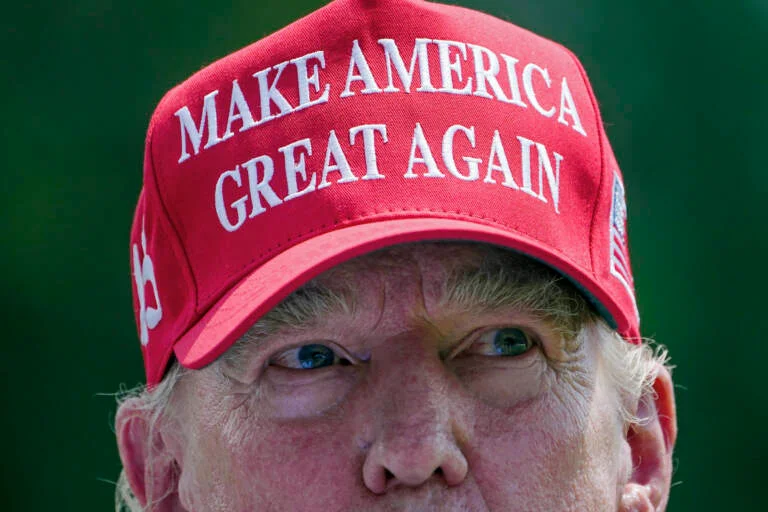
The incident began innocuously enough on a routine Delta flight, likely departing from Hartsfield-Jackson Atlanta International Airport, one of the world’s busiest hubs. The passenger, a silver-haired man in his late 60s or early 70s, boarded without issue and took his seat. He donned a red baseball cap emblazoned with the phrase “Build Back Better My Ass”—a direct jab at President Joe Biden’s signature infrastructure and economic initiative, laced with vulgarity. While the hat’s political leanings are evident, its explicit language immediately drew the attention of a flight attendant during pre-flight preparations.
According to the video, which the passenger recorded on his phone and narrated in real-time, the crew member approached him shortly after boarding. The attendant politely requested that he remove the hat, citing airline policy against offensive or disruptive attire that could offend other passengers or create an uncomfortable cabin environment. Federal Aviation Administration (FAA) guidelines, enforced by carriers like Delta, empower crew to maintain order and ensure a safe, harmonious atmosphere, particularly in the confined space of an aircraft where tensions can escalate quickly.
The man initially complied, stowing the hat in his bag as instructed. However, the situation escalated when fellow passengers—described in the footage as a group of supporters—asked him to put it back on for a quick photo opportunity. Eager to oblige, he retrieved the cap and posed briefly, drawing cheers from the onlookers. This moment of apparent camaraderie proved fateful. The same flight attendant, spotting the hat back in place, reiterated the request to remove it. What followed was a tense exchange, captured in the video’s opening frames.
Visibly frustrated, the passenger argued that the hat was his right to wear as free expression, questioning why it was singled out amid a diverse array of onboard apparel. The attendant, maintaining professionalism, explained that the profanity violated Delta’s customer code of conduct, which prohibits language or imagery that could be deemed harassing or intimidating. As the plane taxied toward the runway, the matter was elevated to the captain, a decision protocol designed to de-escalate potential disruptions before takeoff.
Pilot removes passenger from flight for wearing a MAGA hat.
— Professor Iratus Genium (@PGenium) October 10, 2025
Something tells me that Delta Airlines is going to be serving up a big apology, but quick.
Dumb, dumb, dumb. 🙄
* * * pic.twitter.com/nUqgXQYI1R
In the video’s most dramatic segment, the captain—a middle-aged man with a no-nonsense demeanor—approaches the passenger’s row. Speaking directly into the camera, the pilot clarifies: “It’s not because of your hat; it’s because you’re not complying with the instruction.” He emphasizes the safety implications, noting that in-flight emergencies demand unwavering adherence to crew directives. “How do I know, based on this simple little issue, that you would follow their instructions in an emergency?” the captain asks rhetorically. To underscore the non-political nature of the intervention, he adds a personal aside: “I’m probably more ultra MAGA than you are.” This revelation, delivered with a hint of wry humor, undercuts any narrative of partisan bias from the outset.
The passenger, undeterred, continues recording as gate agents escort him off the plane. He expresses disbelief, stating, “I haven’t said a word to anybody. I haven’t done anything.” Ground crew members handle the removal calmly, with no physical force involved, and the flight proceeds without further delay. The entire sequence, from initial request to deplaning, spans less than 10 minutes, a testament to Delta’s trained response to such scenarios.
Unmasking the Misinformation: Not MAGA, But Profanity and Non-Compliance
At the heart of the viral outrage lies a glaring misrepresentation: the hat was never a MAGA emblem. Social media posts, including those from high-profile conservative influencers, cropped and captioned the footage to suggest the passenger’s ouster was retaliation for Trump loyalty. One widely shared clip zoomed in on the red cap from a distance, omitting the text entirely, while captions screamed “Delta Kicks Out Elderly Trump Supporter for MAGA Hat!” This sleight-of-hand fueled a backlash, with hashtags like #BoycottDelta trending and user-generated boycott pledges surpassing 50,000 in the first 24 hours.
Read : Cody Sierra Marie Bryne Accused of Sexually Assaulting Delta Employee After Being Kicked Off Flight
Fact-checkers, including outlets like Yahoo News and independent verifiers, swiftly debunked the claim. Screenshots from the full video clearly display the hat’s inscription: “Build Back Better My Ass.” The phrase, popularized in conservative circles as a critique of Biden-era policies, is undeniably political—but its crass wording crosses into territory that airlines routinely police. Delta’s dress code, outlined in its contract of carriage, allows for broad discretion in addressing attire that “may offend or disturb other passengers.” Similar incidents have involved everything from offensive T-shirts to disruptive behavior, regardless of ideology.
The passenger’s refusal to fully comply after the initial removal request was the tipping point. Aviation experts note that such defiance, even over minor issues, poses real risks. The FAA mandates that crew maintain authority to prevent escalations that could mirror high-profile disruptions, like the 2023 surge in unruly passenger incidents that led to over 5,000 enforcement actions. In this case, the captain’s intervention aligned with standard procedure: offer a chance to rectify, then remove if necessary to avoid delays or onboard conflicts.
No evidence suggests targeting based on the hat’s anti-Biden sentiment. On the contrary, the captain’s self-proclaimed MAGA affinity—while unverified beyond the video—suggests the crew prioritized protocol over politics. The passenger, in post-incident interviews shared on social media, acknowledged the profanity but maintained it was protected speech. He has since received an apology from Delta for the “inconvenience,” along with rebooking on a later flight, though he was not refunded for the original ticket.
This episode echoes past aviation controversies, such as the 2018 United Airlines passenger removal or the 2021 American Airlines mask mandate clashes. Yet, the rapid politicization here underscores a broader trend: viral videos stripped of context become weapons in the culture wars, eroding trust in institutions like airlines that operate in a heavily regulated gray zone.
Airline Policies in the Spotlight: Balancing Safety and Expression
Delta’s handling of the incident has reignited discussions on the tension between passenger rights and operational imperatives. U.S. airlines, operating under FAA oversight, wield significant leeway in enforcing conduct rules. The carrier’s guidelines explicitly state that “offensive” attire can lead to denial of boarding or mid-flight removal, a policy mirrored across the industry. Critics, including free speech advocates from the American Civil Liberties Union (ACLU), argue this creates a subjective enforcement landscape ripe for abuse, particularly against conservative symbols post-2016.
Data from the FAA’s 2024 unruly passenger report shows a 20% uptick in attire-related disputes, often tied to political polarization. Delta, which transported 200 million passengers last year, faces scrutiny as one of the “Big Three” U.S. carriers. While the airline has diversified its customer base, incidents like this risk alienating core demographics. In response to the backlash, Delta quietly updated its social media monitoring, but executives have remained mum, likely to avoid fueling the fire.
For passengers, the takeaway is clear: expression has limits at 30,000 feet. Legal precedents, such as the 1990s court rulings upholding airline discretion for safety, affirm that cabins are not public forums. The elderly man’s case, while sympathetic, illustrates how small acts of non-compliance can cascade into larger disruptions. As he reflected in a follow-up video, “It was about the word, not the message—but in today’s world, they’re one and the same.”
This viral saga serves as a cautionary tale for 2025’s hyper-connected travelers. In an election year shadowed by division, distinguishing truth from outrage is paramount. Delta emerges unscathed in policy terms, but the dent to its brand reputation lingers. For now, the skies remain a neutral zone, where hats—profane or patriotic—must yield to the greater good of getting everyone home safely.
**mindvault**
mindvault is a premium cognitive support formula created for adults 45+. It’s thoughtfully designed to help maintain clear thinking