
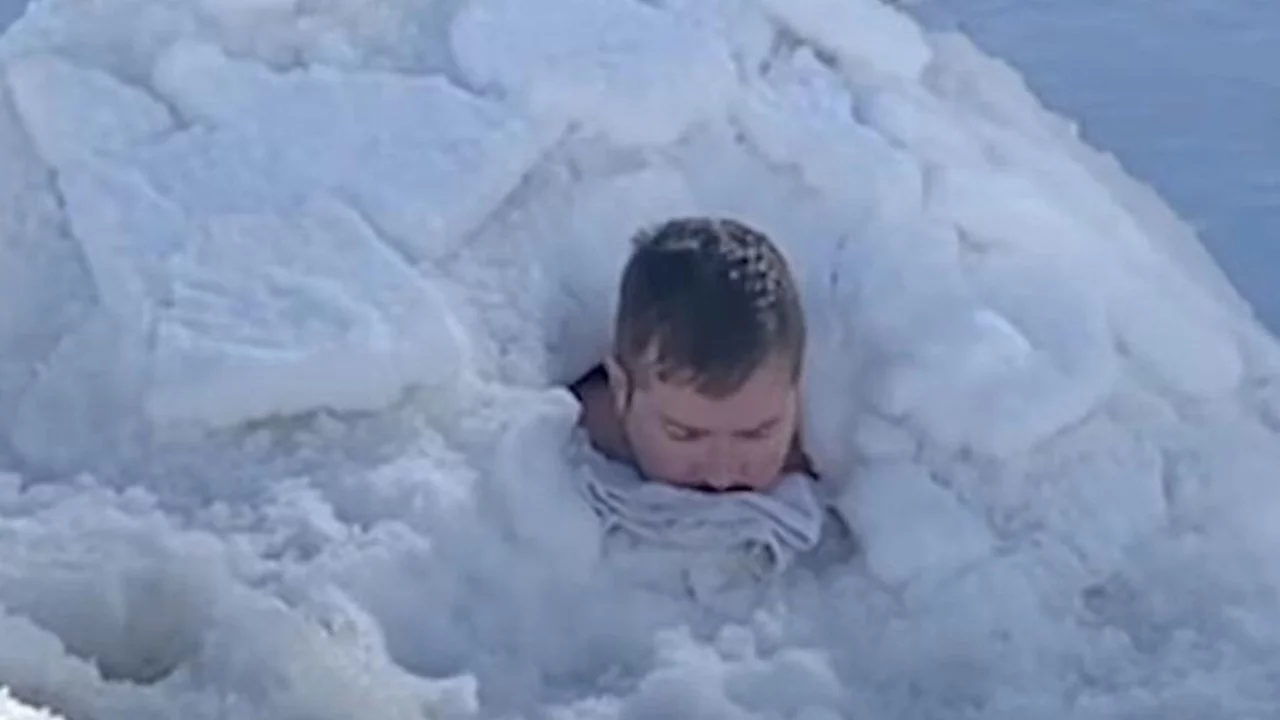
Swiss athlete Elias Meyer has stunned the world with his extraordinary feat of endurance by spending over two hours buried in snow, wearing nothing but his swimming trunks. This daring act not only tested the boundaries of physical resistance to freezing temperatures but also earned him a coveted place in the Guinness World Records.
His achievement is not merely a stunt, but a remarkable display of human resilience, mental strength, and the power of belief in the body’s capabilities. Meyer’s record-breaking attempt took place in Switzerland, a country renowned for its pristine alpine landscapes and harsh winters. On this frigid occasion, those natural elements became the stage for an extraordinary human experiment.
The challenge? To stay buried in snow, in direct and full-body contact, for longer than anyone else in recorded history. The Swiss powerlifter not only met this challenge — he surpassed it, staying submerged for 2 hours and 7 seconds. The previous world record, set by Polish endurance athlete Valerjan Romanovski in 2022, stood at 1 hour, 45 minutes, and 2 seconds.
From Powerlifting to Polar Endurance: Meyer’s Background
Elias Meyer isn’t your typical cold-resistance athlete. His background lies in powerlifting — a sport built around raw strength, discipline, and consistency. Yet, beneath his muscular frame and lifting prowess lies a mindset tailored for endurance. This record attempt was not a spontaneous decision but a calculated, disciplined endeavor.
After researching the existing record and discovering that no one had yet conquered the 2-hour threshold, Meyer saw an opportunity — not only to break a record but to make a profound statement about human potential. He prepared physically through a mix of breath control techniques, cold exposure training, and meditation.
But it was the mental aspect that he emphasized most. According to Elias Meyer, one has to “embrace the discomfort” and “be at peace with the cold,” as the snow not only numbs the skin but weighs heavily on the body.
🇨🇭 Nuevo récord mundial: ¡dos horas enterrado en la nieve! ❄️⏱️
— Últimas Noticias | NOTI724.COM (@noti724_) June 11, 2025
El suizo Elias Meyer pasó más de 2 horas bajo un ventisquero solo con un bañador y una toalla, logrando entrar al Libro Guinness de los Récords 🏆.#Record #Curiosidades #Noticias pic.twitter.com/69Vs83dFEr
During the attempt, Meyer wore only swimming trunks. As he lay buried beneath a thick mound of snow, the cold was not his primary concern. “The heavy snow pressed me down, causing my shoulders and elbows to ache,” he recalled. “Perhaps you also feel a sharp ice cube against your back, with no chance to do anything about it — you can only be thankful, thankful for everything.”
Breaking the Ice: The World Record Attempt
Meyer’s official record-setting event was monitored closely under the strict conditions of the Guinness World Records. The rules required him to be in direct full-body contact with the snow, wearing only standard swimwear, and to remain motionless beneath the snow for the entirety of the attempt.
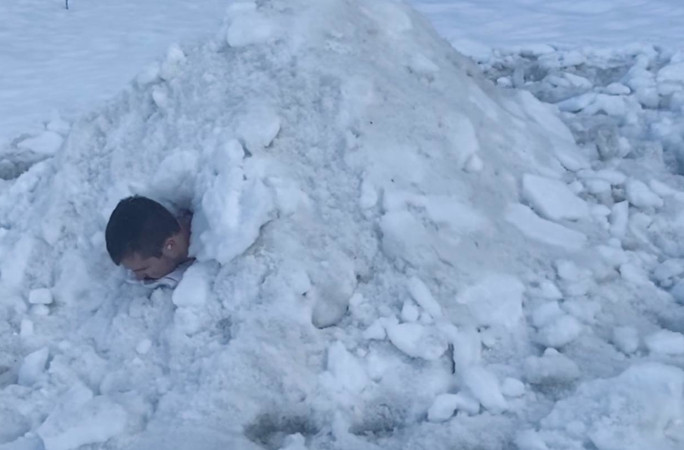
The conditions were brutal. Temperatures hovered well below freezing. His body was exposed to constant cold shock. Despite these challenges, Meyer remained composed and steady throughout the two-hour duration. Spectators and supporters stood nearby, bundled in warm clothes, in disbelief as Meyer lay still beneath the snow, his head and face the only parts exposed.
Read : Chanel Tapper Sets Guinness World Record for the Longest Female Tongue
Once the clock passed the two-hour mark, a small cheer rose from the crowd. A few seconds later, he was carefully unearthed from the snowy mound. His skin, flushed red from the cold, showed signs of deep exposure, but remarkably, Meyer emerged coherent, breathing steadily, and even smiling.
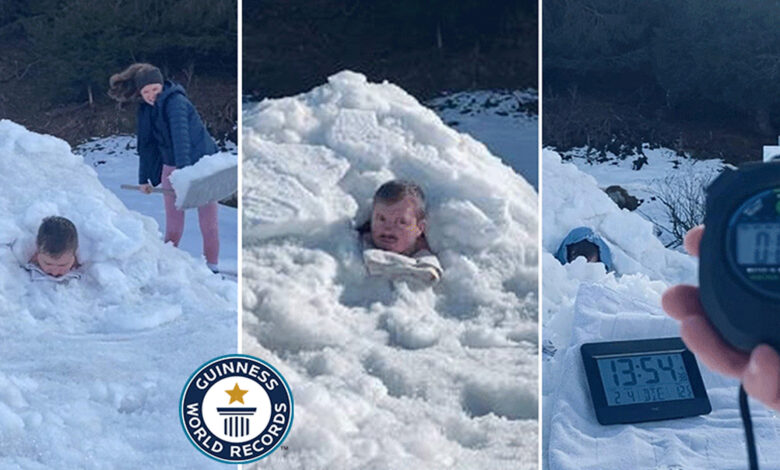
This feat surpassed the previous record by over 15 minutes. Valerjan Romanovski, the Polish endurance athlete who held the previous record, had set the bar impressively high, but Meyer had shattered it with focus and determination. The Guinness World Records later confirmed Meyer’s achievement, officially recognizing him as the new titleholder.
The Message Behind the Madness
For many, this accomplishment may appear to be nothing more than a daring stunt, an eccentric show of bravado. But Meyer’s intention was far deeper. “I wanted to show that the body is capable of incredible things,” he wrote on Instagram. “We often underestimate what we’re made of.”
His message resonates with those interested in human potential and biohacking. Cold exposure has long been used as a tool in health and wellness, popularized by figures like Wim Hof, the “Iceman,” who promotes cold therapy as a way to enhance mental clarity, immune response, and stress tolerance. Elias Meyer’s feat serves as another compelling example of what can be achieved with preparation, mental control, and resilience.
His philosophical reflections post-record are perhaps even more striking than the attempt itself. In one post, he mused about the idea of surrendering to the discomfort, letting the cold become a teacher rather than an enemy. “You learn a lot about yourself when you are still for two hours, frozen, in silence,” he said. “You learn how loud your mind is.”
Supporters have praised Elias Meyer not only for the physical feat but for the humility and thoughtfulness with which he has handled his new-found fame. He has become an inspiration to athletes, adventurers, and everyday people alike who see in him a symbol of human capability.
The Science of Cold Endurance
To endure such low temperatures for extended periods, the body must adapt in several critical ways. When exposed to cold, blood vessels constrict to keep vital organs warm, and the heart works harder to maintain internal body temperature. Hypothermia becomes a serious risk within minutes if the body is not insulated or generating enough heat.
Yet through conditioning, the body can gradually build a tolerance. Regular cold exposure — such as cold showers, ice baths, or winter swimming — can train the vascular system and improve cold shock response. Mental techniques such as breathwork and mindfulness can also help manage the stress response, enabling individuals to stay calm and focused in extreme situations.
What makes Meyer’s record exceptional is not just the time he spent in the snow but the fact that he endured it with minimal clothing and no external heat source. This suggests that his physical training, breathing technique, and mental strength were all operating at peak levels to make the feat possible.
Scientists and sports physiologists may well study Meyer’s achievement in the years to come as an example of how far the human body can go when guided by discipline and intention.
Looking Ahead: What’s Next for Elias Meyer?
Following his record-breaking achievement, Meyer has expressed gratitude to his supporters and hinted that he may not be done with extreme challenges. While he has not announced his next goal, many speculate that he could venture into other cold endurance records or inspire others through workshops, speaking events, or collaborations with researchers.
For now, Elias Meyer stands as a symbol of human endurance and the power of the mind-body connection. In an age where technology often overshadows physical feats, his success is a throwback to the elemental challenges that once defined humanity’s relationship with nature.
By conquering the snow and his own limitations, Elias Meyer has not only earned a world record but also reminded us of a timeless truth: when the mind believes, the body follows — even into the coldest of depths.